The Stonehenge Perspective on Henging, Part 1: Introducing Simon Banton!

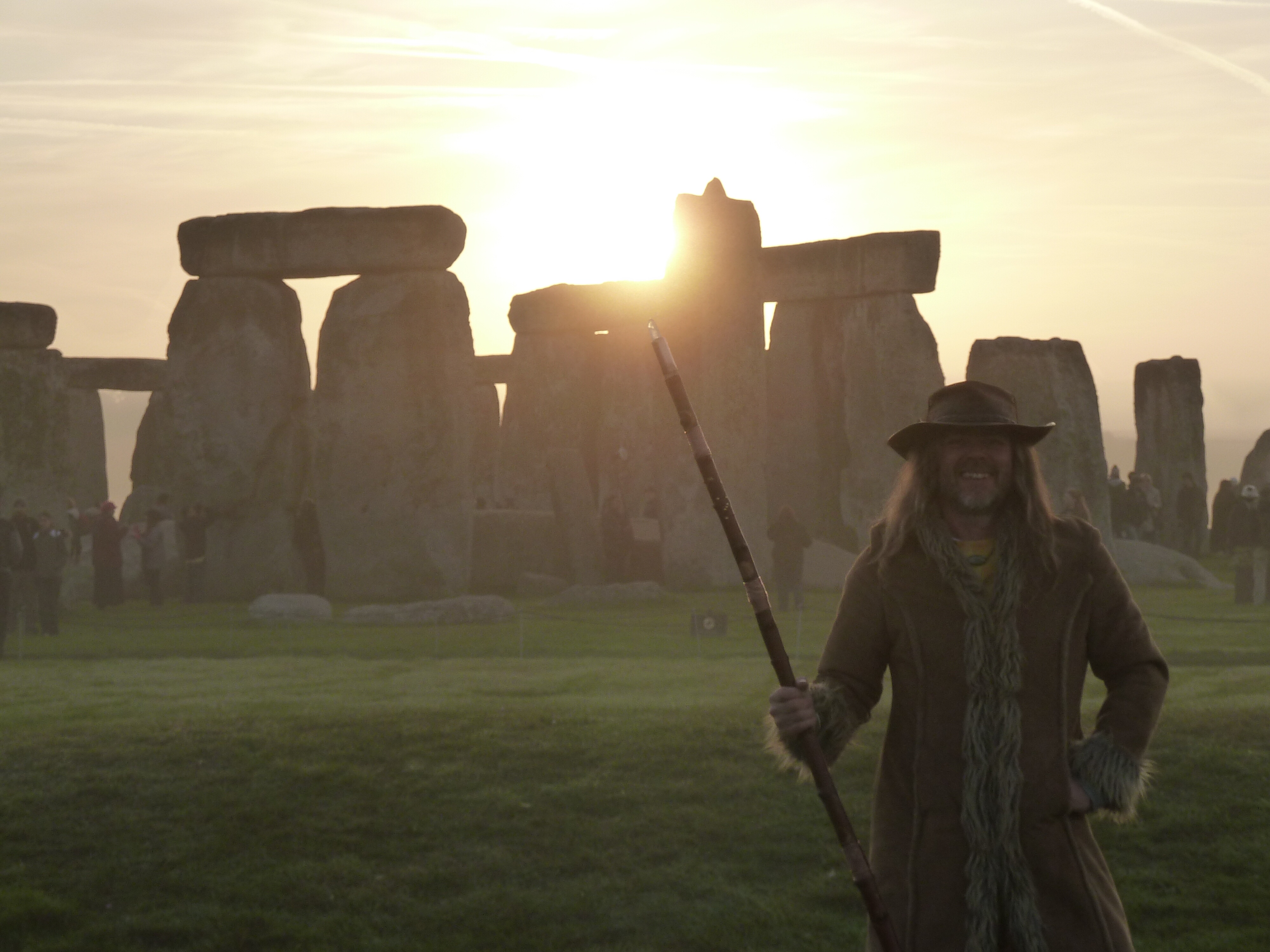
Above: Simon Banton at that famous pile of rocks:

You can notice a lot of subtleties about Stonehenge if you spend 6 years looking at it from all angles in all weathers and lighting conditions.”

It may seem to go without saying that the idea of Stonehenge replicas is inextricably tied to Stonehenge, but we’ve been thinking it needs a little more talking about. What do all these Stonehenge replicas look like to people who are actually familiar with Stonehenge?

Well, a peculiar outcome of doing Clonehenge over the years has been the unexpected pleasure of getting to know a number of people who are connected with Stonehenge in one manner or another. Those people have made us aware of aspects of Stonehenge and its landscape that we knew nothing of before we began this blog and our life of folly. That, in turn, has changed what we see and look for in Stonehenge replicas.img_0552
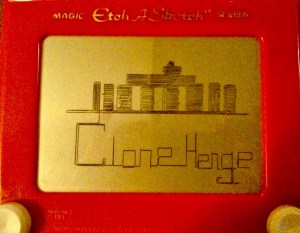
It is in this context we would like to introduce to you Mr. Simon Banton. A few readers may remember him as the fellow who when he found himself at a pub that had children’s toys, made and sent us some Clonehenge art on an Etch-A-Sketch (How do we love this? Let us count the ways!).

But there is a great deal more to him than that, as the photo at the top suggests. He is good natured and deeply knowledgable and has two blogs, The Stones of Stonehenge, with a page devoted to each stone at Stonehenge, and Stonehenge Monument, with information about Stonehenge and the surrounding landscape of the World Heritage Site. We asked him for an interview, and to our delight he agreed. The result is remarkable, if a bit technical in places. We intended to post only a short edit of the interview, but it is so full of information and good thoughts, stories, and ideas that we’ve decided to post most of it, split into two parts, with helpful (we hope) commentary, links, and photos added.

A note to start, because this will come up:

As some will know, there is a commonly agreed-upon numbering system for the stones at Stonehenge. For example, this trilithon, originally part of the outer circle so it would have supported the ends of two more lintels, shows upright stones 4 and 5 plus the lintel, which is 105.
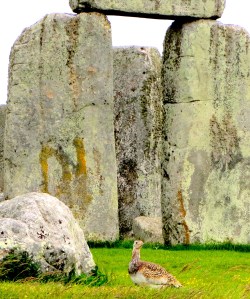
4 5 105(Just ignore the show-off bustard. Apparently bird tourists are permitted inside the circle of the ditch and bank, unlike the rest of us that day. Not fair, but as they say, what is?)
1024px-Stone_Plan
Stonehenge numbered stone plan by Author ©Anthony Johnson 2008

The plan on the right, showing numbers for each stone, is linked to a larger version. And now, the first part of our interview with Simon:

1) First, for the reader, what has been your involvement with Stonehenge over the years? I understand you worked there. For how long and in what capacity?

I first saw Stonehenge when I went to the very last Stonehenge Free Festival in 1984, before the authorities clamped down on it at the infamous Battle of the Beanfield of 1985 (Google it and watch the YouTube vids). Being in and around the monument had a profound effect on me, at the time I was only 19 years old.

When, in 2000, English Heritage, the Police and Wiltshire Council did away with the 3 mile radius exclusion zone that had been in place at Summer Solstice ever since 1985, I felt compelled to go along to that first “Managed Open Access” event to get back inside the stone circle. That, too, was a transformative experience. It poured with rain all night long and 5000 people were thoroughly soaked by the time dawn arrived, with no sign of the Sunrise.

I’d developed a keen interest in archaeoastronomy in the mid-1990s (I’ve been an amateur astronomer since I was 9 years old) and I was actively researching Egyptian sky-mythology. Stonehenge was the next logical step. By 2010 I’d moved to within 3 miles of Stonehenge and I became an Education Volunteer for English Heritage… Within a couple of months this turned into a job as a member of the Visitor Operations Team, standing on the path next to the stones and getting paid for telling people about the place. I did this for 6 years and loved it – it gave me unprecedented levels of access to the stone circle and allowed me to carry out my own research. You can notice a lot of subtleties about Stonehenge if you spend 6 years looking at it from all angles in all weathers and lighting conditions.

2) How many Stonehenge models or replicas do you own, if any?

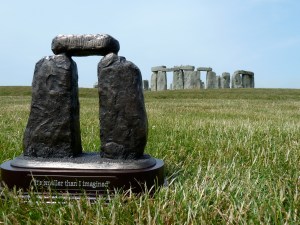
I have a bronzed resin cast model of Stones 4, 5 and 105 that is 8″ high and mounted on a plinth that reads “It’s smaller than I imagined”. I helped a local firm with their project to Stonehenge modelcreate these casts as souvenirs to sell in their shop in Amesbury and they gave me a prototype as a thank you. Stone 5 is the one with the large yellow lichen “DI” lettering that’s visible on its eastern face, a remnant of the RADIO CAROLINE graffiti from the 1960s.
I’ve also got a 1′ high x 2′ wide beaten metal and weld sculptural picture of the monument, done by my friend Michelle Topps of Horseshoes4Hounds (https://www.facebook.com/horseshoes4hounds). Both are utterly unique – I don’t go for snowglobes and the like!
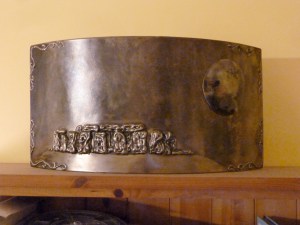
Stonehenge weld picture

[Editor’s note: This is Quite a Nice Thing! Also—a reminder to our readers that opinions of  an interviewee are not necessarily the opinions of the interviewer. We love snowglobes and it’s not too late to send us one!]

3) How many ‘clonehenges’ have you made, if any, and what were the materials?

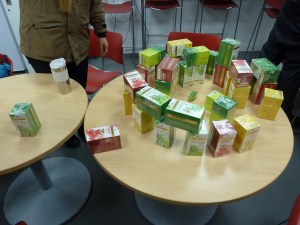
I’ve done one out of bricks (hasn’t everyone?) Teahengebut these bricks were the ones that used to line the edge of the visitor path around the monument, and I acquired them when they were torn up as part of the refurbishing of the path back in 2013. I did once make a trilithon out of snow, which is a whole lot trickier than you’d think, and then there was the 5-minute “boxes-of-herbal-tea-henge”, which was a joint effort with other members of the Stonehenge staff when management somewhat over-ordered one day 🙂
4) What do you find amusing, irritating, or remarkable about Stonehenge models or replicas you’ve seen? Do any in particular stand out, whether as good, bad, funny, or impressive? Do you have a favourite?

I’m always amused by the lengths people will go to to henge things – but I feel vaguely sad when no attempt is made to make something recognisably close to the original in any way. There’s more to a good clonehenge than that.
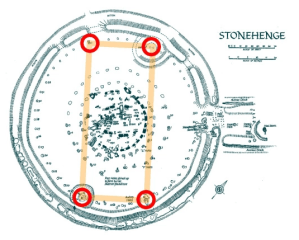
Screen Shot 2018-03-24 at 9.31.48 AMIt also irritates me when the models that English Heritage sell have glaring errors. Don’t get me started on the large models in the exhibition at the Visitor Centre – the Station Stones are so out of whack that “rectangle” is the last word you’d use to describe their arrangement! They also forgot to include the Altar Stone when the models were first made, and when they did finally add them in, they glued them down at 90° to the primary solstitial axis instead of the correct 80° – that really grinds my gears, because the 80° angle is fundamental to the design of the monument. [Editor’s note: The plan above and to the left shows the rectangle formed by the Station Stones at Stonehenge. The rectangle formed by these stones is considered important by some because, along with the alignments of these and other stones, it may be part of the reason Stonehenge was built where it is.]
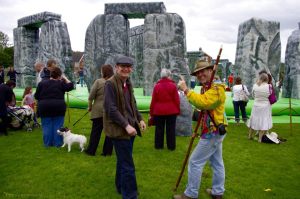
29570597_10155564264413022_4968747390063919463_nThe most impressive has got to be Deller’s “Sacrilege” [Editor: the famous inflatable Stonehenge that toured a few years ago. In this we do not disagree!]. Even though it doesn’t have all the stones, it has just enough of them, done accurately enough that it’s unmistakably close to the real thing. And it’s enormous fun to bounce on. [Editor: On the left, or above, depending on the device you’re using to see this, is a photo of Deller’s bouncy Stonehenge with Simon on the right and English Heritage archaeologist Dave Field on the left. Photo by and with permission of the fabulous Pete Glastonbury.]

My favourite is the one at Esperance, Australia. Although I’ve not seen it in person, I love that it’s a close replica made of actual stone and that it’s correctly rotated 180° from the prototype [Editor: because of its location in the Southern Hemisphere]. It’ll last as long as the original and baffle future archaeologists. •

We end the first part of our interview with Simon Banton here. There’s plenty of information to digest. His opinions about why so many people make Stonehenges, what he would like to see in them, and other advice for hengers, as well as a little advice for Clonehenge itself, are ahead in the next part of the interview. Be sure to tune in!

And until next time, of course, happy henging!
Happy Solstice! A Long Post for the Longest Day!

IMG_0408

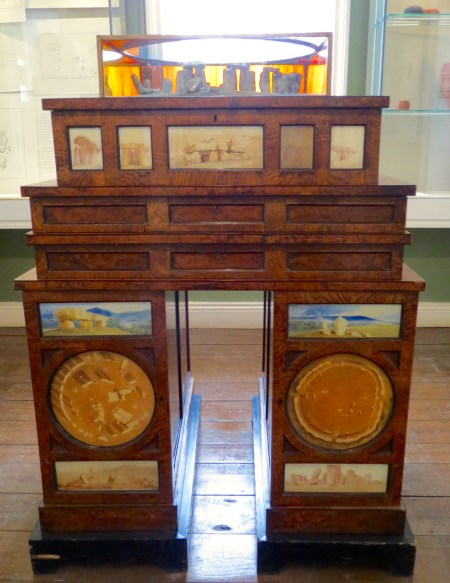
The famous Britton “Celtic” Cabinet at the Wiltshire Museum in Devizes

Greetings and a very happy solstice to all of you out there in the increasingly strange world of now! We know that people generally don’t find time to read blog posts anymore, what with one apocalypse or another looming at any given moment, but in a contrary spirit we have decided to write a longer one than usual. But with pictures, so there’s that!

As some of you may know, a little over a year ago, the entire staff of the Clonehenge blog flew over the sea to the centre of henging contagion, that hulking grey pile of construction debris on Salisbury Plain, Stonehenge itself. We posted in October about the unabashed promotion of Stonehenge replicas we discovered at the shop in the Stonehenge Visitor Centre, but we have yet to share our other extraordinary encounters with replicas shown us by friends of the Clonehenge blog in the area.

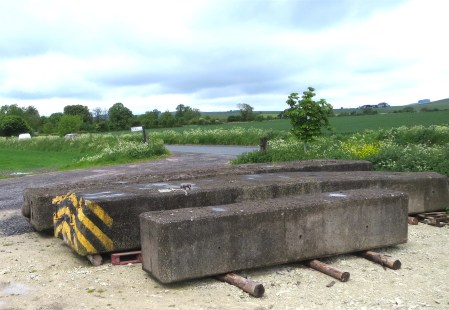
The first of these was a huge concrete trilithon, currently being stored at the farm of Mr. Tim Daw  whose name may be familiar to Stonehenge fans as a result of theories and discoveries he made while employed at Stonehenge. He is also known for his remarkable construction, the Long Barrow at Al Cannings. He kindly treated us to a tour of that beautiful modern long barrow, and then, knowing our interests, led us through chalk mud, a remarkably clingy substance, to the three pieces of the trilithon, currently not set up as a trilithon but in repose. The two uprights, we are told, weigh 40 Tonnes each and the lintel 10 and a half!

IMG_9398

concrete trilithon in the Vale of Pewsy (the markings are not tribal, 😉  but were painted there for visibility on the lorry journey to where they now rest)

These “stones” were used in the 1996 BBC documentary Secrets of Lost Empires: Stonehenge to to represent the stones of Stonehenge’s largest trilithon, in an attempt to demonstrate how those and the other large stones at Stonehenge may have been moved. We assume their length includes the section that in the original stones extended underground to keep them steady and upright. Pictures on this page show their size better than our poor picture above. They are imposing in person, even lying down. Mr. Daw and others are hoping to use them again to test various Stone-Age-appropriate methods for transporting and erecting megaliths, for a programme on how Stonehenge may have been constructed. We look forward to that!

For the next couple days of our trip, we enjoyed the wonders of Wiltshire, its landscape, and many ancient stones and sites (including Stonehenge in the pouring rain, a quintessentially British experience not to be missed unless you have the opportunity to see it in any other weather!). Those days were overwhelmingly beautiful and fascinating, and we extend our thanks to many people for going out of their ways to make it so.

IMG_0241

West Kennet Long Barrow with Terence Meaden, who was kind enough to accompany us there and share his knowledge

And then, on our final day in that county, probably still bearing chalk mud in the treads of our shoes, we visited the Wiltshire Museum in the town of Devizes in the company of long-time friend of the blog Pete Glastonbury. There, to our astonishment, we were greeted by people who already knew of the name of Clonehenge, and who were therefore willing to reveal to us deeply secret Stonehenge models  hidden from the prying eyes of the general public! (Or, yes, possibly just Stonehenge models that would be of absolutely no interest to anyone one but us, but let us have our fantasies.)

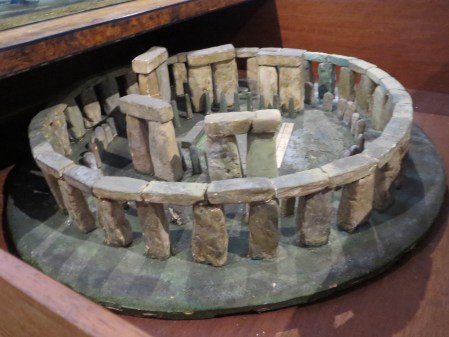
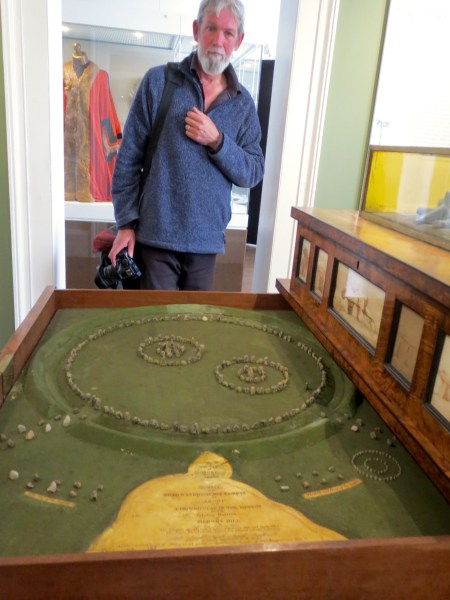
After a few minutes surveying small Stonehenge models available in the museum shop, we were introduced to none other than Director David Dawson and led upstairs to view the wonderful Britton Cabinet whose picture adorns the top of this post. We posted about it on this blog years ago, with photos by Mr. Glastonbury, but it was another thing to see it in person! If we described it in detail, this post would be insufferably long (like it is already, only more so), but as it says on this page, “Integral to the design of the cabinet are three models of Stonehenge and Avebury made by Henry Browne.” We are not ashamed to say that we were moved to see in person some of the historical Stonehenge models made by Mr. Henry Browne himself. Browne’s models were, as far as we can tell, the first Stonehenge models to become popular enough to create a demand. The sale of small Stonehenges that we see today in such profusion probably started with him!

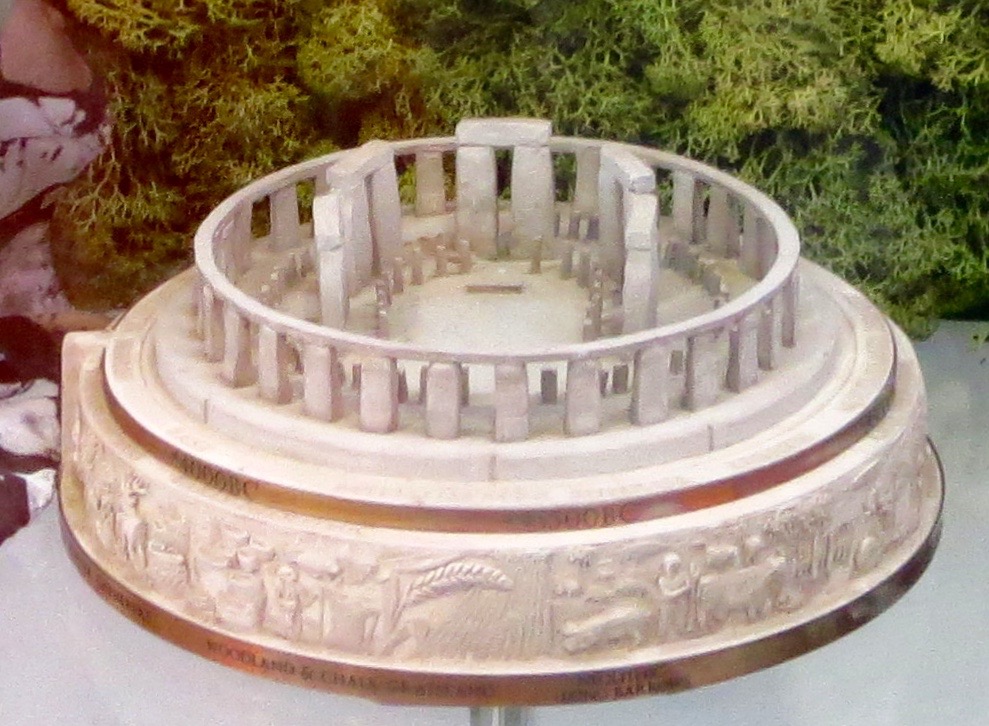
A drawer of the cabinet was opened for us, and protective covering carefully lifted from a model so that we might see it. Unlike the model under coloured glass atop the cabinet, which is meant to show the monument as it now stands, this one represents Stonehenge as it is thought to have looked before the destructive forces of time acted upon it.

IMG_0423

in the drawer, a Henry Browne model

IMG_0432

model of Avebury in a drawer of the cabinet, overseen by Pete Glastonbury

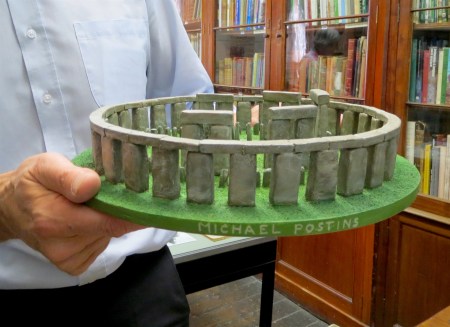
When we had finished looking at and photographing the cabinet and its contents, Mr. Dawson then kindly brought out two more Stonehenge models: a resin one made by Michael Postins, who made the ‘template’ for models sold by English Heritage for tourists,

IMG_0442

resin model by Michael Postins, here held by Director Dawson

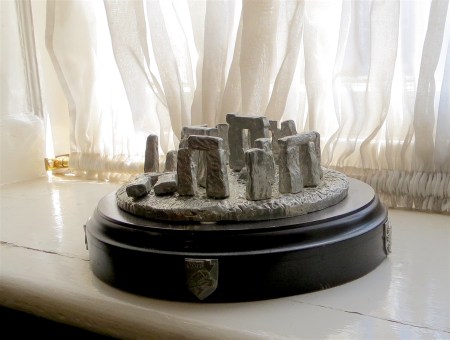
and a smaller metal one with various military badges, a bit eccentric, which, of course, appeals to us. No history is known for this, but it’s a nice portrayal with stones that look a bit organic, as if they were about to come to life.

IMG_0433

There is much more to the museum, of course, including fascinating and beautiful artefacts from Wiltshire, some found at and near Stonehenge and thought to have belonged to the ancient people who built it and celebrated there. If you’re visiting Stonehenge and want more of its story, you should make a point to stop at the Wiltshire Museum.

We had many more adventures worth telling, and saw more Stonehenge and Avebury models on our trip. But solstice awaits, and the long journey toward shorter days. If you have read this far, we thank you for your time. There truly is a wonderful world of Stonehenge replicas out there, and wonderful people who make them or are fascinated by them. Until next time, friends, happy henging!
Exposé: Shocking Photos From Our Visit to the Heart of the International Henge Trade!

poshest Stonehenge replica at the store

poshest Stonehenge replica at the store

Once upon a time, we thought we’d died and gone to Heaven. But it was just the store at the Stonehenge Visitor Centre.  Here is some of what we saw in our undercover foray into the international trade in henges of all kinds.

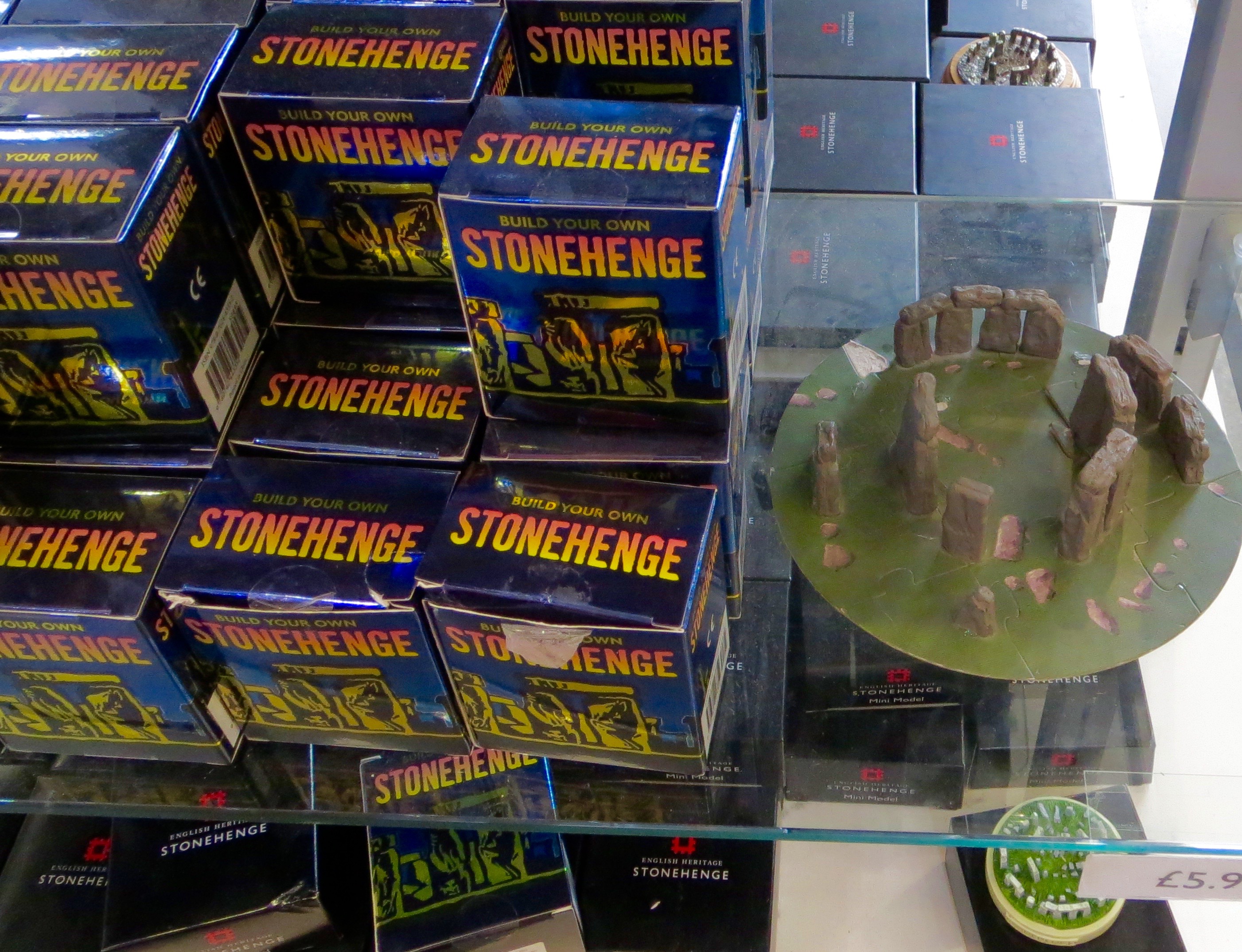
shelves full of Stonehenge replica: Clonehenge dream or Clonehenge nightmare??

shelves full of Stonehenge replicas: Clonehenge dream or Clonehenge nightmare??

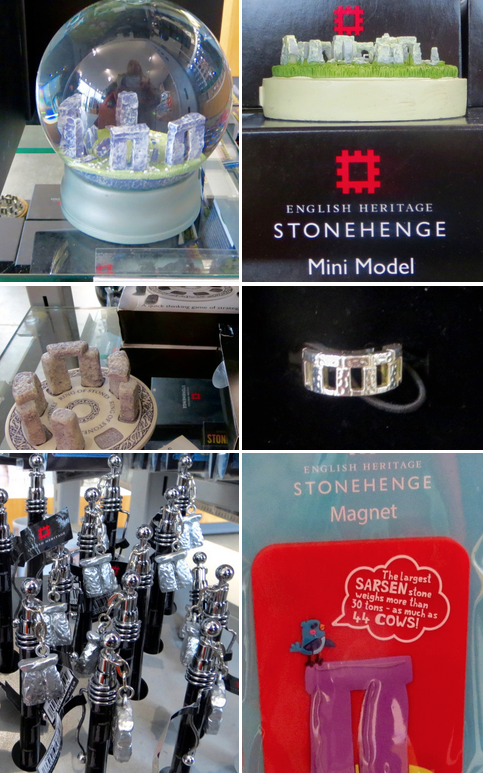
more Stonehenges for sale!

more Stonehenges for sale! a snowglobe, a plaster model, a game, a ring, pens with trilithon charms, and a purple vinyl trilithon…

And what you see here is just a portion of what we witnessed during our investigative visit to discover the extent of the Stonehenge replica trafficking in which English Heritage is deeply implicated. Turns out they are waist deep in serious international trade in henge knock-offs, most of which are not even made in England.

This is the epicentre of a henge contagion that is spreading around the world, carried in the hands of innocent tourists. And yet, brazenly and without shame, EH displays its wares out in the open for anyone to see, with some even targeting the youngest and most innocent among us.

(In the interest of full disclosure, we bought a small Stonehenge in a tin, not pictured here, and a set of the chocolate trilithons, for medicinal purposes only!)

Of course there is still a place for the handmade henge, the Stonehenge made of food, and the garden replica, so until next time, gentle readers, happy henging!

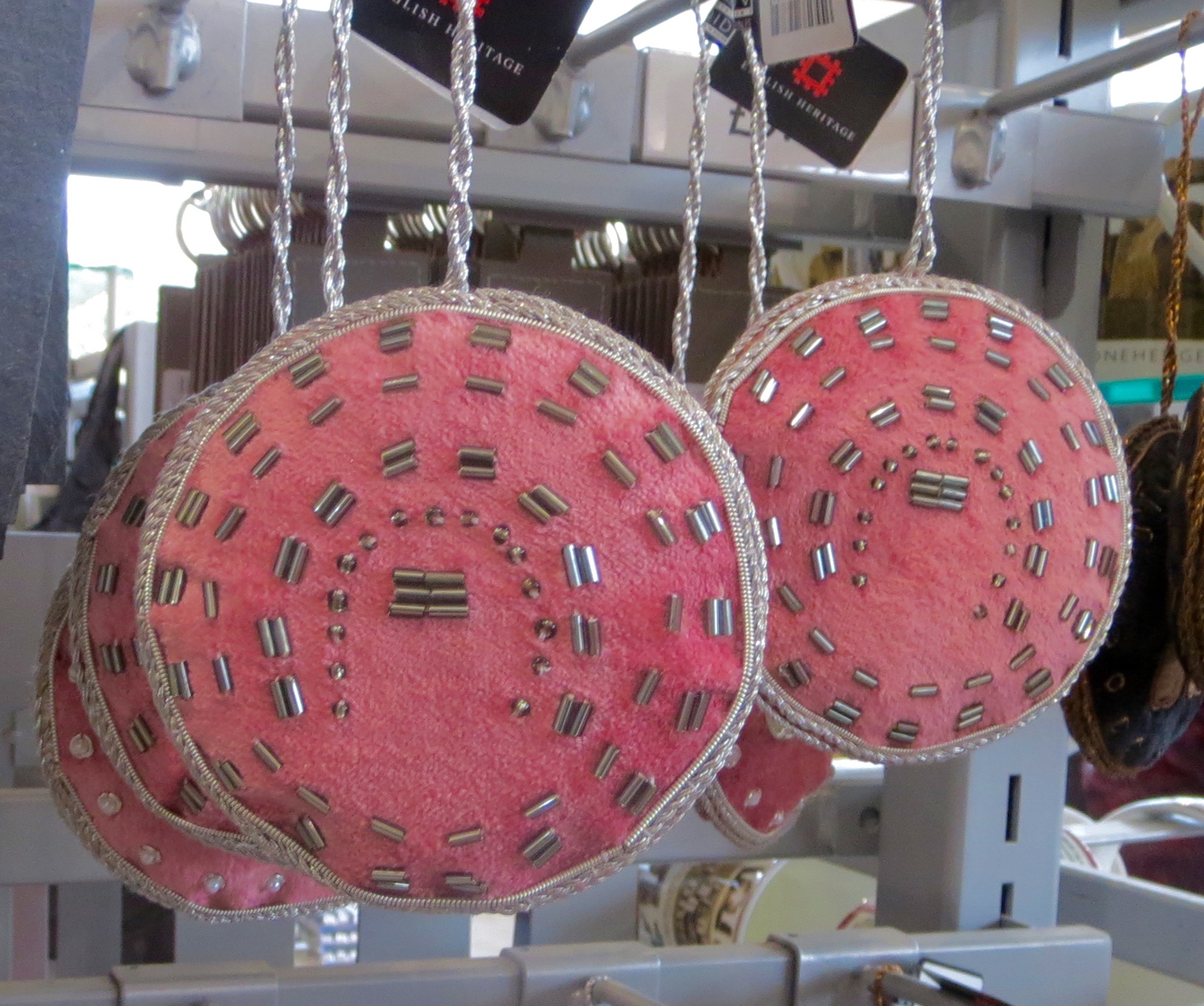
Aerial pattern of the stones of Stonehenge, done in beads!

Aerial pattern of the stones of Stonehenge, done in pink beads! Is this meant for little girls???

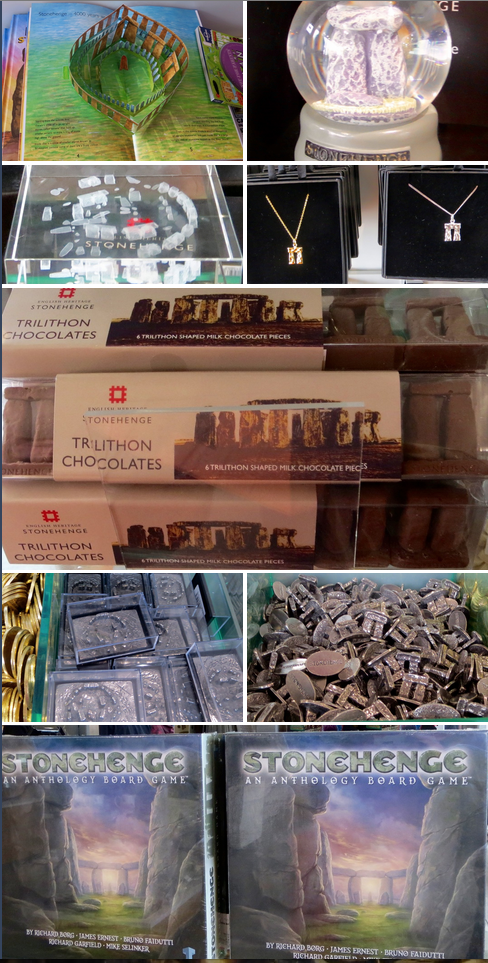
more, more, more!!!

more, more, more!!! a pop-up book, another snowglobe, etched plexiglass, gold-tone and silver-tone trilithon pendants, chocolate trilithons, cheap molded Stonehenge models and trilithons, and the Stonehenge Anthology board game

Clonehenge Goes to Stonehenge: Investigating the Source of the Plague!

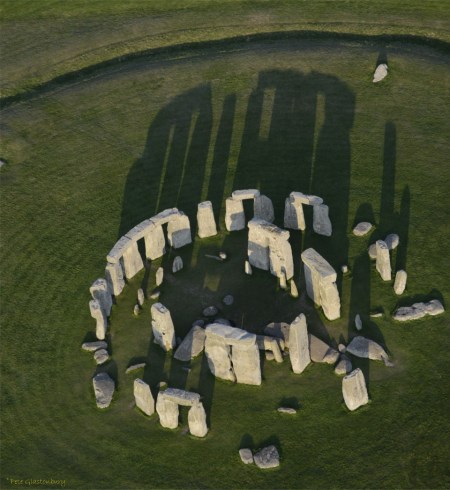
Stonehenge—Warning: NOT A REPLICA!

(Warning: this is NOT A REPLICA !) Stonehenge photo by Pete Glastonbury, used with permission. 

Well, the word is out, so we may as well say it here: the entire staff of Clonehenge.com is headed for the UK and, against the justifiable objections of everyone at English Heritage (probably), will be visiting Stonehenge itself in early June!

Despite the well-known dangers of brain infection that we have documented here on this blog for many years, we have decided that, for the sake of the future of mankind and, indeed, of the entire planet and all of its living things, it is nothing short of our duty to investigate the source of the contagion that is spreading little Stonehenges across the globe. So on an undisclosed day in the next few weeks, we will don our hazmat suits, or possibly a mack and Wellies, and approach the dreaded structure that so many foolish and unsuspecting tourists willingly view in the course of a year.

Thank you. Thank you. Yes, we deserve that thundering applause for our courage and self-sacrifice, but of course we are far too modest to admit it! We are, it is true, still awaiting our funding from the Centers for Disease Control and Prevention in Atlanta, Georgia, as well as our funding from the World Health Organisation, but we’re certain they will come through.

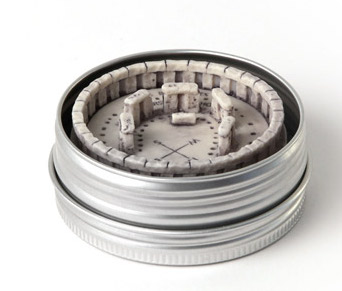
Miniature Stonehenge Model in a Tin, as sold at the Visitor Centre

Miniature Stonehenge Model in a Tin, as sold at the Visitor Centre

While there we hope to investigate stories we’ve heard of numerous Stonehenge replicas, large and small, sold at the Stonehenge Visitor Centre, including a particularly close inspection of certain chocolate trilithons of which we have been hearing ominous rumours!

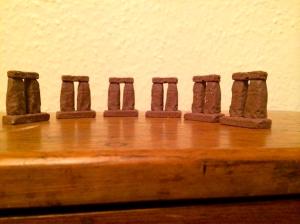
Stonehenge of chocolate trilithons by @SchPrehistory on Twitter

Stonehenge of chocolate trilithons by @SchPrehistory on Twitter

Is it possible that EH or certain shadowy figures associated with the World Heritage Site are complicit in the plot to cover the earth with bad Stonehenge replicas by bringing in millions of tourists to contaminate their minds and then have them take home contagious gifts to families and friends? To find out the truth, we will stop at nothing, even including eating chocolate! It is a tough assignment, but we reluctantly and humbly accept it.

While in the environs, we hope to see other Stonehenge replicas and possibly Avebury and Silbury replicas, too. And the real ones as well. We will report back to our vast but quiet (very very quiet, but we know you’re out there! You are, aren’t you?) fandom.

So wish us luck in our hazardous endeavour. If you never hear from us again, well, you may assume we’re just being as lazy as always!

Until next time, gentle readers, happy henging!
Equinox Henge Sampler or, Good News—People are Still Strange!

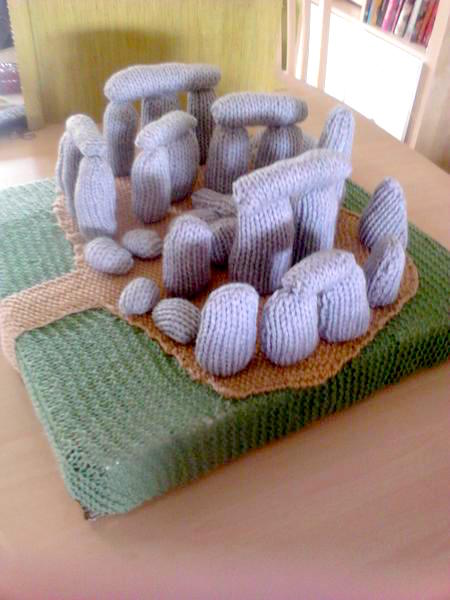
knitted Stonehenge by Toogood Knits

knitted Stonehenge by Toogood Knits

Hello, friends! Yes, it’s vernal equinox in the northern hemisphere already and we haven’t posted on this blog since New Year’s. Go ahead, tell us how YOU’VE done everything YOU should have done since then. What’s that? We’re listening, but we can’t hear you? Okay, then.

At any rate, our absence here does not mean that nothing has been happening in the glamourous world of Stonehenge replicas. Au contraire! (See? Glamourous!) On Twitter and Facebook, many Stonehenge replicas, new and old, have been posted and admired. We thought we would post a few recent favourites here for those who still actually read blogs. Nostalgic for when people used to read, are you? The Clonehenge staff admires your old-school dedication!*

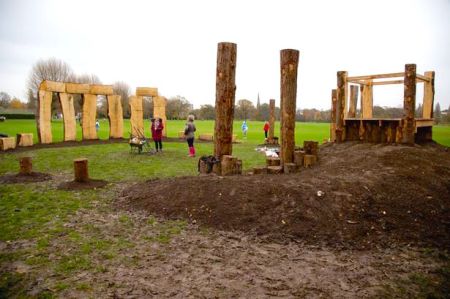
So behold: a wooden henge in a Liverpool park, made by John Merrill and John Ayling.

wooden henge in Liverpool's Princes Park

wooden henge in Liverpool’s Princes Park

A food-safe Stonehenge mold on Etsy, for fondant, chocolate, or candy henges, made by Michele B. Brosseau!

Stonehenge food-safe silicone mold

Stonehenge food-safe silicone mold from Etsy

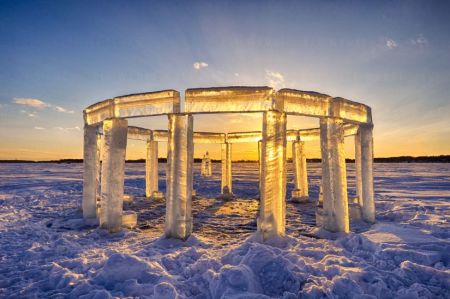
An icehenge, built on a frozen lake in the northern U.S. by Drew McHenry, Kevin Lehner, Quinn Williams, Alec Niedringhaus and Patrick Shields.

Rock Lake Icehenge, in Lake Mills, Wisconsin, USA

Rock Lake Icehenge, in Lake Mills, Wisconsin, USA, photo by Eli Wedel

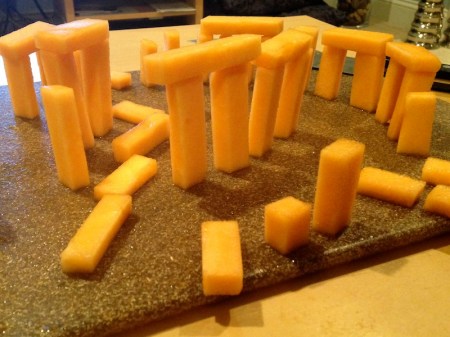
And then, of course, there are the many foodhenges, of which this melon henge is but an example. We’ve seen cakehenges, a beefhenge, and others including that old favourite, the sconehenge.

melonhenge from the blog Keep It Up, David

melonhenge from the blog Keep It Up, David

So, although our blog posts are sporadic, the world’s bizarre obsession with making Stonehenge replicas has not abated, and reports of them are still pouring in! If you can’t be at Stonehenge itself for the equinox/eclipse celebration this year, we suggest making your own Stonehenge and celebrating with friends. It’s the same earth, the same sun as they’ll have at Stonehenge, with less crowding, less noise, and less trash. And you know where to send the pictures!

Our thanks to all who have posted Stonehenge replicas where we could see them or who sent us emails or messages alerting us to them. A very happy equinox to all and until next time (and the Stones only know when that will be) we wish everyone out there some very happy henging!
*(We realise that you’ve given up reading and gone on to another blog by now, but it’s the thought that counts!)

The Fabulous Stonehenge Marbles: Perfect Gift for that Friend Who Blogs about Stonehenge Replicas!

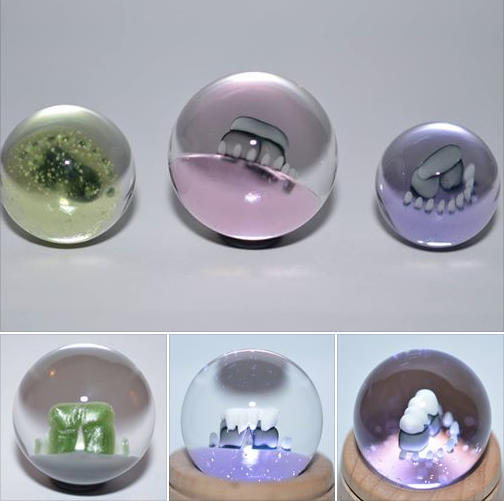
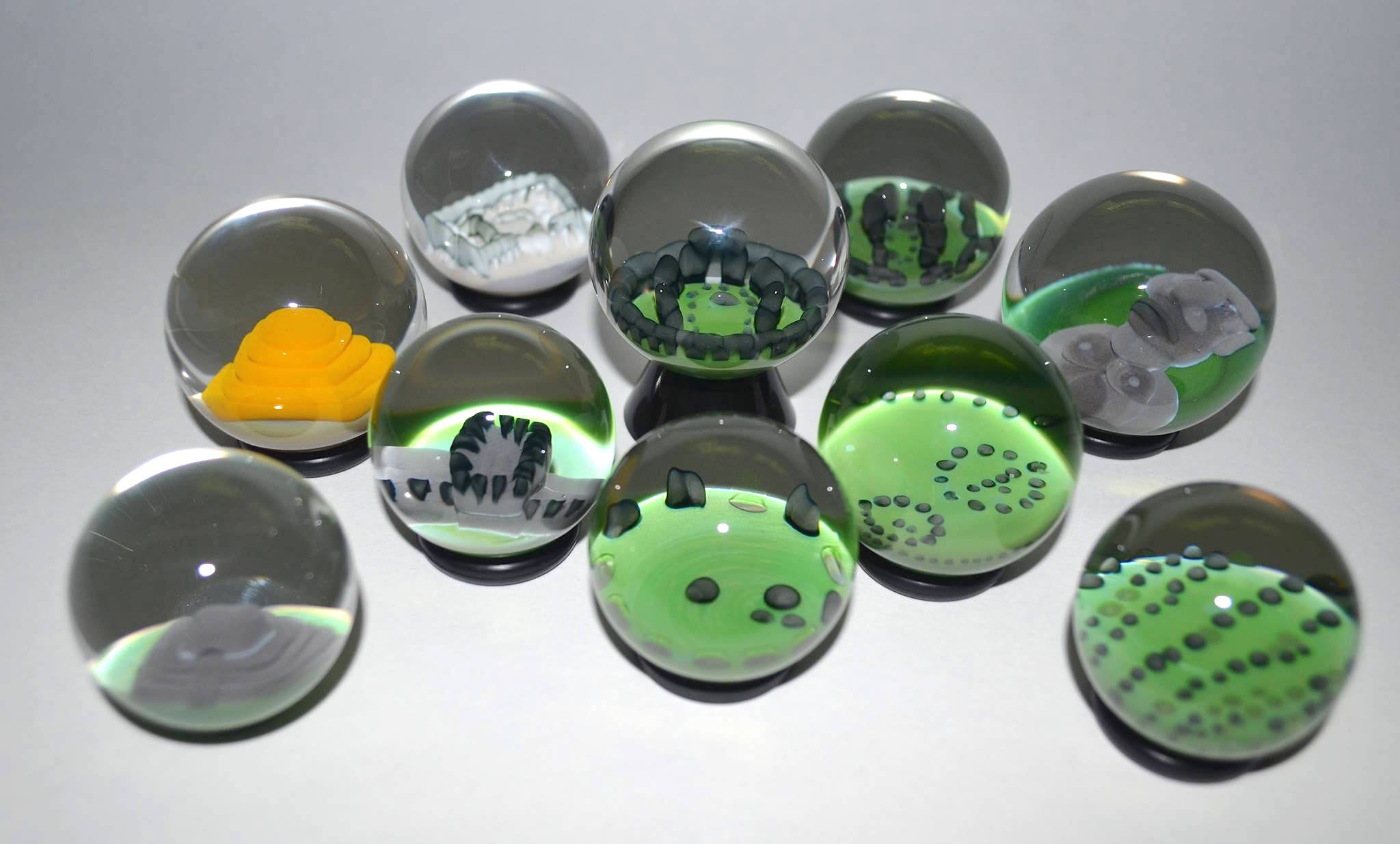
Stonehenge marbles by Chris Inchaos Schiano

Stonehenge marbles by Chris Inchaos Schiano

We’ve all heard of the remarkable, historic, and controversial Elgin marbles, and lately they’ve been back in the news. But here on the Clonehenge blog we have something far more desirable to show you: the fabulous Stonehenge marbles by Chris Inchaos Schiano! Here is the Stonehenge marbles website. Basically we are going to spam you with photos, quote the artist, and end with a suggestion. Mr. Schiano says of his work:

“Stonehenge Marbles are unique pieces of contemporary art. I hand draw each stone out of glass and encase them to create a permanent miniature replica of the sacred sites. Each marble is a labor of love, which I harness to capture the spirit of the megaliths and the people who envisioned them thousands of years ago.”

A Stonehenge marble, yes, at Stonehenge!

A Stonehenge marble, yes, at Stonehenge!

Every day I learn something new about the stone circle that I try to relay into the glass.

more marbles

more marbles

And although these beautiful creations are more than enough, he doesn’t stop at Stonehenge.

Stonehenge and more, trapped in marbles

Stonehenge and more, trapped in marbles

Above we see: “Stonehenge Past and Present, Avebury, Stones of Stenness, Carnac, The Great Wall of China, Egyptian and Aztec Pyramids, the Parthenon, and [not sure whether to say “sadly” or “of course”!—CH] a Moai.” He has even done a Stonehenge marble with an Easter Island moai hidden in the glass at the bottom, in a fine (?) tradition long established among Stonehenge replica creators! Stonehenge marbles may show the monument either as it currently exists or as it is thought to have been originally.

Stonehenge marble with sunset

Stonehenge marble with sunset

Be sure to have a look at this video of a marble that was auctioned off just recently!

*wipes drool from corners of mouth* Heh. Excuse us. That video, tho. There seriously are not enough druids in the world to award for these things.

In closing, we hardly need point out that winter solstice and the Christmas holiday are almost upon us, and we know you’re all wondering what to buy for that hard-to-please but much adored Stonehenge replica blogger on your holiday gift lists. Let us make it easy. Why not order a custom Stonehenge marble (no moai necessary!)? We guarantee it’s bound to please, and think of the satisfaction you will gain from supporting an original artist instead of spending the hundreds you were planning to spend on bric-a-brac. 😉 Everyone wins!

We heartily wish a very happy solstice to all of our readers, and a happy holiday season to everyone. Until the next time, very close and very generous friends, happy henging!
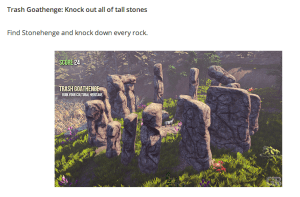
Game Henges: Trash Goathenge. Ruin your cultural heritage!

Goathenge, photo by Jake Crimmins, used with permission

Goathenge, photo by Jake Crimmins, used with permission

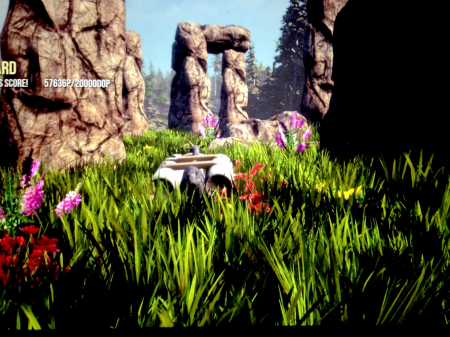
from Venture Beat's Goat Simulator guide

from Venture Beat’s Goat Simulator guide

Virtual henges: no one likes to talk about them, but they are the dirty secret of a persistent reality in the Stonehenge replica world. Hardly a gaming world gets invented without a Stonehenge in it somewhere. Some have several—why should they be limited to one puny Stonehenge like our world is?

Maybe you’ve heard of  the game Goat Simulator. It has created a sensation in the gaming world in the short time since it was released, as much for its bugginess and simplicity  as for its game features. The game is played from the point of view of a goat and the goal is to wreak as much havoc as you can. And, of course, what would be more fun to trash than Stonehenge?? The copy reads, “Trash Goathenge: knock down all of the tall stones. Find Stonehenge and knock down every rock.” “Trash Goathenge. Ruin your cultural heritage.” We especially relish that last one. Almost makes us want to take up gaming! Actually it’s good to know that Stonehenge is still so much a part of pop culture that it shows up in games like this. And there’s something that feels right about goats and Stonehenge.

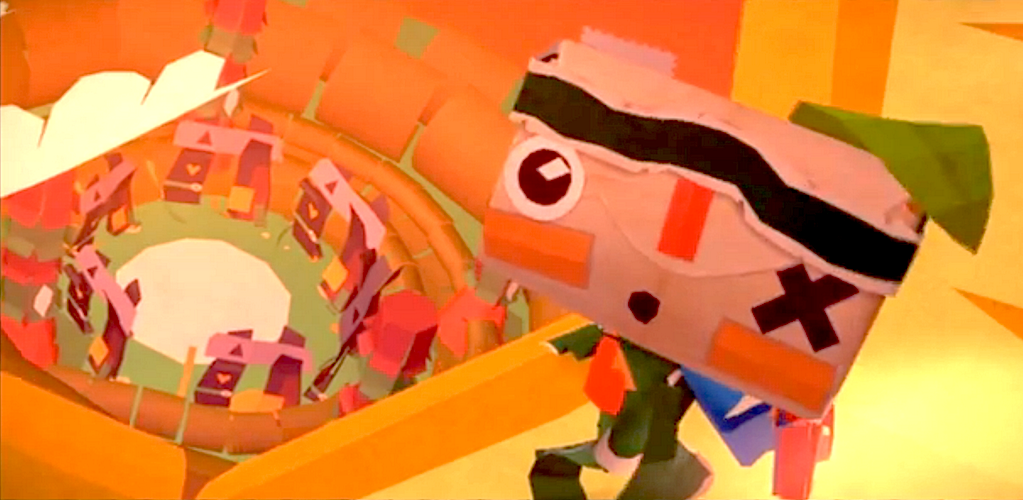
Another trendy game with a Stonehenge scene is Tearaway, a game in which everything appears to be made of sugar paper (construction paper if you’re from the wrong side of the Atlantic). Granted, you have to be watching for this one, but it’s there. In the following picture, you can see the paper Stonehenge below the main character and to the left.

screenshot from the game Tearaway

screenshot from the game Tearaway

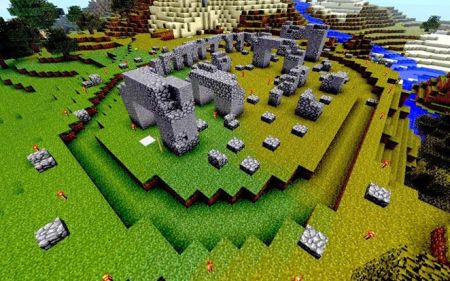
Another Stonehenge, made in this case by a friend of the blog, James Brocklehurst, can be found in Minecraft on Snakeskin.

Stonehenge in Minecraft, on Snakeskin, made and imaged by James Brocklehurst

Stonehenge in Minecraft on Snakeskin, made and imaged by James Brocklehurst

It’s a little lumpy, but we’re told that underneath it is the Pandorica. If you don’t know what that is, drop your device right now and go watch the entire Doctor Who oeuvre! Not that you have to watch them all to know what it is, but it’s clear you haven’t watched them, which means you need to. Go ahead now. See you later.

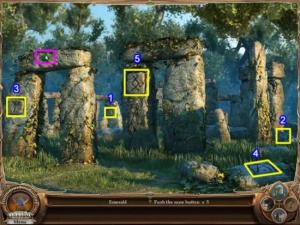
Eternity Stonehenge, from Gamezebo's walkthrough

Eternity Stonehenge, from Gamezebo’s walkthrough

Stonehenges can also be found in games like Eternity and Mystery P.I.—The London Caper. Don’t ask us what platforms these games are on. We  don’t even know what that means. Just savour the henges, which show evidence of someone actually having looked at Stonehenge before designing them!

Stonehenge in Mystery P.I.—London Caper from Gamezebo's walkthrough

Stonehenge in Mystery P.I.—London Caper from Gamezebo’s walkthrough

We hoped to include more in this post, but there were so many game replicas that other kinds of virtual henges will have to have their own post.We have no doubt that readers will want to tell us about Stonehenges in other games. Please do, and we’ll include them in another post somewhere down the line. So far no Easter Island heads among these. Don’t send us anything that would ruin that for us!

Our thanks to inimitable friend of the blog Jake Crimmins for sending us the Goathenge and inspiring this post! And to James Brocklehurst for supplying the picture of his Minecraft henge. We have so many  non-virtual Stonehenge replicas needing to be posted that we have probably forgotten most of them. If you want to keep up, you can join the Clonehenge group on Facebook (or—get professional help!), where they get posted as we discover or learn about them. You would be surprised how often a new one gets posted. The world has a bad Stonehenge infection, and Stonehenge pop up all over like pustules. We’re just lazy about putting them here.

Thanks for taking time out of your busy gaming day to have a look at Clonehenge, and until the next time, friends, happy henging!
Compulsive Stonehenge Making: A Serious Psychological Problem!

(Attraction Dance Group Performance: Stonehenge makes its brief appearance from 16 to around 28 seconds into the performance.)

People clearly cannot help themselves! Lately the Stonehenge replicas have been showing up faster and faster, not just new replica, but new KINDS of replicas. The one in the video above, for example, is created as part of a “shadow dance”, in which dancers’ bodies create silhouettes resembling things, in this case Stonehenge, as well as the Tower Bridge, and so on. (But who cares after Stonehenge, really?)

Another recent television Stonehenge replica bit appeared on the Conan O’Brien show, when the musical group Fall Out Boy did a Spinal Tap tribute that included the legendary miniscule trilithon being lowered onto the stage:

Now, let us explain you a thing: the more involved you get with Stonehenge replicas, the less enthusiastic you become about Spinal Tap. Every time a Stonehenge replica is mentioned, some tiresome wag, impressed with his or her own cleverness, has to make a remark about it being crushed by a dwarf or quote lyrics from the song in the movie. If we had time we would do a blog of those comments and title it, Adventures in Nope. Still, we have to count the above performance as an appearance of a Stonehenge replica. Grudgingly.

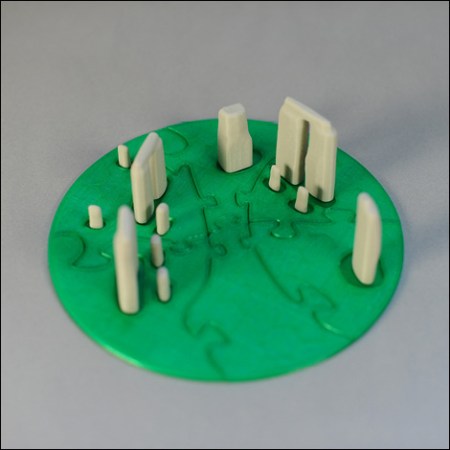
Meanwhile, we have been seeing more small replicas: a Stonehenge cake, a careless foamhenge, a school project replica, a Stonehenge of wotsits, and, inevitable now that 3d printing is all the rage, a 3D printed Stonehenge!

3D printed Stonehenge by MakerBot

3D printed Stonehenge by MakerBot

There is also a small, rather Picasso-esque Stonehenge someone’s mum made for her garden, but permissions are pending, so it will have to be posted later if at all.

We are now convinced that the compulsion to make Stonehenge replicas is emerging as a serious psychological problem, and that it should be listed in the DSM as Compulsive Henging Disorder. By early recognition of this burgeoning syndrome we might be able to stem the tide of Stonehenge replicas of every material and description that could inundate the world of the future, a tsunami of Stonehenges threatening to overwhelm the world as we know it and create a Clonehenge apocalypse of unimaginable proportions!!!

What? Yes. Yes. It IS a load of bollocks, actually, but we have to fill the blog somehow. The point, however, should not be lost: something is forcing people to build Stonehenge replicas and making them think that it is their idea. Is it possible that Stonehenge itself is an alien life form seeking to reproduce itself by infecting the human mind like a virus or like the fungus that infects ant brains and makes them climb to a high point where a bird is likely to eat them? Is it possible that by the end of this sentence we will decide it’s time to end this post?

Possibly! It remains to be seen!

Until next time, friends, happy henging!
21 December, 2012: Apocalypse No!

Poster from Allan Sturm's LoveSmack Studios

Poster from Allan Sturm’s LoveSmack Studios

Greetings, henge lovers everywhere, and a happy solstice to you all from your friends at the Clonehenge blog!

Yes, you read the poster right. It says, “Dance inside a giant to-scale Stonehenge!” Yes, it says other things, too, but we are not the sexism police. We are the Stonehenge replica fandom. Focus! We have before us an exciting henging first–the Stonehenge dance floor!

This is a poster for an End of the World Party. (Apparently at the end of the world, fonts turn into zombies and parts of them begin to fall off. But once again, focus!) The end of the world. Ish. As of this writing, it is 21 December in Europe and Great Britain, but there have been no signs of the world ending. How Stonehenge ties in with the end of the world we’re not sure, either, but who are we to blow against the wind? Let’s see a few of the other pictures posted on the Clonehenge Facebook group recently as the apocalypse approacheth.

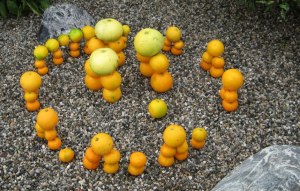
Citrus henge, courtesy of champion henger, Simon Burrow

Citrus henge, courtesy of champion henger, Simon Burrow

Friend and recent poster on this blog, Simon Burrow, posted this artistic citrus henge two days ago. Mr. Burrow is known for henging with unusual materials and with some frequency. If there were a thing like a henging problem, this henger might be said to have one. BUT there is not! So onward.

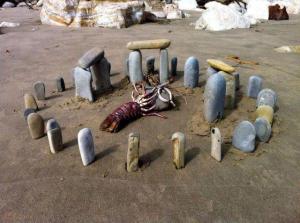
Photo posted by Bob Carlson, not sure who did the henging

Photo posted by Bob Carlson–not sure who did the henging

Ah, the days when Stonehenge was beset by eldritch creatures of the sea! Who wouldn’t want to make a replica of those epic times? Here’s one, a little short on lintels, but impressive nonetheless, posted by the mysterious Bob Carlson. We don’t know much about him, but anyone who henges AND speaks Welsh is all right by us!

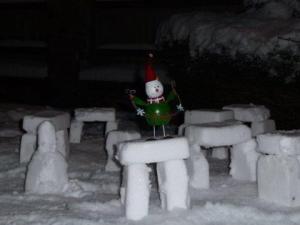
A snowhenge, posted by Rufus T. Firefly

A snowhenge, posted by Rufus T. Firefly

And from R. T. Firefly of Henge Collective fame we have this snowhenge from another year. Don’t let that smile fool you–the creature shown here has teeth like a piranha and a temperament to match! If you see one at a henge, turn and run for your life. You have been warned!

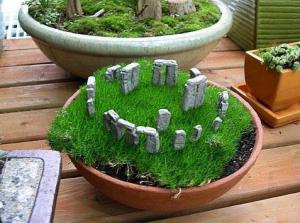
miniature Stonehenge garden by Two Green Thumbs Gardens

miniature Stonehenge garden by Two Green Thumbs Gardens

And, yes, we have posted this last one before, but its popularity never dies–the miniature Stonehenge garden by Janit Calvo at Two Green Thumbs Miniature Garden Center. We include it again because she has furnished the curious with a blog post called How to Make a Miniature Stonehenge Garden for the End of the World. Timely! Briefly. Even better, she mentions us!!!

So there is our solstice/apocalypse post. Another year gone by, another turn of the sun, another special day for henges and hengers. It is also the last day for submissions to our henging contest. If you don’t know how to submit your entries, leave a comment on this post and we’ll answer.

Until next time friends, in this world or the next, happy henging!
Olympic Horse Hurdle Henge: Has the Empire Fallen So Far?!
Olympic horse event Stonehenge

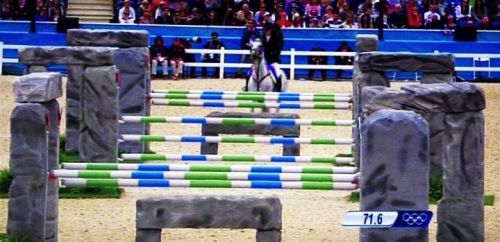
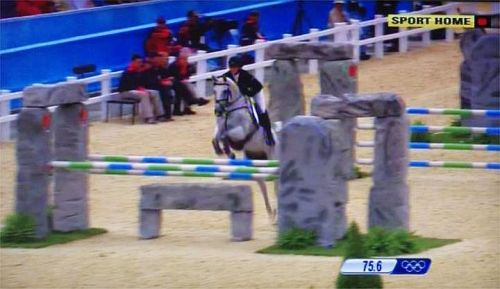
This is not a post so much as an alert. Hengefinder General (E class) Glastonbury’s keen eye noticed these hurdles at one of the Olympic horse events.

I think we can say with some confidence that this is not where your Olympic millions have gone. Still, we post Stonehenge replicas, so here it is!

Another view, taken from the television

We knew there would be Stonehenge replicas connected with the Olympic summer in England. We were tickled with the bouncy Stonehenge, disappointed with the choice of Glastonbury Tor for the opening ceremony. Now we have these.  The stones are very squared off, of wrong proportions (too thin for their height), painted like a secondary school theatre set, and of course, set up like horse hurdles. A little pathetic, but another sign of the hengemania seizing the world!

Our thanks to Pete Glastonbury for noticing these and taking the pictures from the telly. We’re glad that King of the Mountain is not an Olympic sport. We shudder to imagine the muddy little Silbury Hill replica they might have produced!

And until next time, happy henging!