Kennewick Man–Washington State Strikes Again

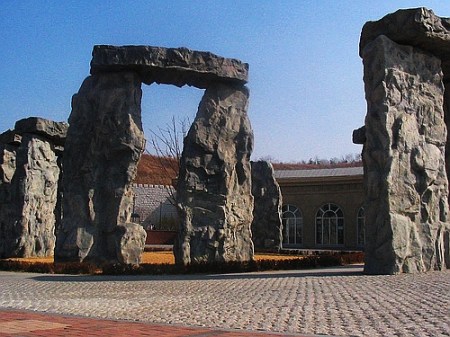
543-at-stonehengereplica-hot-zone

photo by Bethany Lee, reposted from Atomictown.com / Tri-City Herald

We’ve always  been amused by things that show penguins and polar bears together. They’re from opposite ends of the world, right? How would they be together? Turns out there’s a similar trend with Stonehenge replicas: people will sometimes add, not a model of Silbury Hill or a barrow or a stone-lined avenue such as you might find near Stonehenge in Wiltshire but–moai such as you might find halfway around the world on Easter Island.

What’s that about? We can think of three examples* including this one. Unlike Washington’s Maryhill Stonehenge, today’s replica is small and privately owned, built by Ed Mays of Kennewick, Washington to replace the old rose garden in front of his home. Quoting from the article: “After forming some pillar bases for the replica, Mays estimates he went through about 75 sacks of cement, which he mixed all on his own. . . . In addition to the circular henge, he placed a giant rock with a carved out face in the center to portray another large rock design, Easter Island.

Far be it from us to do anything but encourage henge building as a retirement activity! If we get a laugh out of this garden megalith complex (complete with a spotlight on the ersatz moai!), it is meant in the same good humour displayed by Mr. Mays’ admirable creation. Score: 5 druids for a game try by this solo pensioner!

* Stonehenge II in Texas and Harry Rossett’s Stonehenge come to mind.
Shunt Henge, or Haha! Eat this, Smithsonian Channel!

shunt-henge

Photo by linux-works, with permission

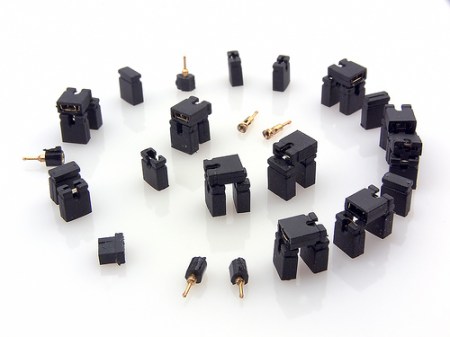
A henge made mostly of jumper shunts–who would guess they would make such a striking picture? linux-works, the builder and photographer, did an outstanding job catching a clean image of this excellent henge.

When Smithsonian was cruising Flickr looking for images for their henge video, they saw the image here, and approached the artist who declined to release it for commercial TV without being paid. (Tch, tch, sucks to be them! *Clonehenge shakes head and grins*)  We, however, being about as uncommercial as one can get, was given linux-works’ generous okey-dokey and here is shunt henge for you to see. Thank you, sir!

We’re told there is a back story, too, and we’ll add it if we get it, but for now we will score without. As you may have noticed, we kind of equate electronics with druidry, an advantage for this one. We award 6½ druids to this minimalist henge, which seems almost to hang in mid-air.

Paju City Stonehenge: England in South Korea!

korean-stonehenge1

Photo by Sonja Jean, with permission

If English speaking is vital for success in South Korea, how can less affluent children get an experience of immersion? One way is to create an English village in Korea. And what is more likely to be part of an English village than–you guessed it–Stonehenge?!

It’s a nice big one, too, possibly bigger than the original, although the pictures hint that it is not complete. There are few sites about it in English. Here is a report about the village from a radio show in the States.

Some replicas demonstrate astronomy or represent ancient observatories, some are to show creativity with stone, others to be cool, some make a political point or serve as a monument to the dead, plus some we suspect are, well, compensation, but this was just built to make it seem like England. So many reasons to build a Stonehenge replica!

How to give druids when we can’t get a look at the whole thing? We’ll say 7 druids for size and whimsy (whose idea was it, we wonder?) and for being so far from its ancient home. A side note: there are real ancient megaliths near Paju City as well.

Share

Stonehenge in Poland

poland-stonehenge

photo from the Kurier newspaper

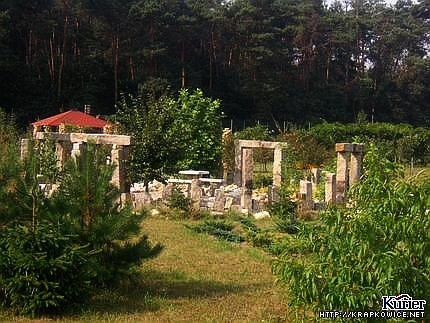
We don’t know much about this one, but we suspect there are hidden Stonehenge replicas like this scattered about in surprising places around the world. People get the bug or the thought, “I could build a Stonehenge in my garden!” We aren’t able to find them all, but let this stand for all the ones we’ve missed. We know there are hengers out there building or planning as we type this!

Here is all we can glean about where this henge is: “It is hard to find, hidden in the stands Krzakach, in one of podzdzieszowickich gardens.” We can’t help you with the pronunciation or meaning of that nice long word there. It gives us the strange feeling that the whole thing was written by WOL.

Clonehenge may go on hiatus for the weekend, so best wishes to all. Druids for this one, you ask? Oh, let’s say piec or szesc. These things need to be encouraged!

Bookhenge, or Henging with the OED in the Maritimes

oed-henge

Photo by John  “the Bookmonger” Doull, with permission

Sorry for the late post! We are crying in our utterly un-beerlike beverage this evening after being turned down–representatives of an artist who created a vaguely Stonehenge-like sculpture not only denied us photo permissions but asked that we never reference the sculpture on our blog as the artist had no intention of referencing Stonehenge. *sob!* So if and when we ever end this blog, there will always be at least one structure out there that people will think we missed! Still, we do respect artists, so that’s that.

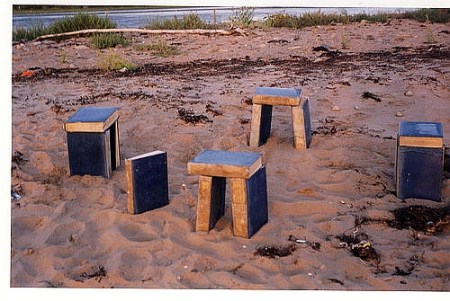
Anyway, on to the matter at hand and that matter is–The Oxford English Dictionary. We assumed when we started this that there would be a lot more bookhenges than there are, books being squarish things and, in many homes at least, always at hand. So we’ve kept our eyes peeled for a bookhenge worth posting and along came this bit of poetry with a lovely late (or is it early? Wait, book lover, right? Late it is, then!) Nova Scotia light giving the books and the sand a rosy glow.

The sand and the implication of leisure time begin to set up a scene of peace and relaxation until we remember to imagine someone lugging a bunch of old dictionaries out there and building a henge when they could have been taking a romantic sunset walk. Hmmm, what manner of people are these? Perhaps a bit too much like us.

And what do they get for it? How many druids can we give for such a rudimentary construction? These are hardy northern souls and they can take the bitter disappointment of getting no more than 4 druids for their bit of OED play. Now, who can help us get the verb “to henge” into the next edition?!

Bonehenge, or who can resist a pun?

bonehenge

photo by kaymoshusband, henge by Winnie ?

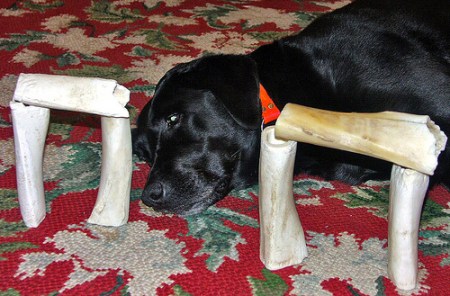
It’s the first non-stonehenge in the Smithsonian video, and while it’s far from the only bonehenge out there, this one has the advantage of having been made of real bones rather than Milkbones. And, of course, there’s the astronomical aspect.

The caption on Flickr reads:  “Last night I caught Winnie building a working model of Stonehenge on the rug, using the only materials she had available. In this photo, she is double-checking the replica’s precise astronomical alignment, in anticipation of this evening’s Vernal Equinox.” One might expect such expertise from a German shepherd or a border collie, but I suspect astronomers are rare among labradors!

Of course it is not a full replica. Some henges get their druids from chutzpah alone. Score: 5 druids, and our thanks to Bob Gaffney and, of course, Winnie!

Autohenge, Ontario

autohengefromair

photo from williamlishman.com, with permission

Before there was Carhenge, there was Autohenge. Built in 1986 by artist William Lishman at the request of Chrysler for a commercial, it stood proudly on the Canadian landscape for 5 years until it was removed. There is some evidence that suggests Lishman would consider creating anotherAutohenge if he could raise the money.

autohengewithgeese

Maybe it’s just us, but these pictures seem to have caught something melancholy and magnificent. Its history is interesting. How many Stonehenge replicas have been sponsored by major corporations? May that happen more and more!!

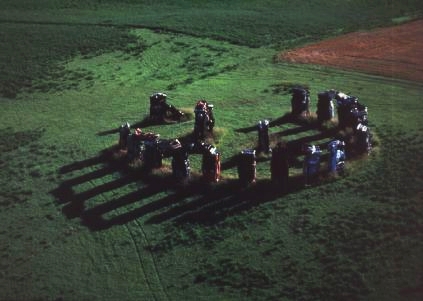
We’re nearing the bottom of the list of large replicas. A handful more and then we’ll just be posting small ones. This seems to us to be a good example of a grand tradition. Maybe the Canadian government could give Lishman a grant!

Score: Look at that picture at the top. 8 druids, at least!

P.S.: We do not plan to list Cadillac Ranch, Truckhenge, or Airstream Ranch, as they just are not hengy enough.

Cellphonehenge, a tour de force

cellphonehenge-51We have been saving this one because once it is posted, it is unlikely to be surpassed. Among all the small, homemade henges we have had the privilege to see, this one is a rock star. As inaccurate as it still is as a Stonehenge replica, it has that je ne sais quoi that allows it to rise above.
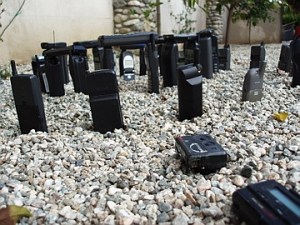
Listing the faults sounds petty: no lintels on the outer ring and too many trilithons in the center for starts . . . still, what it lacks in the letter it proffers in spirit. The commentary, too, enhances the installation. The caption on the Flickr photo below reads, “A closer view showing how the setting sun in mid summer shines down the avenue of pagers, through the Motorola arch and directly on the altar phone. ” There’s more where that came from.

cellphonehenge-31And whom do we have to blame–no I mean thank!–for this extraordinary henge? Once again it is the work of the inimitable Simon W. Burrow and friends. Here is his Cellphonehenge blog post and here is a Flickr link from which you can click on 7 photos to read the captions.

Score? We’re giving this one 8½ druids. If only they had dug a little ditch and bank with a stick or something . . .

Mystical Horizons, North Dakota’s Stonehenge

mystical-horizons-3

photo in the public domain

We’ve been working on getting photos of this structure which is named Mystical Horizons and is often billed as a Stonehenge for the 21st century. We have received no answers from the photographers, but finally found this rather nice photo posted on a tourist site and marked clearly “in the public domain.” Thank you, internets! [Sorry, our old links are dead. Here’s one given us in a comment by one Gentle Reader.]

The wall by the benches has notches that line up with the standing stones to capture the sun near the horizon on certain crucial days during the year. There is also a star tube for viewing Polaris. This really is a 21st century creation in the sense that it lacks the ponderousness and wonder of Stonehenge and also takes the guesswork out of the viewing process. It seems very user-friendly: stand here, look there. Not in the ancient mysterious style at all!

We’re probably influenced by the beauty of the flat land and the distant horizon, because it isn’t a Stonehenge replica in any real sense–not a lintel in sight!–and yet we’re awarding it a score of 6½ druids. Something about it and its command of the wide horizon musters enough wonder in us to make it seem special. Nicely done!