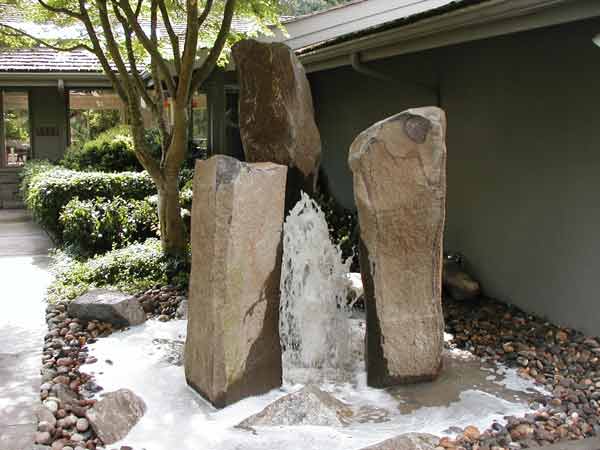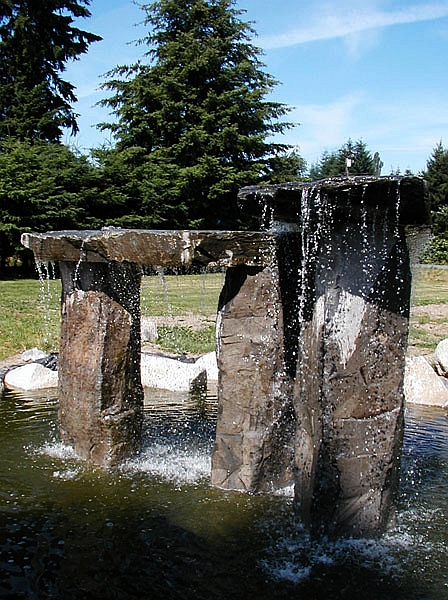
Splash Stonehenge Replica, Monroe, Washington

stonehenge2

photo from the website of Falling Water Designs

Why couldn’t Stonehenge be a fountain? As a matter of fact, English Heritage, it is not too late! Make that tunnel you’d been planning a little smaller, put pipes in it, and have a water feature expert come in and design the water flow . . .

Well, maybe not, but to make up for it, Rick Perry, owner of Falling Water Designs in Monroe, Washington (yes, Washington! We’ll get back to that), outside Seattle, created this remarkable partial-Stonehenge-replica water feature of what looks like real stone to us. We know that Rick or someone he works with has a mild case of megalithia* because of other photos on the website.

This seems to be made of two trilithons at an angle to one another, a configuration we haven’t seen before. Score: 5½ druids. Yes, it is ridiculous, but that element of humour might help the thing remain a pleasure over time. Hmm . . . do you think, if we slow the water down, we could grow mosses?

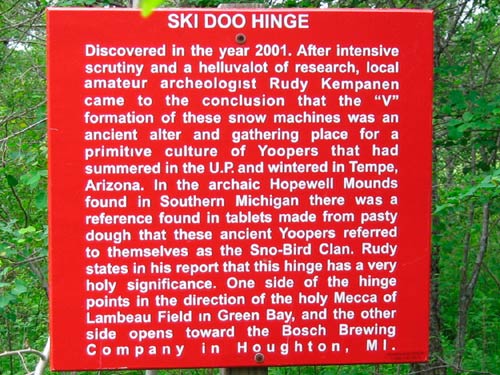
Anyway, it is Washington State again. Despite Michigan’s desperate attempts at holding its title, like a woodhenge we’ve heard of but can’t seem to find and an odd snowmobile “hinge” that doesn’t quite make the henginess cut, it looks like Washington State has usurped the coveted title of The Stonehenge State. And we still have a Washington replica we have yet to show you! What is going on up there??

* a condition, rarely fatal unless combined with clumsiness, which creates a compulsion to erect megaliths
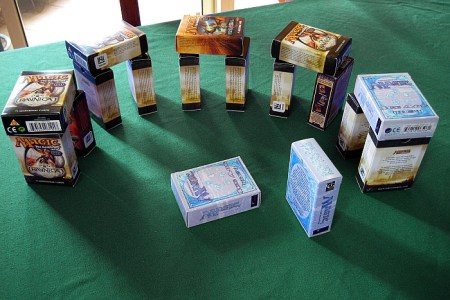
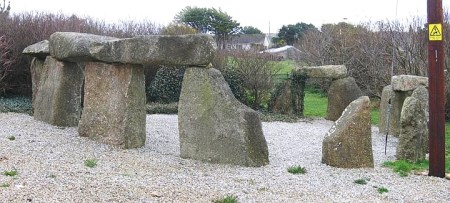
MagicHenge, the Gathering

magic1

photo by David Morgan-Mar, aka dmmaus

We know– a bunch of you are saying, “OMG, lame!” But the connections between Wizards of the Coast, makers of the game Magic: the Gathering, and Stonehenge are real, if subtle. A post coming up in a few days will point up an aspect of that.

A henge of Magic card boxes appealed to us because games like Magic feed off the mystique of icons like Stonehenge. What, in a sense, has more real mana than the lurking stone beast of Salisbury Plain? There is a hopeful feeling here, as if this were an effort to bring to life the fantasies depicted on the cards!

This is not the first time we have mentioned and posted photos from the Thinghenge pool on Flickr. We are grateful to Mr. Morgan-Mar, the visionary behind its creation. It is not Flickr’s only such pool, and we will tell you what the other is when we remember it ourselves . . .

Score? We can only give this 4½ druids as a Stonehenge replica but there is a lot of blue mana in those lintels and uprights!

Stonehenge in Treave, Cornwall

treave-4

photo by Alan S., with permission

This height-challenged Stonehenge replica is one of several replicas of British megalithic antiquities built by a rather eccentric woman who ran the local holiday cottages in Treave.  What a relief to learn that she did not add any Easter Island heads! She wanted to make the circle larger, but couldn’t get planning permissions. Fortunately, in Wiltshire the original Stonehenge was grandfathered in.

The woman who built this circle was a dowser but when the Cornish Earth Mysteries Group visited in 2000, we’re told they got very bad vibes out of it. There’s not much to it—a ring with a few lintels. Score: 5½, almost a 6. Cornwall is full of real megaliths. What inspires people with the urge to henge? We at Clonehenge hope they don’t find the cure too soon!

[more photos of this replica can be seen here]

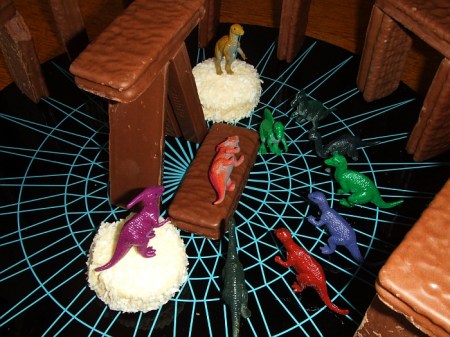
Chocolate Henge and the Lizard People, Just as We Suspected!

sacrfice

henge and photos by Jeremy Dennis, with permission

Another foodhenge–some chocolate to fortify you for the work week to come. This one was created by Jeremy Dennis–not one you know, but the female cartoonist in the U.K. She certainly seems to have a twisted enough sensibility to belong on Clonehenge!

chocohengeShe calls the above photo a bloody sacrifice (as in the PeepHenge photo* we mentioned before). It is clear to the practised eye, however, that we’re looking at a healing, in keeping with the new thought about Stonehenge’s purpose as a sort of lithic Lourdes.
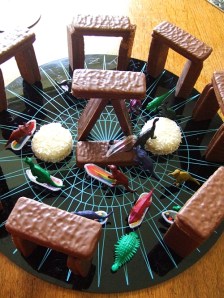
skateboardsProof of this appears in the photo on the left, in which we see the subject from the slab in the first photo skateboarding happily around the left-hand caramel coconut sweet. Tellingly, there is no blood on the altar stone. These rasta druid skater dinos aren’t killers. They just want to work on their ollies and add to their tricktionaries!

Those who want to know more about this henge can see it here. As for scoring, well, we must say there’s something brilliant about this while also a little discomfiting, but that’s not always a bad thing in art. Score: 6½ druids. Skate on, dudes!

* see the gruesome last photo on this page. Viewer discretion is advised!

World Park Stonehenge, Beijing

world-park-sh

photo by Apple de la Vega, with permission

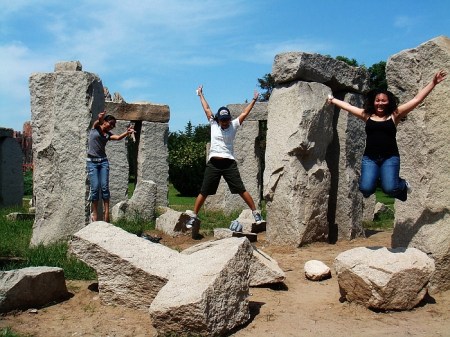
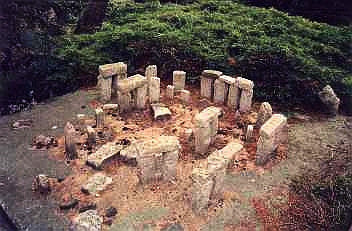
No, we haven’t changed our name to Girls N Trilithons, (or I Can Haz Stonehenge, or F*** You, Henges, or Replica Overload). Once in a while, something more universally appealing than a Stonehenge replica is bound to find its way into a picture we post. We can relate to the enthusiasm these girls show. Another replica in China–it’s exciting!

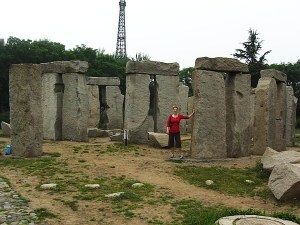
This one is at the World Park in Beijing, which is much like the Window of the World Park in Shenzhen, except the Stonehenge in Beijing isn’t quite as good.

world-park-stonehengeThe exciting thing is that you can see the Eiffel Tower behind it. The stones, however, do not have the lichen-like patina we were so impressed with in Shenzhen, and they are squarish. As usual in these cases, no attempt at bluestones or other details of the original. Score: 7 druids. We’re starting to think we should organise Stonehenge tours of Asia!
second photo by Merritt Wilson, with permission

Butterhenge, Chicago

butterhenge

installation and photo by David Prince, with permission

Some days you just feel like a foodhenge! Luckily we’ve run across a few good ones lately. Butterhenges are not an uncommon form, what with the rectangular prism shapes that butter comes in, and its presence in most homes, including those where alcohol is also present. But this is no ordinary butterhenge, standing in the grasses of a Chicago park!

The artist, David Prince, sent an explanation that is too long to quote in its entirety, but he says the sculptural work tries to relate the experiences of daily life to the larger histories of prehistoric, geologic, and cosmic time. “I’m also interested in exploring time as something that can appear linear, cyclical, and disjointed. . .Butterhenge is a humorous investigation into these scales of time.”  He goes on to say, “I chose Stonehenge because of its relationship to butter in shape, and also its history as an archeological artifact, and its longer history as a part of a geologic process. In relating these two objects the results are comical, but hopefully lead to questions about what it means to pass through a human life on a human scale , and to question what it means for humans to fit into a larger scope of history.

Fair enough. Probably that’s what a lot of these replicas are hinting at, although most builders never put it that way, even to themselves. It’s what makes this Clonehenge idea funny.  Score: 6½ druids. The words and the grass swayed us!

Challenge to readers: We would love to see a butter Stonehenge replica in which the butter was sculpted into Stonehenge-like shapes. See your henge featured on the prestigious Clonehenge blog! 😉

Coca Cola Stonehenge, Atlanta, Georgia

coke-stonehenge

photo by Jeff Crites, with permission

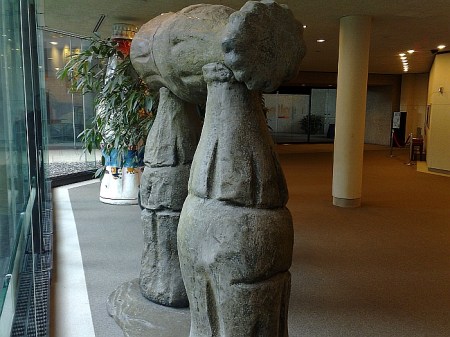
The word you’re looking for is gratuitous–gratuitous use of the Stonehenge idea in a trilithon of imitation-stone Coca Cola bottles. This piece of art was donated by the U.K., one of many Coke-related artworks given to the Coca Cola company by countries around the world. We’re sure the kindness offered by their friend and ally overseas will not be forgotten by a grateful nation.

But it’s a bit of fun for us and another illustration of the pervasive nature of the Stonehenge/trilithon image. The implied assumption is that everyone knows what this is meant to represent. This is not the only soda (or pop) Stonehenge image, of course. You can see another here. Score: Does it even deserve 5? We’ll give it 5 druids–as an international gesture!

Dowdell Stonehenge Model, Wiltshire

earthwood-near-stonehenge

photo by Rob Roy of the Big Stones Website, with permission

From the book Stone Circles by Rob Roy, “A number of years ago, a very accurate model of Stonehenge was built by Albert Dowdell, now deceased, just five miles from the real thing. Jaki, Darin, and I managed to track it down from an old book. The new owners, a young couple who had only owned the place for a year or two, were delighted to show us the model, and have us in for a cup of tea. We were very surprised to hear that we were the first people to stop and ask about Dowdell’s model. The ‘stones’ were cast in concrete in just the right shapes, the tallest not much over six inches in height.

We’re not certain whether this nice little model of Stonehenge still stands, but we are grateful to have a picture. We think it’s very well done for a small garden model, full of detail and with a sort of grace. Score: 8 druids!

Getting permission to use this picture put us in touch with the interesting people at the Earthwood Building School in upstate New York. More from them another day, but this passage on their site seemed to go straight to the heart of the phenomenon we chronicle here:

After visiting Stonehenge, I knew that someday I would have to build a stone circle of my own. Why? The only explanation I can give is that I was compelled to build it, just as the Richard Dreyfuss character in Close Encounters of the Third Kind was compelled to build a large replica of the Devil’s Tower mountain in his front yard. Incidentally, compulsion is a reason I have heard given by at least two other modern stone circle builders.

Aha! Compulsion does seem to be the key. And the Dreyfuss comparison is one we often think of as we work on this blog. Maybe the aliens are going to meet us at Stonehenge!

Dubhenge, Several Locations, U.K.

dubhenge

photo by Ian Lloyd, with permission (kombi trilithon here)

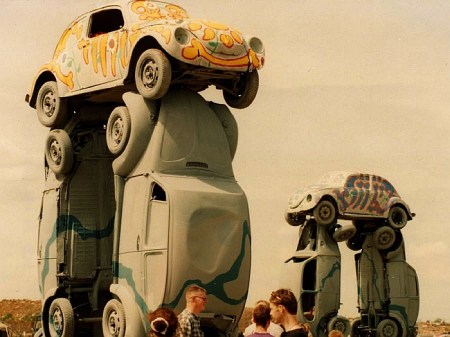
In 1996, a group of artists who call themselves Hugh Jart (get it?) set up this henge for the Beetle Bash at Avon Park Raceway for summer solstice. It was a Stonehenge replica made of donated junk VWs, both VW beetles and buses or kombis. More pictures: the whole replica, Hugh Jart’s Dubhenge photos, MTV’s video of solstice sunrise at Dubhenge. And the poster used to solicit the cars needed for the sculpture (we like this!).

The installation was moved to the Glastonbury Festival that year, to the Park Festival in Scotland and then to the V’97 Festival at Leeds before being scrapped.

What’s not to like? Score: 7 druids for the bug-ly henge. We like the happy hippy vibe and the idea of a monument to such a beloved piece of transportation!

Alton Towers Stonehenge, Staffordshire

alton-towers2
photo from TowersTimes.co.uk, with permission

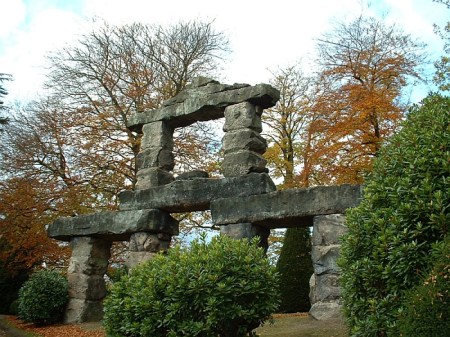
Lest we think Stonehenge replicas that barely resemble Stonehenge at all are  a phenomenon limited to clueless Statesiders, today let’s look at one of the older so-called Stonehenge replicas in the U.K., the one in the gardens at Alton Towers in Staffordshire (shown here in the English Heritage National Monuments Record). These days Alton Towers is best known as an amusement park and resort, and a pretty rockin’ one at that, but at one time the estate was best known for its gardens and conservatories.

In the early 1800’s one of the eclectic fancies added to those gardens was this odd construction which is still characterised,  when it’s mentioned at all, as a Stonehenge replica. Hmmm . . . We would guess that they built the smaller faux trilithons, connected them with the higher lintel, stood back, decided it just wasn’t grand enough for those gardens, and went on to add the un-Stonehenge-like fancy at the top just for style.

We weren’t sure whether this belonged on our list of the large permanent replicas, it is so odd. But if the Guidestones are on there, then this should be, too, right? Score: 5 druids. Don’t grumble and say that’s too high. It was built by Brits–maybe they knew something we don’t!