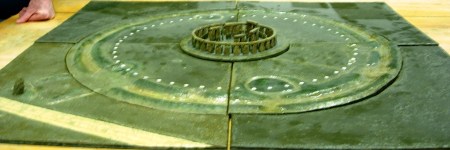
A Gerald Hawkins Model, Long Before Spinal Tap!

Model built for Gerald Hawkins at Boston University

Model built for Gerald Hawkins at Boston University

First off, let us say:

If, before reading this, you already had an opinion about Stone Number 11 at Stonehenge, or even if you have just thought of arguments against someone else’s opinion on the subject, then even if we never get to meet you, you are one of our favourite people in the world! Clonehenge loves you and henceforth wants to make itself a better blog for you.

As part of that effort, today we offer you some Stonehenge model history.  For those who are not familiar with his name, Gerald Stanley Hawkins was a British archaeoastronomer best known for his 1963 (1965? sources differ) book, Stonehenge Decoded, in which he advanced the now well-known ideas about Stonehenge being a precise astronomical observatory. We won’t go on more about that, but if you’re curious, Google or Bing or DuckDuckGo can help you out!

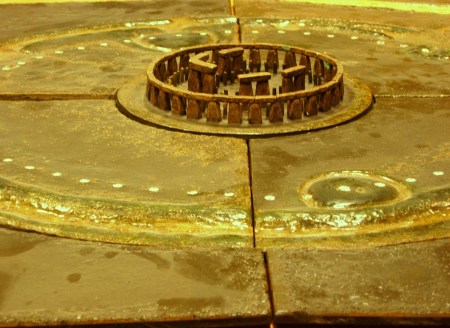
Shot of the model showing stone shapes

Shot of the model showing stone shapes

Dr. Hawkins was chairman of the Department of Astronomy at Boston University in the States from 1957 to 1969, and during that time he had the above model built for him to use in teaching undergraduate university students and for use in documentary films and television shows. The model is now at Boston University and we show it here by the kind permission of Quinn Sykes, the very generous help of Vance Tiede, and of course, the inspiration and tireless work of Hengefinder General Extraordinaire Mr. Pete Glastonbury (Is that the brilliant Wiltshire photographer and author of the must-have Stonehenge Guide ebook, you ask? Yes, friend, none other than!) . Clonehenge thanks you, dear sirs!

It is clear that this is a brilliant model of a sort very rarely built any more. These days archaeoastronomers prefer computer models for their demonstrations of how light would shine on ancient sites and what stars were visible where at various times of year. But back then, something like this was the only option. The description, by Mr. Vance Tiede, is as follows:

The model appears made of plaster and each quadrant measures roughly a 24″ on a side or 16 feet square in total area. The detail is very good, even with individual post holes to the NW of the Heelstone. Stone 57* is missing, as the model was made before the hole for a Stone 57 was discovered. Stone 11 is two times too big and the lintels should be removed.

And there it is:  Stone 11. Stop everything! What is he talking about?

Well, Gentle Reader, we thought you would never ask! It turns out that there is a controversy about Stone 11. Mr. Tiede, when we asked him about it, answered:

“…the two lintels shown above Stone 11 should be removed, as Atkinson pointed out, Stone 11 is one-half the width and height of the other 29 uprights of the Sarsen Circle. The is a highly significant astro-architectural detail as the total number of uprights is literally 29.5 stones, i.e., one stone for every day of the Moon’s Synodic Period of 29.53 days. Similarly, Stonehenge’s 30 Y-Holes and 29 Z-Holes together represent the Double Month (later used in Athens, ca. 500 BC) of alternating 30 and 29 Days (and still used in the Jewish Liturgical Calendar) also producing an average of 29.5 days.

So there is a short stone in the outer circle, Stone Number Eleven, and Mr. Tiede thinks it never had lintels. Another opinion we have run across is that Stone 11 was short on purpose, as Mr. Tiede says, but that it still had lintels, and may even show the marks where they would have fit. Meanwhile, Sue Greaney, Senior Properties Historian with English Heritage, says that recent laser survey analysis suggests the stone is short because it is broken, and therefore may have been just as large as the others at the start.

Who’s to say? But it’s something to keep in mind when you make a replica. Find a chart showing where each numbered stone is at Stonehenge and make number 11 short if you want.

Before ending the post we should add  that there is reason to suspect that this model had another part. Another model we have seen Gerald Hawkins use on a television show had an alternate center circle in which the stones stood pretty much as they stand today, a ruined Stonehenge that could be switched in and back out again to show differences between how it looks now and how it may have looked in its heyday. This may have included something similar.

Score? Because of its historic association with Dr. Hawkins, and the detail such as good stone shapes, the Aubrey holes and outlier stones being included, we award this miniature Stonehenge 8 druids! Well done, indeed!

One more thing to consider. Someone recently told us that the outer sarsens were once uniform in size and shape, and only the wear of thousands of years has given each its idiosyncratic shape. To us it is hard to believe that the beautiful oddities of Stonehenge were not a part of it in its youth, but who knows? Many little mysteries: Stonehenge continues to guard its secrets.

And there is your Stonehenge history lesson for the day! There is a lot to learn about this little pile of stones. Until next time, friends, Happy Henging!!

*As to the comment about Stone 57, see the correction in the comment below, by Mr. Simon Banton, who knows Stonehenge well.

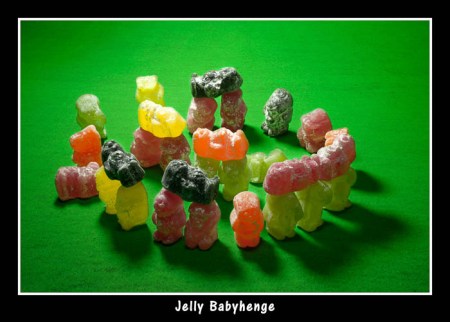
Babyhenge! The Jelly Kind (Best We Could Do)

Jelly Babyhenge, photo and henge by Dave Dummet

Jelly Babyhenge, photo and henge by Dave Dummet

In honour of the Royal Sprout, whether he lives to rule or to banish the monarchy, we wish him and his parents and grandparents good luck and good health!

Oh, and we hope you like our new look. It is here to stay. Comments are welcome.

Blobs of Compressed Wonder Bread: Stonehenge Replicas Hit a New Low!

Stonehenge, the grand and mysterious ancient ruin of Salisbury Plain, thought by some to be the spherical temple with many offerings located in Hyperborea, as mentioned by Diodorus, has now been reproduced in the medium of compressed Wonder Bread, which, if you are not familiar with it, is bread in the same sense that coconut-scented shampoo is fruit. But there it is: you can see it above. A crumby little Stonehenge. Sigh.

This is not to say that the artist, Milena Korolczuk, has not been very clever in creating her Stonehenge de pain, her megaliths o fara, her ancient stones van brood. Of course very few people would be able, or would want to create a careful little sculptural sketch like this from such an unorthodox substance. It is brilliant in its own way. We applaud her.

Score: 6 druid. Six tiny little crumbly stale druids. We had put them at the back of the shelf the first summer we started Clonehenge and forgot about them all this time, but here is the perfect way to use them. We don’t even have to brush the cobwebs or mouse dropping off of them. There, little fellows, off you go!

What’s interesting about this for our purposes, if you look at the page it came from, is that except for a depiction of the earth, all of the other sculptures are human portraits. Stonehenge is the only monument or icon, or anything. Which brings us, as always to the question that echoes down the centuries of posts amassed on this now millennia-old blog,

WHAT IS IT ABOUT?

No, that’s not it. What is it? Let’s see…

WHAT IS IT ABOUT STONEHENGE????

Yes, thank you. That’s the one precisely. What is Stonehenge doing to us as a species? Why do people stuck in Antarctica build snowhenges? Why do people drinking wine make cheesehenges? Why do people at the beach make little Stonehenges from odd roundish stones? Why do rich people build full-sized Stonehenges, and regular people build those odd one-trilithon henges? Why, when people build odd things from stone that don’t look like Stonehenge AT ALL, do they call them Stonehenges?

People laugh at us when we say that Stonehenge has a secret force that in a sense lays a psychic egg in the minds of those who loom at it, forcing them to reproduce it in some form at a point in the future. But tell us, oh you mockers and laughers, how do YOU explain it? What dark forces are at work that has created Stonehenges on every continent? That has forced scientists and artists and students and real estate agents and all sorts of people with little in common to reproduce it in countless forms? We leave this question here for you to ponder.

As for what we want, we ask for two things, two forms of Stonehenge now that we have our inflatable bouncy Stonehenge that once was only a dream. We would like to see: 1. A Stonehenge replica, no matter how small, on the International Space Station, and 2. We would like to see an inflatable FLOATING Stonehenge, preferably of a good size. These are our dream henges. See what you can do. You aren’t busy with anything important. You don’t fool us.

The world shambles on in strange lurches, its rhythms forced by powers we cannot imagine, and when we try to site ahead, we see only dim inexplicable shapes in patterns of motion that defy understanding. Someday we will actually write a humourous blog, but until then, dear readers, happy henging!


The New Stonehenge Project in Wiltshire, Your Legacy Sailing into the Future!

A mockup of the New Stonehenge, with permission from Mr. Colin Shearing.

A mockup of the New Stonehenge, used with permission from Mr. Colin Shearing.

It has been announced with great fanfare. Even a BBC article has announced the unveiling of the plans for this grand Stonehenge for the new millenium, its site only four miles from the original. The plans are unexpectedly elaborate, including a flooring of white quartz granite, a moat, gardens, and yurts for visitors who wish to spend the night.

Consider all of that, along with uprights that are to be of various colored stone types from around the world, eight gates, a white wall, and a visitor center and exhibition domes that will be built to look like Newgrange: and of all this the project leader, Colin Shearing said, “It’s going to look like Stonehenge as we believe it looked as it was new.” and “You can’t really experience how [Stonehenge] was when it was new because it’s old, so a new one would give you an opportunity to experience what our ancestors experienced when they went to the original one.

By “experience what the ancestors experienced”, does he mean a simulation of the way things look when you take psilocybin mushrooms, as our ancestors probably did? Because this New Stonehenge is beginning to sound more like an elaborate American cemetery than like anything resembling the original Stonehenge and its surroundings.

Still, that doesn’t mean that Clonehenge doesn’t fully support this effort! We do, most emphatically. This is the most ballyhooed and trumpeted Stonehenge replica project of all time, or at least for all of the centuries during which the Clonehenge blog has been operational.

The build-up and fanfare so far has been sensational. The plans are unbelievably elaborate and posh. The work is being done to have an environmental impact study of the planned site completed. Only one major piece needs to fall into place. It’s not so major, actually. After all, it’s just money. That’s right, folks, they lack funding. And that’s where YOU come in. The site says,

New Stonehenge is to be a Global Legacy Monument built to last 5000 years like Stonehenge itself.

 The New Stonehenge project has now devised a strategy whereby 30,000 families from around the globe become the project’s founding families; the people who really make this project become a reality.

This set of sponsors gets a brick of Preseli bluestone engraved with their names, or the names of their choice, and set into the wall around the monument. They and their descendants will have free access to the monument in perpetuity. They get a plaque to keep in their home, and, (drumroll), t-shirts! All for the tidy sum of  £700. If you’re interested, the information can be found here.

We may seem to be making light of it. (That’s what we do.) But the fact is, if you’re looking for a way to commemorate your name or the memory of a loved one, associating it with a monument that might still be standing thousands of years ago is an uplifting way to go. These names will be seen by people who visit for concerts, festivals, weddings, and other events, or just to see the monument and gardens. This Stonehenge will be like a glorious steam ship steaming ahead, not across the sea but across time, carrying the memory of those who had the foresight and vision to see it built and secured.

IF it is actually built. That remains to be seen.

Someday we would like to see a replica built that is truly based on Stonehenge as we see it now, imitating the shape of each stone and extrapolating from that to just how the original builders saw it when it was complete. This is not that project. But a large Stonehenge replica/sculpture in Wiltshire, so near the original would be wonderful to see. Maybe we could have a Clonehenge party at its opening! As things develop with the New Stonehenge, we will keep you posted.

Until then, friends, happy henging!

(Please read Colin Shearing’s comment below for a better description and explanation than we had room for here.)

New Stonehenge Cakes: A Quick Post to Catch Us Up!

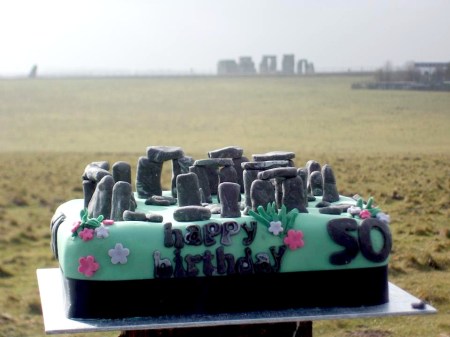
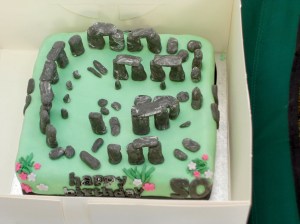
Stonehenge cake at Stonehenge Drove, spring equinox

Stonehenge cake at Stonehenge Drove, spring equinox

The Stonehenge cake, a sub-genre of the Stonehenge=you-can-eat category, is one of the most popular forms of small Stonehenge replica. And this brilliant photograph also falls into the rarified category of Stonehenge replicas AT Stonehenge, one of only three that we can remember, including Straw Echo Henge, and a film including a small trilithon model used by Stonehenge scholar Professor Richard Atkinson to demonstrate how he thought Stonehenge was built. Rarified company indeed! So far we know the henger of this cake only as Tracey’s sister, but we will NOT REST until we have wrested the truth from wherever it lies!!! Well, we might actually rest. One needs sleep, after all, and anyway, most of you (pretending here that our theoretical readers have any basis at all in reality) probably do not care a whit who made it. Still.

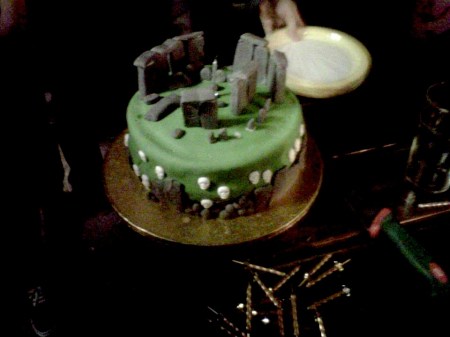
Another picture of the cake, made for the birthday of one ONj Le ChAØs

Another picture of the cake, made for the birthday of one ONj Le ChAØs

Quite a nice cake! Note the trilthon horseshoe facing the three-lintel stretch. One wonders, did they read Clonehenge first?? Score: 8½ druids, to match our former winner, which was made by Sharon Barwell of Iced Moments, Nottingham! Our thanks to Hengefinder Francis Stoner for bringing it to our attention!

While we’re on about cakehenges and Stonehenge cakes, here is another recently posted on the wall of the Clonehenge Facebook group, which is where you can see pictures of most of the things that end up here well before they, well, end up here.  (Yes, we know how bad Facebook is, how it’s killing our bees and forcing corporate seed ownership and cutting down rainforest, killing indigenous children, clubbing baby seals and fracking the land, thus poisoning our water [We MAY have got it mixed up with a few other corporations there. Never mind. We work in broad strokes], but, hey, it is also convenient, so we’re all in!) And anyway, much more important than anything in those parentheses, here is the other henged cake.

From the Archaeology Tea Club, made by Kaitlin Mckenna

From the Archaeology Tea Club, made by Kaitlin Mckenna

This cake is, obviously, lovely, and by all accounts it was scrumptious, too. The new twist here is on the sides of the cake: remains of those who were buried at Stonehenge, skulls and all! Clever, we must say. Our 8½ to the others forces us to give this one 8 druids, the buried remains almost making up for the limitations of space on top and the resulting limits to realism in henge form! Our thanks to Nicola Didsbury for bringing this one to our attention!

Lovely cakes, and proof that henging is nothing like an all-male obsession. It has been brought to our attention that it would be useful for us to post lists of all of the henges we have posted, according to category, for example, a listing called Edible Henges with categories under it like Cheesehenges, Cirtushenges, Cakehenges, etc. There must be some edible henges that don’t begin with the letter C! Carrothenges? Damn. Aaaanyway, yes, we should do that. We could list miniature outdoor henges, planetarium henges, woodhenges, gardenhenges, and so on. If only we were that kind of people, that Organised Kind of People! Alas, we are not. That’s why there is a search box at the right of the blog!

Our concession will be to list the cakehenges we have listed so far. Mind you, we have not posted every Stonehenge cake we’ve ever seen, so any list will be partial in the larger sense. We will proceed to do so, any day now, on the end of this post, so watch this space! We mean it. Come back in a day or so and be amazed!

Until then, kind friends, happy henging!

Addendum: Cakehenges We Have Known:

Cakehenges come in two main categories: a) Primitive lintels-over-uprights constructions, and b) sculptured Stonehenges. When we started out, we gave great scores to the first kind because we had never seen the second kind. We begin this list with the simpler variety and work up to the works of art.

1. A Cakehenge for Morris Dancers, posted in December 2009.

2. Let’s Call it Cakehenge, posted in July 2009.

3. Cupcake-henge: You Know You Want It!, posted in March 2009.

4. Cakehenge, Done Right!, posted in April 2009.

5. Gingerbreadhenge, An October Classic, posted in November 2009.*

6. Celebrating Sixty: A Battenberg Cakehenge (by our royal celebrity guest blogger!!), posted in October 2012.

7. Icing Henge: Perhaps the Ultimate Stonehenge Cake!, posted in January 2010. (With this one, we leap with both feet into the second category!)

8. Cakehenges and Word Fields, posted in June 2011. (Actually 2)

9. Best Stonehenge Cupcakes Ever!, posted in August 2011.

10. Let Them Henge Cake: Sweet Stonehenge from the Land of Robin Hood!, posted in May 2012.

and…

11. A Little Stonehenge, Cucumber, and Eleven!, posted in January 2010. (Its own genre of Stonehenge cake, based on Spinal Tap.)

*seems to us there have been more gingerbreadhenges, but enough is enough!

There you have it, folks! And that doesn’t include sconehenges or that one of French toast wrapped in bacon.

Compulsive Stonehenge Making: A Serious Psychological Problem!

(Attraction Dance Group Performance: Stonehenge makes its brief appearance from 16 to around 28 seconds into the performance.)

People clearly cannot help themselves! Lately the Stonehenge replicas have been showing up faster and faster, not just new replica, but new KINDS of replicas. The one in the video above, for example, is created as part of a “shadow dance”, in which dancers’ bodies create silhouettes resembling things, in this case Stonehenge, as well as the Tower Bridge, and so on. (But who cares after Stonehenge, really?)

Another recent television Stonehenge replica bit appeared on the Conan O’Brien show, when the musical group Fall Out Boy did a Spinal Tap tribute that included the legendary miniscule trilithon being lowered onto the stage:

Now, let us explain you a thing: the more involved you get with Stonehenge replicas, the less enthusiastic you become about Spinal Tap. Every time a Stonehenge replica is mentioned, some tiresome wag, impressed with his or her own cleverness, has to make a remark about it being crushed by a dwarf or quote lyrics from the song in the movie. If we had time we would do a blog of those comments and title it, Adventures in Nope. Still, we have to count the above performance as an appearance of a Stonehenge replica. Grudgingly.

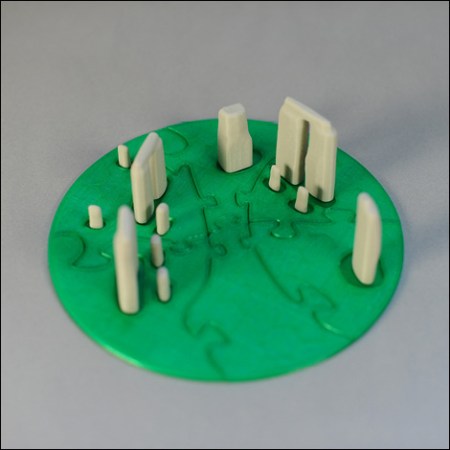
Meanwhile, we have been seeing more small replicas: a Stonehenge cake, a careless foamhenge, a school project replica, a Stonehenge of wotsits, and, inevitable now that 3d printing is all the rage, a 3D printed Stonehenge!

3D printed Stonehenge by MakerBot

3D printed Stonehenge by MakerBot

There is also a small, rather Picasso-esque Stonehenge someone’s mum made for her garden, but permissions are pending, so it will have to be posted later if at all.

We are now convinced that the compulsion to make Stonehenge replicas is emerging as a serious psychological problem, and that it should be listed in the DSM as Compulsive Henging Disorder. By early recognition of this burgeoning syndrome we might be able to stem the tide of Stonehenge replicas of every material and description that could inundate the world of the future, a tsunami of Stonehenges threatening to overwhelm the world as we know it and create a Clonehenge apocalypse of unimaginable proportions!!!

What? Yes. Yes. It IS a load of bollocks, actually, but we have to fill the blog somehow. The point, however, should not be lost: something is forcing people to build Stonehenge replicas and making them think that it is their idea. Is it possible that Stonehenge itself is an alien life form seeking to reproduce itself by infecting the human mind like a virus or like the fungus that infects ant brains and makes them climb to a high point where a bird is likely to eat them? Is it possible that by the end of this sentence we will decide it’s time to end this post?

Possibly! It remains to be seen!

Until next time, friends, happy henging!
Brazilian White Quartzite Stonehenge on Live Moss, from Brazil: Small but Fine!

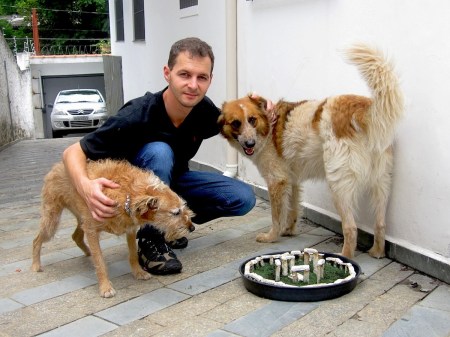
Sergio Greif, henge, and curious dogs

Sergio Greif, henge, and curious dogs

Olá! We greet you from Brasil, como Brasileiros! Yes, it is literally true that we are in Brazil, given the modern usage of the word literally! Poor word, it has a bad case of inflation. But—back to the henge! (Great titles for a book, there: Back to the Henge. You’re welcome.) The miniature Stonehenge in the picture above was sent to us by charming reader Sergio Greif of somewhere in Brazil. We have been meaning to post it since February, but, well, we didn’t, so now we are. (Is it just us, or do those dogs look like they are eager to celebrate the solstice?)

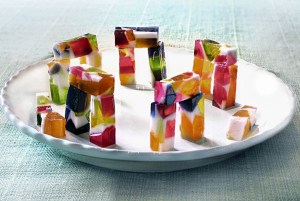
This is not our first henge from Brazil, not even our second. Very early on, we posted the beautiful mosaic fruit jelly henge:

fruit jelly stonehenge

And about a year and a half ago we posted our first South American permanent replica in São Paulo, Brazil at the Center for the Study of the Universe (!!). So Brazil appears to be a pretty happening place, hengewise.

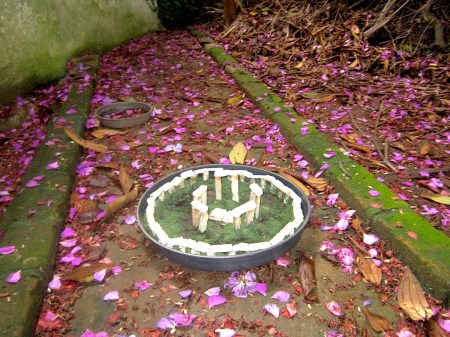
Quartzite henge on moss

Quartzite henge on moss, another view, with fewer distractions 😉

As some of you may know, we had two email apocalypses, and unfortunately the original email from Mr. Greif has been lost, but part of it was preserved on the Clonehenge Facebook group and read as follows:

Here is a Brazilian Stonehenge, made in white quartzite and natural live moss specifically at December 23, 2012. Hope you like it.

 all the best, Sergio Greif

As you can see, we don’t actually know much about this henge, the why of it, especially, but it is lovely, and we’re curious about the source of the quartzite. Did Mr. Greif somehow cut those pieces to size? Were they left over from some other project? The live moss is certainly a nice touch, bringing it close to falling into the miniature garden category that has become so popular.

Score? We give it 6 druids! That might seem a little high to some, but this thing has a charm about it, and we like the presentation, with the flower petals in one picture and such cuteness in the other (referring to the dogs, of course. Well, mostly… ) Thank you, sir. Some very nice henging going on in your country!

While we’re on the topic of smaller Stonehenge replicas, the Henge Collective is still hard at work, and posted a set of pictures depicting Fimohenge, a small henge of a kind of modeling clay. Eventually, we are told, this model will be the basis of an animated Henge Collective movie! The planet holds its breath in anticipation. In the future, all art will be henge art.

That is literally true!

Keep sending in your pictures, or posting them on the Clonehenge group or page on Facebook. You can even find us at @Clonehenge on Twitter. We haven’t made the move to App.net, but we will if people start switching over! We go where you go, to bring you the henges you need, when you need them!

Until next time, friends, happy henging!
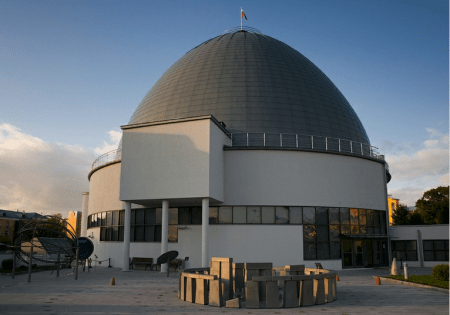
Stonehenge at the Moscow Planetarium: Our First Russian Henge!

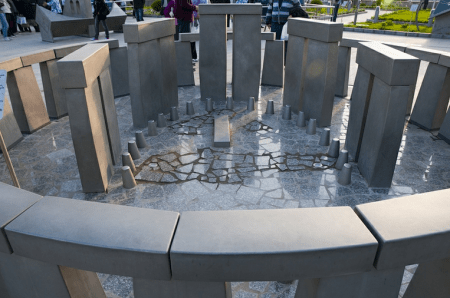
Stonehenge replica at the Moscow Planetarium

Stonehenge replica at the Moscow Planetarium

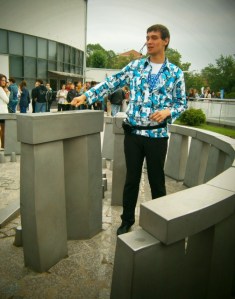
We don’t mean to brag (LYING!!!), but on our page of the 76 large, permanent replicas, we asserted, “Surely Russia and India must each have at least one!” Well, guess what, you sweet little hengers? We found one in Russia, OH YES WE DID! Well, sort of. It is permanent, but calling it large might be stretching the truth. A bit. As seen here: (What shirt?)

waist high

waist high

In the past we have pointed out, for the benefit of would-be hengefinders, that planetariums are great places to look for Stonehenge replicas, because their designers and builders like to reference mankind’s observation of the stars throughout history and prehistory, and, right or wrong, Stonehenge is understood by many to have been an astronomical observatory. Great justification for science-types to let their mystical side out a little!

The Moscow Planetarium Henge is a  fairly standard planetarium replica, in the precise placement and clean lines of the stones. It is a little stiff and overly uniform, although we must give them credit for noticing the basic shape of the stones, and including not only the inner trilithon horseshoe, but also the bluestones inside it. They did, however, skip the inner bluestone circle, which is a shame. Afraid of tourists tripping over them, perhaps.

Still, we like it overall, an eye-pleasing take on the idea of what Stonehenge may have looked like originally but leaving out a couple of lintels and part of at least one sarsen in order to give visitors easy access to the inner space. Letting people walk around inside it is a plus!

Moscow Planetarium and replica

Moscow Planetarium and replica

Score? We award 8½ druids for this lovely bit of sculpture, to which we might give the title Stonehenge as Designed by Steve Jobs. If you go to Moscow, it’s worth a visit!

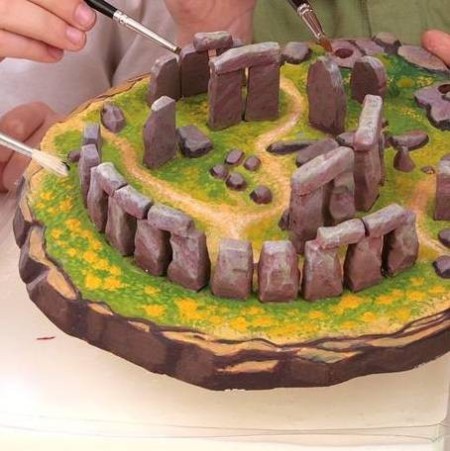
Before we go, we’ll add a photo of a Russian Stonehenge-building craft set from toy website Igranadom.ru .

Stonehenge craft set

Stonehenge craft set

We doubt sets made at home will look like this, but the makers did get a nice result here! Worth 6½ druids, we think. It’s good to know that Russians make Stonehenges just like people do all over the world. Stonehenge replicas make all of us family. This could be the key to world peace! Don’t forget to hug a henger today!

Coming up soon (ha ha jk!) we have an enigmatic Stonehenge replica in Illinois, USA, the new one in Alabama, USA (eventually), some small replicas sent in by readers (Thank you! Send moar!), and eventually another European henge-ish public sculpture. Judging by the number of people who search “How to make a Stonehenge model” and thus find Clonehenge, there won’t be a shortage of things to post on this blog for a very long time to come! Remember, keep your eyes peeled for Stonehenge replicas, and until next time, friends, happy henging!
P. S.: Asking for opinions: should this one be added to the list of large permanent replicas, or is it too small?

Radio Clonehenge, Another Step on Our Path to World Domination!

James McCormick's Stonehenge, from Rushing's website

James McCormick’s Stonehenge, mentioned in the interview

GUYS! We were on the radio! \o/

Yes, yes, it was back in February, but we haven’t posted it until now, because of reasons. Reasons like, well, we forgot to see if the interview was online. But now we remembered! You can hear just the interview here. Or you can hear the whole show here: CLONEHENDGE . Yes, they spelled it that way. No, we don’t mind, and it’s possible they are pulling our legs (or, as we call them, uprights). Our interview runs from shortly after the 13 minute mark to just after the 25 minute mark on the show.

Peghenge, henge and photo by Felder Rushing

Peghenge, henge and photo by Felder Rushing

It was fun! Our thanks to peghenge creator, Felder Rushing! And to all, happy henging!