Watermelonhenge, or, Where the So-Called Monkey Gets His Smile

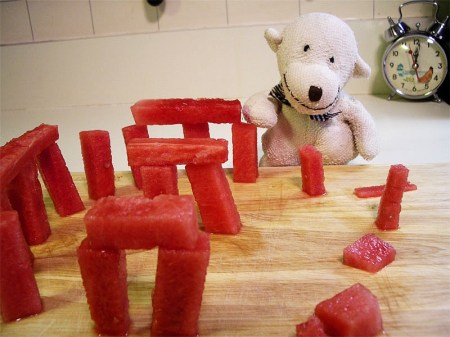
watermelonHenge 2

henge and photo by monkey, with permission

The season is over in the northern hemisphere, but here it is–watermelonhenge, or, as monkey (a white stuffed monkey who looks curiously like a dog) calls it, watermelon stonehenge. And as monkey says, “everybody loves a good henge.” Especially when it’s tasty! He offers a tutorial here. And we belatedly discovered he has his own website here.

Of course this is not the only watermelonhenge on teh intarwebs (here’s one),  but it is the nicest. Monkey seems to benefit by being a world traveler and possibly having influential friends. It’s hard to tell about someone who uses a vague etymological term for his name. He’s not our first monkey with a henge, by the way. Some of you may remember this sweet children’s henge with a mother and child monkey pair along with a dog, which is, frankly, what monkey still looks like to us!

But on to the henge–nicely done for a foodhenge. Only two trilithons in the middle and not many fallen uprights, but at least he got the outer circle and didn’t just make it a ring of trilithons. That’s so last century! Anyway, we make allowances for foodhenges, as you know. And that incredible smile on monkey’s face tells us he is very happy with how the whole thing turned out.

Score: 6½ druids. We can see how someone clever with a knife could make quite a nice little watermelonhenge for a party plate. We recommend tapering the uprights so they’re smaller at the top. Why not give it a try? Look how well this fellow did and he just has fingerless stumps for hands! Well done, monkey! Let us know if you do a bananahenge. We already have a dog bone henge.

[And if you want to serve a non-henge watermelon plate for Halloween, we suggest this.]

Share

The Colour of Magic; Virgin Sacrifice Gone Awry!

COM clonehenge 3from Youtube

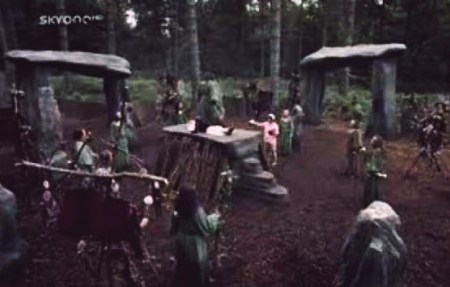
We have long thought that if there is a Heaven (and we could get into it), it must consist of new, unread Discworld books, and friendly people who like to discuss them as much as we do.  Discworld author Terry Pratchett has given us many hours of happiness, and we were bowled over to find, upon renting the Discworld movie The Colo(u)r of Magic last week, that it includes a Stonehenge replica.

On the Discworld, stone circles are the computers and druids are the IT specialists and hardware consultants. (Yes, there is a Discworld and Pratchett Wiki. Get over it.) Here’s a druid line from The Light Fantastic: “They’re having trouble with the big circles up on the Vortex Plains. So they say, anyway; I wished I had a bronze torc for every user who didn’t read the manual.

In the scene above, Twoflower, the Discworld’s first tourist, is intervening in a druid ritual, for although he appreciates its ethnic charm and primitive simplicity, he objects to the actual killing of the virgin . . . The druids aren’t thrilled to have him interfere, and the plot carries on from there.

Silly stuff, definitely, but as always Pratchett uses silly stuff to address serious issues sideways and to lampoon cliches and human foibles. Score for this replica: 6 druids. [Later correction by one P.G.: 7 Wizzards and an ArchChancellor] It’s just some trilithons, but one of those  druids is awarded for the gentle jab at society’s  romanticising of the henge builders and users. But without all that romanticising there wouldn’t be so many replicas, now, would there? And then where would we be?

Candyhenge, or The Little-Known Druid Years of Queen Frostine

candyhenge

photo by Toy Master, with permission

[note: it has come to our attention that our British friends may not have shared the joys of CandyLand as children. It is a board game peopled by fantasy characters like the beautiful Queen Frostine and the evil Lord Licorice. It was often the first game for children because the characters advanced by colored cards matching to colored spaces, with no numbers. And the story inside the lid of the game was some people’s first introduction to the fantasy genre.]

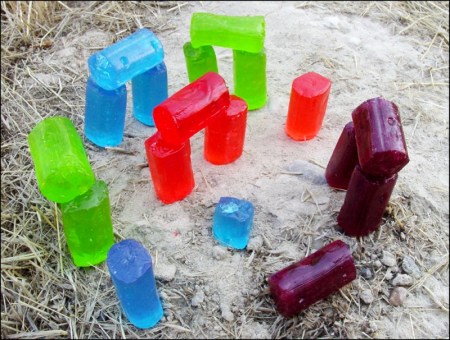
So here’s the plot: Queen Frostine makes an impulse marriage with the Jolly Rancher and together they decide to memorialise their love with a Stonehenge replica. Little do they know that over in the next kingdom a jealous Lord Licorice is breeding a race of sugar-eating bats . . .blah, blah . . . and then everything went horribly wrong! . . . blah, blah . . . happily ever after.

Who says we can’t write a screenplay? The truth is, plans for a Candyland movie do exist, and we doubt they’ll think of the exciting henge angle without our help. When someone sent us a link to this candy replica, we saw our chance to do some hinting. (We wanted Terry Gilliam to direct, but sadly it is not to be.)

Back to the henge. Ann from Heritage Key sent us the link to the picture, which is probably the most recently-made item in the Heritage Key Flickr group. We do like the colours and of course the juxtaposition of food on the ground adds that bit of squeamishness that can substitute for drama in a pinch. Score: 5½ druids. It’s just a ring of trilithons, after all, and it doesn’t quite have the charisma of sausage henge.

We think Hugh Laurie would make a great Lord Licorice! When you read this post, Hollywood movers and shakers, give us a call. We have more henge-movie ideas you’ll love!

Pinball Henge, North London

Pinball henge

photo by Feòrag NicBhrìde, with permission

Oh, what fun–a bit of guerilla henging with a tantalising hint of a celebrity connection! This is great stuff.

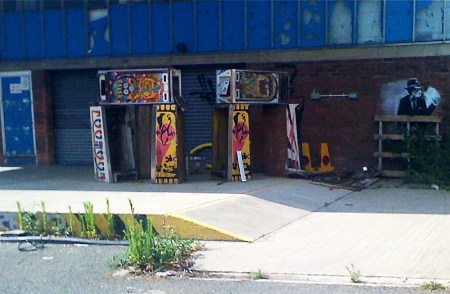
Feòrag, our sender-in, says, “I spotted this interesting construction on the way to the Wenlock Arms the other day. It’s located in a yard at the junction of Wenlock Road and Micawber Street in Hoxton, North London.  Google Maps shows the yard still in use and full of trucks. There are no vehicles in the Street View, but none of the graffiti either, so I think the yard has only fallen out of use recently.” [ Note to U.S. readers: The British use of the word yard has a much more industrial/business-related connotation than it does in the States.]

It is just two trilithons of pinball machines, but its appearance in an abandoned freight yard is intriguing. And our alert hengefinder continues: “Located on the wall is a piece of graffiti featuring a police officer with a ghetto blaster, which looks suspiciously like a Banksy to me – he’s known to be active in the area – though much of the area is tagged ‘RESO’.

See that bit of wall art at the right of the picture? It does have that Banksy look, doesn’t it? Then cast your mind back to Glastonbury several years ago and Banksy’s masterful Stonehenge replica constructed of of port-a-loos. Could it be that he revisited that concept with this group of  machines? If so, we don’t doubt it has deep inner meaning. Too bad we aren’t deep. We must leave such intellectual discernment to our readers!

As happened with Doorhenge, the guerilla art aspect increases the druid score. We think this is an exciting thing to have pop up among the city streets. May the trend continue. 7 druids, 7½ if it really is Banksy’s! And extra thanks to Feòrag, for taking the time to stop although she was headed for the Wenlock Arms. Now that’s what we call dedication!

Let’s Call It Cakehenge

giraffe cakehenge

photos and hengery by Bill Bevan, with permission

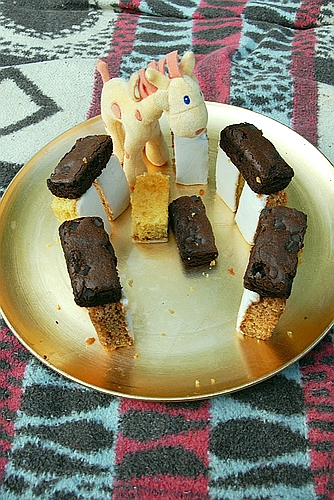
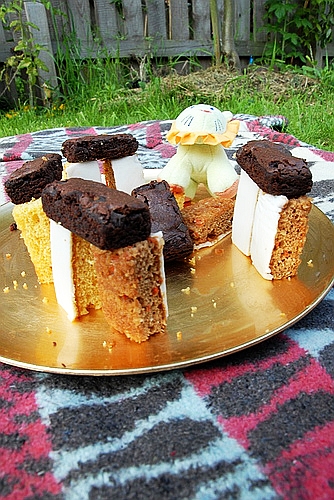
Oh, why don’t people take ancient monuments seriously?! The way we do. Heh. Well, here is a stuffed giraffe examining a Stonehenge replica (of the just-a-few-trilithons variety) that was made of lemon slice, carrot cake, and chocolate brownies, set on a golden plate, which is set on . . . is that a faded beach towel?

Our studied analysis: While he projects a mood of play, the henger here has a serious agenda, suggesting that the toppled stones at Stonehenge were toppled by the curiosity of ancient northern woolly giraffes that lived in the times of the mammoths. This discovery pushes the age of the building of Stonehenge back to the ice ages. The alternative at which he barely hints is that the stones were actually erected by ancient sentient giraffes, a branch of the family which has since gone extinct!

Exciting stuff. Almost too controversial for our humble blog, which is simply a bit of light entertainment. But wait, there’s more.

lionGiant crosses between lions and daisies also appear to figure into the theory! This is way over our heads. Could Stonehenge have been a corral for megafauna? And what about the cake? He gives some cryptic explanation here. Warning: one or two of the close-ups of trilithons seem barely decent!

Score for this henge: 6 druids. Why six, you say? Sometimes things are just so bad that they’re good. And we think he knows it. Quote: “My 14 week old daughter thought Spongehenge was pretty funny, though that might have been wind!

Bill Bevan’s impressive photos of the real Stonehenge can be seen here, and are worth a look. Click on the word Gallery at the top for more amazing photos from around the world.

Scouser Solstice Sconehenge

1245316624-Sconephoto from article in Click Liverpool

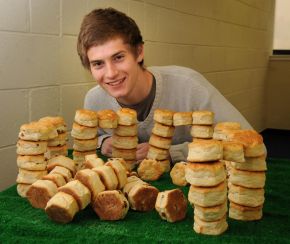
We bring you this youthful venture in the series-of-trilithons tradition, our second sconehenge (see the first here).  We can’t determine from the article if the young henger, Mathew Growcoot, baked these scones or bought them, not that it matters a great deal. He’s an artist, not a baker.

It looks very much as if he originally set up a circle of trilithons and then two trilithons fell over or were pushed. Recognition of the fallen stones is good. On the other hand, too bad the scones were anchored with toothpicks. We would have awarded an extra druid if it had been by mortise-and-tenon in the manner of the original.

But, alas, although we appreciate the lad’s intention and enterprise, it is difficult to award a high score for a circle of trilithons. This is what we might expect from an American student who never looked twice at a Stonehenge photo, not from a Liverpudlian who must surely have learned a bit about Stonehenge somewhere along the line!

Still, we must encourage youthful henging. (And we do appreciate how, in this picture, he is subtly using his head to represent the rising of the sun!) Score: 5½ druids. And negative druids for the writer and his “half-baked” and “piece of cake” puns. Come on, man–some of us eat while we read!

Self-Promoting Bookhenge

solving stonehenge

photo by akent, sent in by Sean Johnson

You know how when you get too many calls promoting a politician you like, you start to think you may not vote for him, or when there are too many annoying adverts for a product, you swear you’ll never buy it? Well, on sites related to Stonehenge lately, plugs for the book  Solving Stonehenge have become so frequent and insistent that we resolved to ignore them as much as possible.

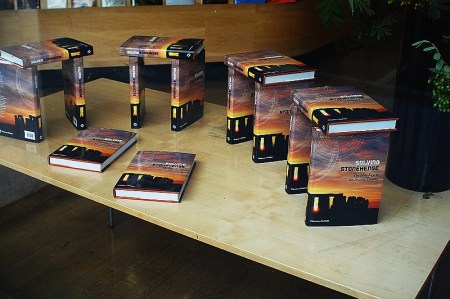
Then someone (possibly related to the author) sent us this picture and we found ourselves in a bind. Do we ignore a perfectly good replica photo or do we post it and fall into being additionally annoying to people already wearied of hearing about this book? We came up with a brilliant solution:  post it and whinge about it. A good whinge now and then is therapeutic.

Don’t get us wrong–this could be a decent book for all we know. There are so many people who have come up with a brilliant theory for what Stonehenge was and did that one more doesn’t hurt anything. As a matter of fact here’s our theory: Stonehenge was built to generate as many completely bonkers theories as possible. Maybe we should write a book!

Score for this replica: 4½ druids (it’s just trilithons). Wow, we feel better! What else can we whinge about?

Kerbhenge

kerbhengephoto by Tom Ryan, aka mint imperial, with permission

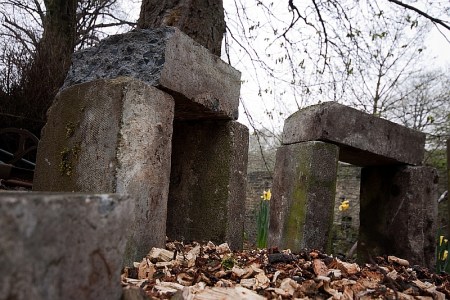
Somewhere in Britain, after removing decorative standing stones (!) and doing other work in his garden, Tom Ryan decided to build some trilithons with the debris. You see the result above.

What we like most about this photo is the angle. He manages to make these concrete chunks look like august and ancient stones. Impressive.

We won’t go on and on about this one. A nice whim-of-the-moment garden replica, which he tells us is dismantled already. Score: 6 druids. The season is young, gentle readers. Every garden needs a henge. Send us yours!

Deutsches Museum, Stonehenge Model

german-museumphoto from the Deutsches Museum website

Not much info on this one. Like many or most astronomical museums, planetaria and observatories, the astronomical section of the Deutsches Museum in Munich includes a Stonehenge model. It appears to include at least some of the sarsens with lintels in the circle, the horseshoe of trilithons, and bluestones, plus a rather nice lighting effect simulating a sunrise or sunset.

Unfortunately we know little else about it–materials, who built it or even its size. When you’re in Munich in September or early Oktober, how about stumbling in there before you get completely blind and getting us some information? We’d appreciate it and you might take home memories of something other than bier. Naah, who are we kidding? You won’t remember it. So email with the info while you’re there, please!

Score: 7 druids. Nicely done from what we can see.  We’re still looking for a photo of the replica at the Granada Science Park in Andalucia. If you know anyone near there or going there, bribe them for us, please! We’re still looking for our first Spanish-speaking Stonehenge.

Raven Hill Discovery Center Stonehenge, Michigan

ancient-world

photo from Cheri at the Raven Hill Discovery Center, used with permission
(Stonehenge replica on the left and moai on the far right.)

At present our Stonehenge replica contains just the ‘bluestones’ of Stonehenge,”  a note from Raven Hill tells us. Although it may look like a simple stone circle, great care has gone into stone placement, and the heel stone, altar stone and inner horseshoe are all represented.

It is part of the 30-acre Ancient World section of RHDC, which includes this Stonehenge, a Mayan ball court, an obelisk, a house foundation as from Skara Brae, and other things including–but of course!–a moai, or Easter Island head.

Now normally we lightly mock the moai/Stonehenge combination, using the penguin/polar bear analogy used here before, but we will cut Raven Hill some slack. We know it isn’t easy to attract the attention of the young. You might say Stonehenge and the moai are the Brad Pitt and Angelina Jolie of stone monuments. If you’re trying to reach kids, what could be better than putting both on the cover of your magazine, so to speak?* And including Skara Brae is a point in their favour!

Score: 5½ druids for the care and knowledge that went into this replica, despite no trilithons or ditch and bank. Raven Hill looks like an excellent place for a family day or several family days a year. See the comments for more info on this interesting and informative place!

*This does not let other Stonehenge/moai combiners off the hook. Sorry!