
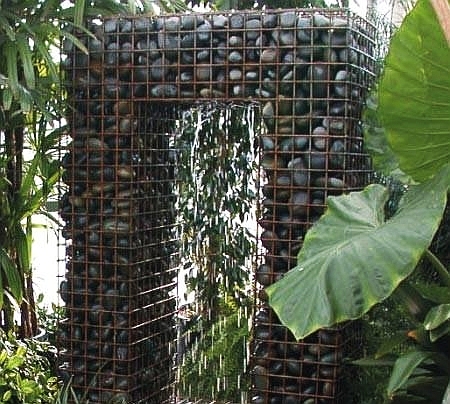
photo from Opulent Items website
It’s not for every garden. But look: you do not need to erect huge stones in order to have “this aquatic Stonehenge replica” in your garden. Just assemble the metal encasement and fill it with the Mexican pebbles. Voila! Just like a Stonehenge trilithon but even better because there’s a pump cycling water through it to create a constant waterfall. Heh.
So what if it looks like a standing gabion? [Admit it–you learned a new word just then!] The website says: “The serene sights and sounds of the flowing waterfall is a gift to any patio setting. . . . Ideal if seeking very unique outdoor decor ideas.” It is very unique, and its sights and sounds is a gift.
This isn’t our first Stonehenge water feature. Remember this? After seeing this one, we almost feel we should have given that one another druid or two. In fact, if this weren’t called “Waterfall Stonehenge” we probably wouldn’t even be looking at it. But it’s good to have a post about something like this once in a while, isn’t it? Pointing out lameness can be fun if done in moderation.
Score: 3½ druids, and that’s generous. Not, we hasten to say, that it might not be just the special feature one needs for that certain garden (after all , it is only $5,500), and a miniature version might even be a charming touch for some of those miniature gardeners out there. You know who you are!
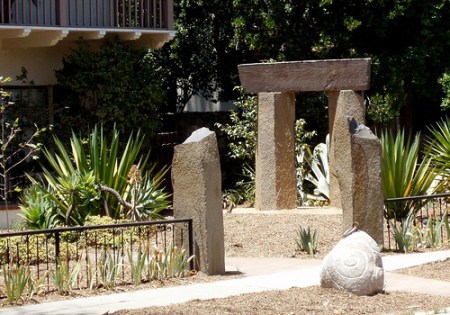 photos by
 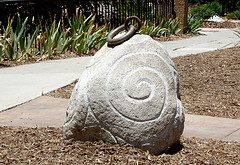 Mr. Burrow likens the spiral on the hitching stone near the trilithon to the Anasazi snail design, but some of our readers may be reminded as we were, of the
  photos by
  The replica at the top of this post, seen in glass on top of the cabinet, is one of the cork models by Henry Browne,
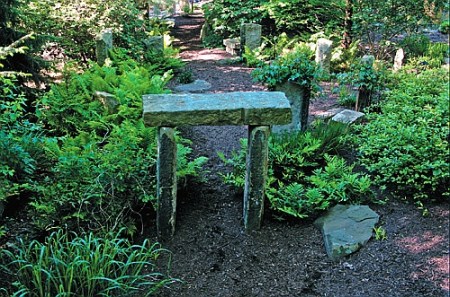
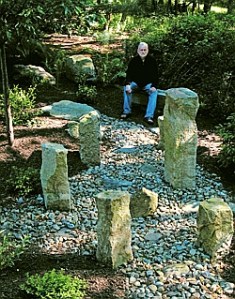 The “henge” includes five other uprights. We include it to show that you can incorporate Stonehenge-like elements in your garden without being too literal about it. It’s not a real Stonehenge replica, but it certainly looks like a cool, peaceful place to be on a hot summer day.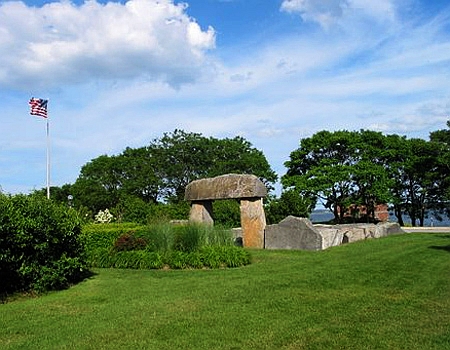
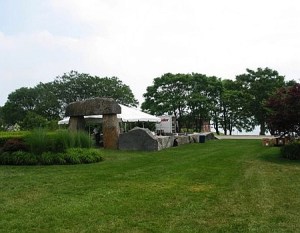 It’s hard to make out the entire construction. The single trilithon is accompanied by what appears to be a rectangular space enclosed with low standing stones.
 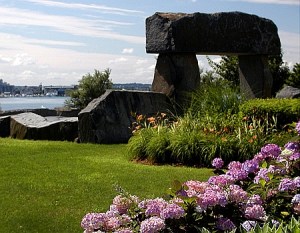 Our Boston replica, however, has the advantage of an ocean view. Looks like a lovely place to spend an hour or two, but is it a Stonehenge replica? It is another example, like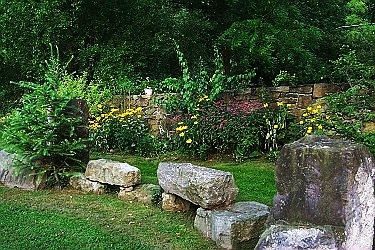
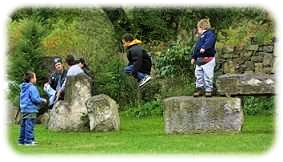 The site says: “The mission of Stonehedge Gardens is to provide a healing, sacred, inclusive environment for the cultivation of personal and community transformation and wellness through the gardens and nature, the arts and holistic education.” The gardens are said to be beautiful, but why Stonehedge? Perhaps to meld the spiritual implications of Stonehenge with the garden word hedge. We do think they spelled it that way on purpose, unlike some. (See the 3rd comment below for the real explanation.)

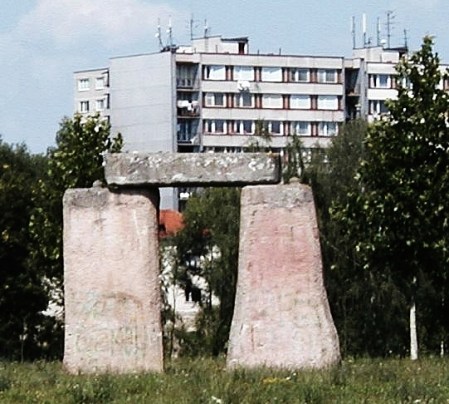
 The second is a trilithon (Yes, we have learnt to spell it properly!) at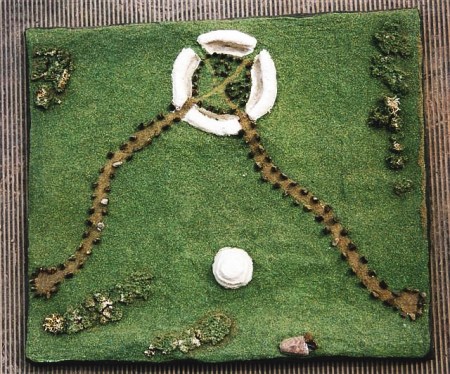
 CLONEHENGE
