Kansas State Fair Crinoid Stem Stonehenge Models

crinoid 4photos by Ace Jackalope, used with permission

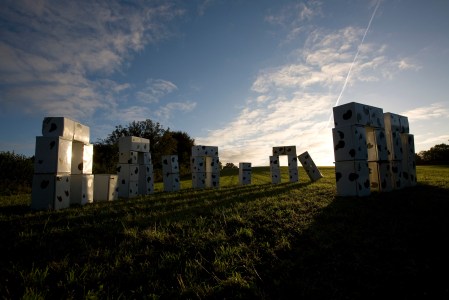
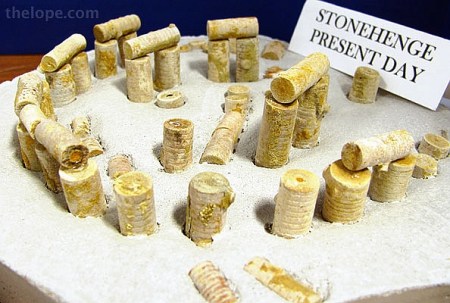
Well, it was going to be watermelonhenge today, but after encountering some technical difficulties we decided to go with this brilliant entry from the 2009 Kansas State Fair: Stonehenge models made from fossil crinoid stems (crinoids are a kind of sea animal that resembles a lily, more or less, many of them anchored to the sea floor by stems). As our new friend Mister Jackalope posted, “Morgan Reves of Pottawatomie County, Kansas, treated the public to this special exhibit: two models of Stonehenge – past and present – made of fossil crinoid stems.

Why fossil crinoid stems? We don’t know, but they are common. Presumably Morgan had a bag of them sitting around and was struck one day, as people are, with the idea that she (or he?) could make little Stonehenges with them. What we love is that the two models on display show the monument as it was, or is thought to have been, at its fullest stage, and in its modern, partially toppled condition (seen above).
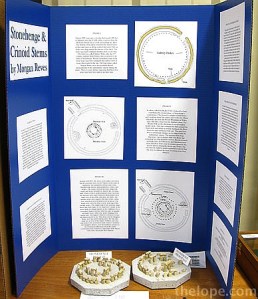
crinoid 2As you can see on the left, diagrams and explanations of Stonehenge, and possibly of fossil crinoid stems, accompanied the models. Was this a science fair project or some other kind of display? We can only speculate, but we’re glad it was there to add to the weird materials list for Stonehenge replicas!

As relatively common and obvious as fossils are, they were bound to be noticed and used by the megalith builders at least once. While there may be others, the most famous real megalithic site to feature a fossil is the long barrow at Stoney Littleton (yes, they really give places names like that over in Great Britain–Tolkien didn’t make that up!). You can see a photo of the fossil ammonite on a stone at the front of it here. There is no chance that the builders didn’t see it, but what they thought of we can never know.

Score for these crinoid stem henges: 6½ druids. Fine work, Morgan Reves! The diagrams pick up the features, like the bluestones and the ditch and bank, that the models don’t show.

We end with a quote from an email we received from Ace Jackalope himself: “There’s a blog just for Stonehenge replicas? Surely the Internet has now fulfilled its greatest possible potential!

Yes, it’s true. Just as in the Vonnegut book The Sirens of Titan humans were created in order to build a replacement part for a Tralfamadorian spacecraft that had broken down near Earth (and Stonehenge is a message in Tralfamadorian), so these internets were built  for this and this alone. Everything else is simply an outgrowth of this ultimate process. Enjoy!
Ohio’s Earthworks and Stonehenge for a Day

ohio

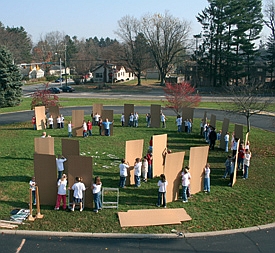
Miller Elementary in Ohio, creating ‘Cardboard Stonehenge’ © Ray Picton 2006

It’s a big week for the Newark Earthworks Center in Newark, Ohio. A pilgrimage (Walk with the Ancients) is taking place along a long-lost 60 mile road that runs straight as an arrow across the Ohio landscape, to end at the Newark Earthworks, the largest geometric earthworks complex in the world, with a day of celebration. We’re so glad to see this amazing site and its native builders getting notice. We lived there for a short time 20 years ago and couldn’t believe it wasn’t internationally famous. Maybe its time has come.

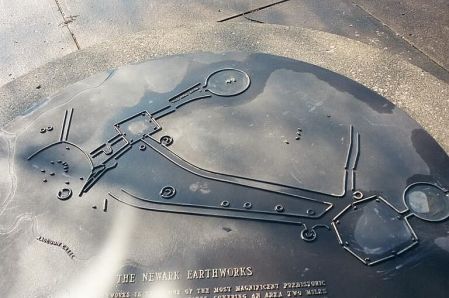
Newark_map

(our own photo–please ask permission) This is a partial map of the original earthworks at Newark, Ohio. The Great Circle is in the center at the top.

So how can that tie in with Stonehenge replicas? It’s more likely than you think! And that is because of one Ray Picton, whose Newark/Stonehenge story can be seen here. He wound up in a Fulbright teacher exchange that took him from Salisbury, England to Newark Ohio. Inspired by Stonehenge and the amazing site at Newark, he and his exchange teacher had their primary school classes do comparative studies of the sites. And of course for the classes in Ohio this inevitably meant Stonehenge replicas.

Apparently many were made, but we could only find photos of this unique effort in which students went out o the lawn with large pieces of cardboard and created a Stonehenge replica formation. (Why couldn’t we have done things like this when we were in school?!!!?) Needless to say we love Mr. Picton’s picture at the top. What a great effort!

The Ohio students became more aware of the significance of the site in their own community. Meanwhile children in Salisbury, too, were learning about the amazing earthworks at Newark as well as their own great monument.

Having been at Stonehenge and Avebury and Newark, we can tell you that there is a striking simlarity especially between Avebury and one part of the Newark complex called the Great Circle. In fact the Great Circle qualifies as a henge in the strict sense, which involves ditches and banks rather than stones. It’s not as large as Avebury, of course, but it is a sizable circle with a mound in the middle, presumably for ceremony. When we lived there, native wildflowers bloomed on the grounds within the circle in  spring.

We heartily applaud Mr. Picton’s successful efforts “to embed the comparative study of the two sites into the curriculum at both schools.” This shows what a difference one person can make. And we cannot leave the topic of the Newark Earthworks without mentioning Dr. Brad Lepper who has been involved at Newark since we lived there and heard him speak many years ago.  It is largely by his work that the road of pilgrimage being walked this week was discovered.

Score? Are you kidding? We award the rare 9 druids to this living Stonehenge made of cardboard and children. We know that in recent news people have been complaining that some awards are given undeservedly, but we think that work that gives hope and paints a better future for our children deserves the highest rewards of all!

P.S.: Newark Earthworks Day is this Saturday, October 17, 2009. If you can be there, we highly recommend it!

Share

Gingerbreadhenge: An October Classic

gingerbread 2henge and photo by The Dude, with permission

Cold weather is arriving here in Clonehenge Land. We may have our first frost tonight, and may have to run the furnace for the first time when we get up in the morning. And as the cold nights and chilly mornings roll in, thoughts run to warming comfort foods like gingerbread. Not the cookie kind, mind you, but the nice spicy cake kind, served warm with homemade whipped cream and maybe a cup of cocoa or Irish coffee for those so inclined.

What’s that? We’re wandering off the subject of Stonehenge replicas? Sorry, we were carried away by cozy reminiscing! Gingerbread is not an unheard-of henge material (what is?). Other gingerbreadhenges do exist, but most are the cookie kind. This appears to be a nice straightforward cake type. We think it took a little work.

It’s just the sarsens, rather too many, with a circle instead of a horseshoe of taller trilithons in the center. Still, a nice one as foodhenges go. Something like this could be decorated with some leaves and berries for a holiday centerpiece this Christmas. Keep it in mind and send us a photo!

Score: 6½ druids. Thus do we welcome the colder days!

Share

Asian Cupboard Henge: Stonehenge-Generated Art

syjuco stonehenge

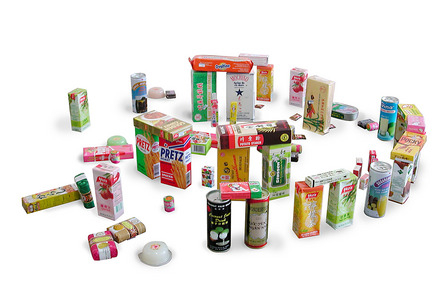
“Pacific Super (Stonehenge),” by Stephanie Syjuco, used with permission

Stonehenge as a basic form for art is a recurring theme on Clonehenge. The Whitney-exhibited artist whose work this is, Stephanie Syjuco (her website is here), was born in the Philippines and lives in San Francisco, and one of her themes is the interplay of eastern and western cultures as it manifests in the marketplace as the average person experiences it. Her statement for this artwork:

Description: downloaded an image of Stonehenge from the internet and used it as a template to go shopping at Pacific Super, a chain of Asian supermarkets in Daly City. I chose products based on how their shape and size would “fit” into my own recreation of Stonehenge. The resulting model is made of mainly inexpensive food products imported from China, Japan, the Philippines, and Thailand. ‘Pacific Super’ addresses issues of global production, consumption and cross-cultural translation, using the familiar image of a world-famous ‘mystical’ European landmark and everyday Asian goods.”

We’re willing to bet that the original builders of Stonehenge never saw this one coming! Little did they know the multitude of messages they would someday help people communicate.  If only we were the direct inheritors of their estate. Think of the royalties!

Looking at this as a structure, we can tell Stephanie was working from an image (*applause* sadly, many people don’t bother). We can see the outer circle and taller inner trilithon horseshoe. There are fallen stones and even a hint at bluestones. This one is very nice for what it is, rising above the average trilithon circle made of cupboard boxes (and oh, yes, there are some!).

Score: 6 druids, maybe 6½ because we like that clean photograph look, plus–we sometimes use that kind of soap!

By the way, a friendly wave and hello to any readers blown our way by search-engine winds while navigating for more about the newly discovered bluestone circle near Stonehenge. We invite you to have a look around the blog. We’ve posted photos or links to well over 200 Stonehenge replicas and there are more to come. We suggest a look at our interview and the list of Large Permanent Replicas for a start!

Share

Fridgehenge in Wiltshire: Organics on the A303

fridgehenge

photo from Mirror.co.uk

We’re late with this one. It’s already gone. Unlike the other Stonehenge on the A303, this replica built of refrigerators was a temporary construction, unveiled on the morning of September 22, 2009, and removed on the 29th. Our thanks to a number of people, including Andy Burnham of the Megalithic Portal and Pete Glastonbury, ancient-sites photographer and friend of Clonehenge, for bringing it to our attention!

The Organic Milk Cooperative stated: “Fridgehenge is a monument to organic farming and is intended to symbolise the natural goodness of milk that’s been produced on farms that don’t use artificial chemicals and pesticides.” In an added whimsical gesture they painted each of the more than 30 recycled fridges with a cow-like spot pattern. Which, despite its non-circular design and simple trilithon construction, makes this a unique and likeable replica in our opinion!

Promoting organic milk is still another new reason for building a henge. Communications manager for the group said, ““We are very proud of ‘Fridgehenge’ and hope it helps to inspire more people to drink organic milk . . .” To be honest, we’re not sure it works for that sort of thing. But we do know how it is when you’re struck with the compulsion to build a henge–you’ll reach for any rationalisation that allows you the illusion that it was your idea. No ancient monument tells us what to do, eh?

We’re inspired by the placement of this fridgehenge. Immediately we begin to imagine the A303 becoming a sort of avenue of the henges with people building replicas of every size and description along the highway leading to and away from the real thing. True folk art of the most peculiar kind–archaeologists would have a cow!

Score: 7 druids. We wish the builders well and hope the Old Gods hear their plea.

[Other fridgehenges have also been temporary: one in Santa Fe, New Mexico and one in New Zealand (outside link with no photo). And we doubt we’ve seen our last!]

Share

Garbagehenge: Replica with a Message

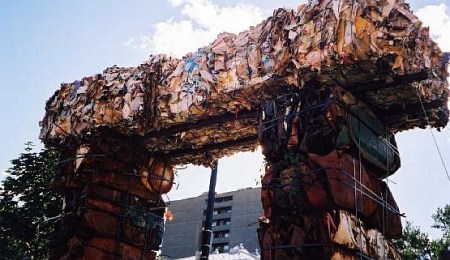
ATSA 4photo ©ATSA, used with permission

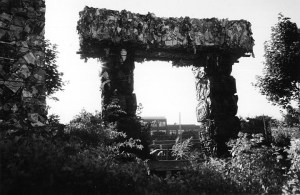
ATSA, the creators of this replica or sort-of replica made of garbage, stands for Action Terroriste Socialmente Acceptable, meaning, as far as we can tell, Socially Acceptable Terrorist Action.This is probably one of the most interesting and provocative uses of the Stonehenge imitation we have seen.

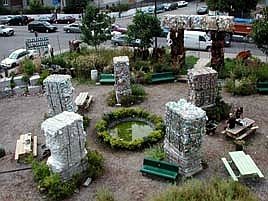
ATSAATSA stonehengeThis construction was created, again, as far as we can tell, in the city of Montreal in 2002. It was part of a piece of urban art called Parc Industriel. The ideas behind it were complex, but to simplify, the Stonehenge structure is used to evoke the idea of looking back on our culture from the far future and finding that the monument we left was not a great and timeless work like Stonehenge but our massive accumulations of garbage.
As we say, that is a (gross) simplification of the message, but you can learn more by poking around the ATSA site.  We like the sub-title: When Humans Were Still Able to Reproduce Naturally. They even have a panorama, video and soundtrack here. It’s all very impressive. Not optimistic, exactly, but . . .

A quote from the site: “This temporal “jump” gives us the perspective of a fait accompli, allowing us to look at the facts from a neutral, even humorous point of view, one that encourages reflection and gives us the distance we need for self-criticism.” And a partial description: “An arched doorway built from masses of compressed metal and paper leads us to a body of polluted water, surrounded by columns of recycled material that remind us of Stonehenge (a metaphor for how truly infinitesimally small our existence is).”

Stonehenge as a metaphor for how infinitesimally small our existence is . At first blush that sounded new to us, but wait–isn’t its unwieldy age, size and ponderousness what all the humour is about when people build mini Stonehenges of butter or candy or biscuits? Like, “OMG, I can’t think about life and eternity and death but I can think about bourbons and custard creams!” [USAnians–those are varieties of what you call cookies.] So ATSA is using that same connection but plunging and twisting the irony a little deeper in our guts.

Score for this henge-with-a-message: 7 druids! We’ve seen a lot of replicas and this is a standout, demonstrating for us once again the malleability and broad applicability of the Stonehenge image. Like Indo-European root words that form many seemingly unrelated modern words, Stonehenge can lend weight and import to many different kinds of statements. Its ancient age and ruinous beauty arrest our attention and ask us to (HELP! PLEASE!! NO!!!) think.

Share

Tiny Tick-Tock Stonehenge Clock

sh-clock-2photo by Stonehenge Guy, Bob Bradlee of Stonehenge Collectables
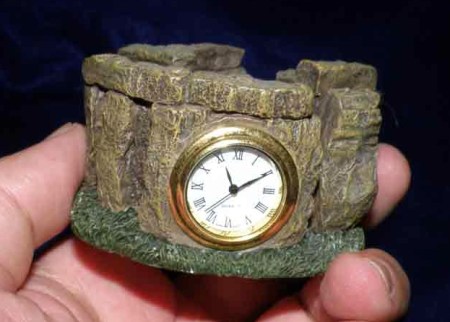
You’ll find it on Ebay, this curious little Stonehenge with a clock on its side, made by Westland Giftware. Who thinks of these things? Who was the person who said, let’s make a tiny little Stonehenge-ish thing and put a small clock face on it? You have to wonder.

But clockmakers and astronomers are among those most aware of Stonehenge. We showed you a trilithon replica at a clock museum in a post about two museum replicas. Stonehenge is seen partly as an ancient timekeeper, so combining a clock with Stonehenge isn’t completely random. Not that we mind things that are completely random–they’re often our favourites!

This item is wrong in so many ways–proportions are all wrong, it’s all one solid piece . . . And yet, can you feel it? That pull? We can feel it calling us to buy it and set it to gather dust on the shelf above the computer where we do our Clonehenging. It’s kind of, well, you know–cute. Stonehenge isn’t supposed to be cute! Bad Stonehenge replica!

Score: 5  itty bitty, tiny little druid fairies! Aww, can’t you just see them dancing? And picture their footprints in the dust on our shelves? Wait, what’s that the cat has in her mouth? Uh oh, gotta go!

Share

Bed-Henge Project, Yet to Be Realised

bed-hengephoto by Sebastien Fouet, intermittent artist, with permission
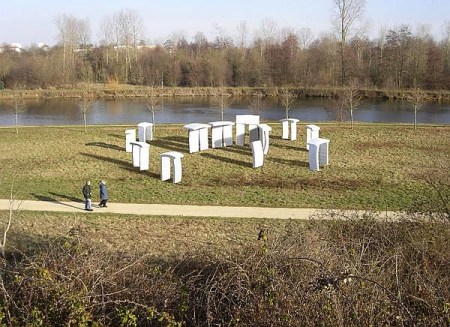
Looks real, doesn’t it, until you stop and think about how those skinny mattresses are standing by themselves. It was a thought while doing housework: beds are rectangular–there has to be a bedhenge. And there it was, on the first page of the search. When we asked to post the picture, Monsieur Fouet, the impudent Frenchman said, “Well, Yes, You can use my stuff for your fetishist Henge web site 🙂 , no problem.” Ouais? Eh bien, merci, mon petit chou!

But then he emailed again, telling us what we should have known– that this arrangement of mattresses is virtual, existing only on computers. So should we post it? Well, why not? We haven’t had a French one yet. There’s something about beds in a park that seems so very French. And we must say that the shadows of the mattresses are nicely done.

You can see another construction, named Document but nick-named Mattresshenge, in the fifth picture down on this page. Nice, but not meant as a Stonehenge replica. It was the only other thing we could find.

So what about the image above? It is almost all trilithons, understandable but not optimal. Perhaps the most surprising thing about it is his inclusion of the center trilithon horseshoe, which seems to be taller than the others, just  as in the original.

Score? We give it 5 druids. Let us know, Sebastien, if you ever get your project off the ground. [How does that idiom read on Google Translate?!]

Oh, yeah, we almost forgot–Yarr, mateys. Shiver me timbers. Avast ye scallywags. And the like. Happy Talk Like a Pirate Day, a bit late!

Share

Werner Wick’s Stonehenge in Bavaria

bavarian SH 2photo from Markt Velden

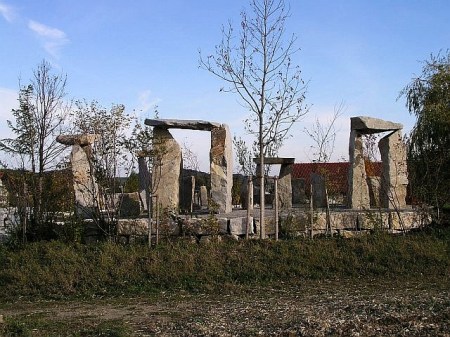
Yes, another one for the Large Permanent Replica list! This one was masterminded by horticulturist and landscape gardener Werner Wick on the property of his business near Velden, Bavaria, Germany.

The Germans have their share of these things, don’t they? Let’s see, there was Stonehenge in der Oberpfalz, the one at the Deutsches Museum, the tiny one at Miniwelt and of course the one at Therme Erding (consistently one of our most popular posts but we suspect that’s more because of the words mandatory nudity in the title than because of a great enthusiasm for spa megaliths).

This is one of those quirky privately inspired replicas, which always have their unique aspects. It consists of just the five center trilithons and an inner horseshoe of smaller stones representing bluestones. A neat way to make a smaller structure and still have it be fairly accurate. And he has anchored the uprights in cement to prevent falls, just like they have in the original in modern times.

As far as we can make out from the translated page, the idea had been on Herr Wick’s mind for about 30 years before he built it with a friend’s help. A serious traffic accident from which he emerged unharmed seems to have spurred him on. Perhaps he was spared because his mission to build a Stonehenge replica had not yet been fulfilled!

Score: 7 druids. We like this sturdy homage to the megalith builders. May Werner Wick live many years in order to enjoy his creation!

Share