Building Stonehenge Games and Sets

Henge_1.sized

henge_5.sizedPhotos from Stonehenge Collectables

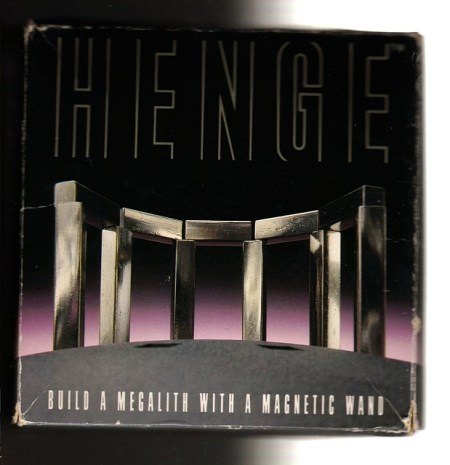
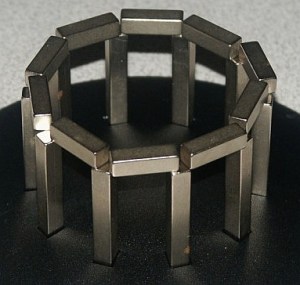
For this post we present a couple examples of boxed build-your-own henge sets. The first is called, simply, Henge, and it says it is “a game of sculpture and skill based on prehistoric Stonehenge. The aim is to create a circle or henge of steel blocks using a magnetic wand.

It appears to be a handsome thing and the object, apparently, is to create the equivalent of the complete outer circle of Stonehenge by manipulating those steel bars with that magnetic wand.

The lingering question, of course, is: Then what? But with two sets, of course, you could begin to do something a little more accurate. Please note, it says “Made in England” and then, “Nashville, Tennessee.” This is an intriguing item and we would be curious to see one in the hard copy world.
building stonehenge

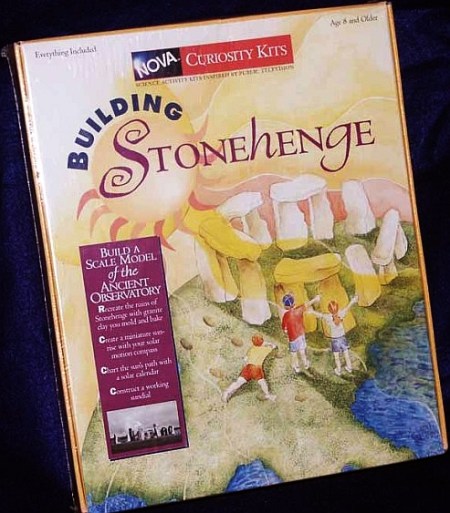
The other item here is a more complex educational set made for children. The copy reads, “Create a miniature sunrise with your solar motion compass and chart the stars path with a solar calendar and working sundial.
Materials: Granite clay, printed Stonehenge base plate, solar motion compass, sundial-solar calendar, glue and brush, and an illustrated instruction poster, home oven and flashlight repaired.
” (Perhaps they meant required?)

We don’t know whether this one includes info on the bluestones and the ins and outs of the outer circle, the heel stone, the “altar stone,” the ditch and bank, etc., but a dedicated person could do the research and include all of that (even add some aliens or a Buddha if they wanted!). This seems like a fun thing to play and learn and be creative with. “Chart the sun’s path with a solar calendar.

Either of these could give an adult and a child a fun day thinking about Stonehenge, its form, its possible functions, and who built it. With the first, you could also talk about magnetism. With the other, you could also talk about astronomy. And with either, a creative person could take it further. Score for the first, 4 druids. For the second, 5½ druids.

These are just two examples of hands-on model sets generated by Stonehenge one way or another. That mysterious urge to re-create it comes through in every form and size, with many new conceptions  of the Stonehenge idea yet to emerge. What brings people back to it again and again, recreating the ancient monument in ever newer ways, no two alike? We like to think that this collection we’ve created here at Clonehenge may help to bring us closer to an answer.

If not, at least it brings us to another, equally important question: Aren’t people, well, a little weird? Just sayin’.

Welcome to Clonehenge!

montana-rainbowStonehenge at Crystal Lake Golf Course, Montana

We have noticed an influx of new visitors. We invite you to explore. We’ve posted well over 200 henges, large and small. If you want to find the nearest one to visit, check out the list of large permanent replicas.

stone-hengeWe also have many foodhenges (cheesehenges, butterhenges, candyhenges, even a cheese puff henge) and beautiful museum models of Stonehenge, Avebury and Silbury Hill, along with many other beautiful and ridiculous (okay–we do lean more heavily toward the ridiculous!) Stonehenge replicas, models and sculptures. Try the search function at the right or click on any term in the Words in Use cloud further down the page.

snowhenge2We’re always looking for additions to the blog–replicas you know of or have made (Or will make! For us!). Read The Rules of Henginess page to get an idea of what we’re looking for.

For why we’re doing this and how we got started, read Clonehenge, the Interview and/or Why, You Ask? Well, It’s Like This. And, yes, we do address the topic of Spinal Tap! More than once. Questions and comments on anything here are welcome. Thanks for dropping by the oh-so-terrific fabulousness that is Clonehenge!

Untitled Stainless Steel or Admit it, Washington State, You Have a Fetish!

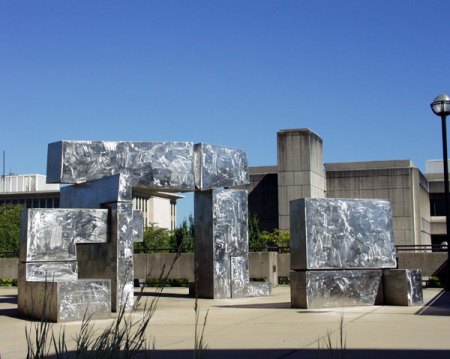
Stainless02photo from the website of the General Administration of the State of Washington, with permission

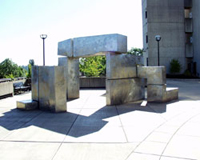
Okay, so it’s only a sculpture with Stonehenge references, but coming as it does from the Stonehenge State, we thought this huge untitled piece worth documenting on Clonehenge. The sculptor was Lee Kelly, an artist well known in the Pacific Northwest.

Olympia is the capital city of Washington, and this sculpture is installed near the Transportation Building on the Capitol Campus in Olympia. Stonehenge reaching right to the Capitol of the Stonehenge State! According to the website we linked to above, Kelly said that with this sculpture he wanted to “deal with the ancient attitudes of man and his relationship to what he makes with his mind and hand.

Stainless03To suggest ancient attitudes, he mimics, without stating, the trilithon, in steel. It is a likable public piece. We can imagine children clambering over it and running through it. And by children we partly mean, of course, the imaginations of adults who are too stiff about their image in the eyes of others to actually do any of that. But their minds suggest it and their fingers ache to touch that cool steel.
The sculpture was completed in 1973, and we think the Seventies show in it a little, that cosmic resonance people looked for back then, the plainness and friendliness. Kelly also said about the piece, “the forms are simple in that everyone can ‘understand’ them. The mystery is in their interrelationships, the spaces they create, as well as the relationship to the building and plaza.

Here is another work Kelly did at roughly the same time in his career, and here are other works, most of them newer. Of course, this isn’t a Stonehenge replica so it is difficult to score. Score: 4½ druids as a replica. Quite a bit higher as a piece of public art. We think it is handsome and has that quality of suggesting greater things! You can see the other Stonehenge replicas and sculptures in Washington State here. What a place for henge-ophiles!

If anyone has any replicas they would like posted, this would be a great time to send them in, as we’re running uncharacteristically low, not because of scarcity, of course, but because the photo permissions have been elusive. Come on, help us out. We’re almost at the end of our first year of posting, so you can call it a birthday present!

Stonehenge of Roanoke County, Virginia

stonehenge roanoke

photo by D. R., with permission

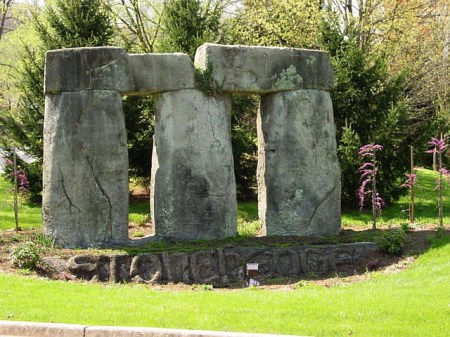
Many, many companies and businesses–consulting services to pavers to home builders to golf courses and many others– are named Stonehenge. You may well ask why. But curiously, most do not build any Stonehenge-ish thing to put outside their headquarters. In Roanoke County, Virginia, however, a community of homes that calls itself Stonehenge had an artist create this very nice twenty foot high monument in 1978.

The artist, George Solonevich, was from Soviet Russia [obligatory joke: In Soviet Russia, henge stones you!] and had spent time in a concentration camp because his father was a dissident, eventually ending up in Roanoke County with his wife, Inge, also an artist. How it came about that he was selected to create this sculpture we do not know, but it was a happy accident!

Gone are the stiff straight lines of most American replicas, gone is the monotone look and the obsession with the simple trilithon. In these five faux stones (quintithon?) made of wood, wire, and stucco, he has captured that elusive ancient feel most replicas miss. Mr. Solonevich is with us no more, but maybe he can hear us when we say, Well done, sir!

And, yes, it does have the word Stonehenge just below it. But that’s better than the one in Athens, Georgia. Remember that one, with Stonehenge written across the lintel? Have a look at this link and then tell us Mr. Solonevich didn’t take the concept to a higher level!

Score: 6½ druids! You can see a brief video interview (no mention of this sculpture) with George Solonevich here. [In Soviet Russia, view inters you! Hmmm, we just can’t seem to catch on to that meme!] As far as we know, this Stonehenge isn’t on any of the other Stonehenge replica lists out there. Another Clonehenge exclusive, and another large permanent replica!

Share

Takino Stonehenge With a Buddha—in Japan!

takino 2photos by kamome, used according to Creative Commons License A-NC 2.0

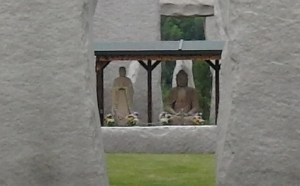
below–the center of the photo above, enhanced to show the shrine

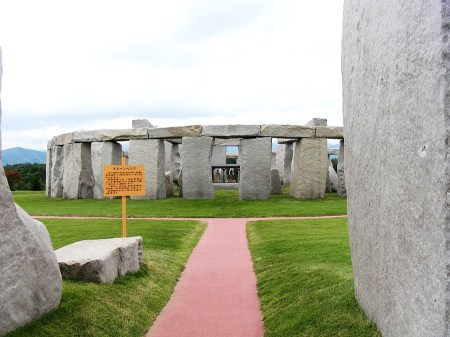
takino buddha shrineYokoso! (Welcome!) On Japan’s northern island, Hokkaido, the Makomanai Takino Cemetery Park hosts, among other impressive stone sculptures, a full sized Stonehenge replica. A striking element of this replica is that the ditch and bank that make Stonehenge a henge have been included. See the bottom photo at this link. Nicely done!
Of course, the authentic feel ends in the middle, at the Buddhist shrine. There’s also a giant Buddha nearby, and a row or two of Easter Island moai.

takino moai 2See them there? They and Stonehenge often seem to end up hanging out together. We can think of five replicas we’ve posted or linked to that had moai, too. ( Texas Stonehenge II, Raven Hill Discovery Center in Michigan, Harry Rossett’s in Indiana, Kennewick in Washington State, and someone’s  Obama Gardens of Hope. There may be others.) Weird, considering the originals are on opposite sides of the world, but okay, we’ll go along with it for now.
Do you think it looks like a pretty gaudy cemetery? But not everyone wants to rest in piece, right? Some are hoping to rock on!

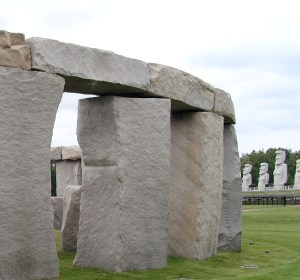
It’s a great replica: made of real stone, cut unevenly (leave it to the Japanese to get it that cutting the stones in perfect rectangular prisms detracts from the monument!), bluestones included, ditch and bank included. It is true that they may have added things here and there. There probably wasn’t a buddha in the center 5000 years ago, but there may have been a shrine. Who knows?

Score: 8 druids. We would give it more if it weren’t rubbing shoulders with the moai and the huge Buddha. Good ambience requires space.

What a replica! Maybe we should have saved it for Clonehenge’s one year birthday, which is coming up soon. We’ll end with a sentence we like from  a Google Translate page of a blog post about a trip to this cemetery. (Google Translate makes us lol!) “Why the road to heaven is like this?” A koan to ponder . . .

Packing Foamhenge: A Mini Tour de Force

foamhengehenge and photos by Drew at thinkythings.org, used under Creative Commons Attribution-NonCommercial-ShareAlike 2.5 License

We look at a lot of websites while doing this blog. Many times we get distracted and spend way too much time looking at non-henge-related pages. But never have we seen a site that so sweetly reveals a quirky and interesting mind the way thinkythings.org does. He discusses an odd assemblage of topics, from a 1940s woodpecker toothpick dispenser to what phrases you can make with a set of children’s alphabet blocks (warning–R-rated!) to (our favourite!) common or famous first names that are also verbs (with categories for variations you end up thinking of if you try listing them yourself), and many other odd things that somehow elicit a smile.

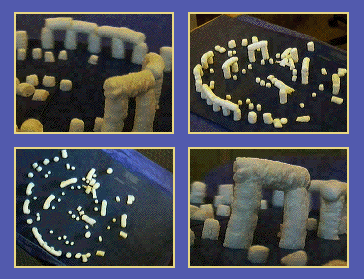
This is the kind of stuff we hope for from the internet, brilliant things arising not from the drive for money, but from the sheer quirkiness we each possess. (Don’t get us wrong–we’re not averse to money. Clonehenge remains nonprofit, like some people who remain virgins, not out of virtue but because of a dearth of interested petitioners!) One of topics that this unusual and prehensile mind touches on is the topic of Stonehenge, Stonehenge made with eco-foam, a material used for packing peanuts that will dissolve in water and disappear, hence “eco“.

In Drew’s words, “In 1994, a small team of software engineers at a consulting company in Cleveland, Ohio discovered that Eco-Foam does not dissolve when it is only slightly dampened. The part of the foam that comes in contact with the moisture becomes tacky, and this property can be used to stick Eco-Foam peanuts together or to other objects. The natural consequence of this discovery was to build a scale model of Stonehenge.

Of course, he endeared himself to us in the first paragraph where he asserts that “if the Druids worshiped at Stonehenge, it was without knowledge of the site’s origins or purpose, for Stonehenge was completed 1500 years before the Celts arrived in Britain.” Hurray! It could only be better if he explained about the Beaker people. As if this weren’t enough, it is obvious from the photos, especially those from above the model, that the builders looked very closely at detailed layouts of Stonehenge. (Here is an aerial view for comparison.) This model is brilliantly made and of an unexpected material. Cha-ching!

ob2-2Score: 7 druids! That’s high for a small henge, but this fellow even makes a point on his Odd Things page of giving the true definition of the word henge. You can’t beat that with a stick! As they say. Whatever that means.

Thank you, Mr. Drew, whoever you are. You serve as a model for those who aspire to make a better henge. And a better blog.

Scary Stuff! Caelum Moor, Arlington, Texas

caelum moorphotos by Robert Asplet, blogged from Flickr

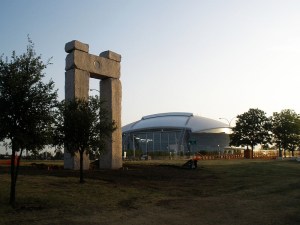
A wee bit o’ Scotland has come to the outskirts of Cowboys Stadium, and with it a foggy auld controversy over whether a Scottish sculpture park is also a pagan shrine that might hex the Dallas Cowboys.”  “ ‘I believe there’s a devil and that we tugged on his cape.’ ” (From this article, the second a quote from Michael Tummillo.)

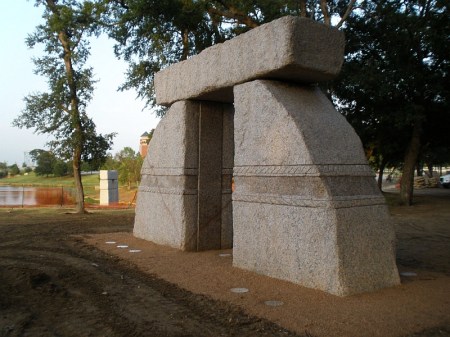
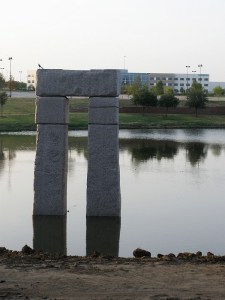
Ah, Texas. Welcome to Caelum Moor. Five modern megalithic sculptures made of granite, three of them trilithons, that have been in storage since 1997 have recently been re-erected in a park near Arlington, to the great joy of many art lovers and to the alarm and even anger of some on-the-fringe Christians, led by nursing home chaplain Michael Tummillo, who assert that it is pagan, therefore evil and therefore likely to attract–yes–the devil!

caelum moor 2It is clear that Tummillo has more belief in the power of the sculptures than anyone else does and maybe he ought to be admired for that. Pagans, at least the ones I know, would be unlikely to expect that modern sculptures recently placed near two sports stadiums will draw in any kind of spirits, let alone a spirit who is, let’s face it, pretty much a Christian construct.

You know the drill–Tummillo and his gang somehow get from worrying about pagans and Wiccans worshiping at the sculpture park to talking about satanism, which is much closer to being a heretical sect of Christianity than it is to having anything to do with Wicca or paganism. And it all makes assumptions that don’t work, like that these sculptures are not art but religious objects, or that people won’t practice paganism or Wicca if the sculptures aren’t there.

Of course, the vast majority of Christians can enjoy these sculptures for their beauty and the resonance of ancient Britain they carry, without getting weird about it. They can instead chuckle at the bit about Scotland in that opening line above. Name a stone circle with lintels in Scotland–We didn’t think so!

caelum moor 3Controversy aside, the combination of landscape and sculpture in this park seems to transcend its site in the sports and business complex. You can see a walkthrough of Caelum Moor here. There is no circle, none of the other characteristics of Stonehenge, but it does have a grand feel, even over the internet. We give it 6½ druids. They’re not real druids, okay? We don’t want to scare anyone!

The artist’s name is Norman Hines. We applaud his beautiful work! And a note about Michael Tummillo: he has written a book about his experience fighting Caelum Moor the first time it was up (so we doubt he’s trying to drum up media coverage! 😉). And as for the Cowboys–their problems probably can’t be traced back to public sculpture. Just a hunch.

Our thanks to Karen Hetherington for telling us about this one. And again, we wish everyone a wonderful Halloween and Samhain!

[See the comments for a statement from M. Tummillo.]

Share

Witch Henge–Be Prepared for Serious Mojo!

Witches_1aphoto by Bob Bradlee of Stonehenge Collectables

This item has witches on it which makes it intrinsically sweet and worth 5 druids by itself, but once I turned it on, that’s when the magic happened! The evil gleeful witches began to revolve around the fire, which glowed like the eyes of a wolf howling at the moon. I don’t know how I lived until now, without this tasteful objet d’art!

After I plugged it in that first time, my life changed. Mail poured in, all full of checks for thousands of dollars. I’ve had to stop going to public places because of the throngs of ardent admirers I attract. When I step into the garden, bunnies and hedgehogs follow me and colourful birds light briefly on my shoulders or in the nearest branches and sing to me sweetly. Flowers open as I near them, and fill the air with a wonderful fragrance.

Indoors, dust has stopped settling on the furniture. The whole place cleans itself  now. My health has improved, I’ve lost weight, and I look ten years younger. I could go on, but of course there is this odd henge to discuss!

This is a resin model made by Lemax for their Spooky Town collection (called Witches’ Cove–do they mean coven or is it a reference to the Cove at Avebury?). There are the four uprights lintelled, one trilithon and some fallen stones. Then  there are six witches, or are they just Welsh women in traditional dress, who having swept up at Stonehenge are now burning the debris?

The witches (could one of these be Juniper?!) do revolve in a circle and the fire does light up. The owl, vulture, raven, black cat, skull and bones are there to add atmosphere. It’s surprising there’s no jack-o-lantern. Do you think someone said, “No–that would be over the top!” Heh. You can see more photos here.

Seriously–who comes up with this stuff (and why six witches instead of three?). We love the addition of the autumn leaves in the grass. How often do maple leaves blow onto the grass at Stonehenge, do you think? How much does EH pay per year to have someone come in with a leaf blower? No.

Score: We are waffling on whether this is so bad it’s good, or whether it’s just bad. Okay, I suppose we got a chuckle out of it. We’ll give it 5½ druids–or six witches! We considered just naming this post ROFLMAO. But then we thought of the wolf shirt.

Happy Halloween, Samhain, or whatever you celebrate! And seriously, if any of you witches out there do dress and party like this, send pictures!

Watermelonhenge, or, Where the So-Called Monkey Gets His Smile

watermelonHenge 2

henge and photo by monkey, with permission

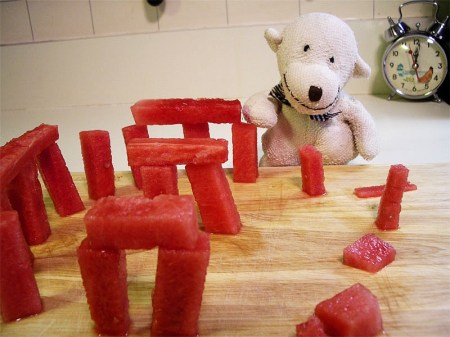
The season is over in the northern hemisphere, but here it is–watermelonhenge, or, as monkey (a white stuffed monkey who looks curiously like a dog) calls it, watermelon stonehenge. And as monkey says, “everybody loves a good henge.” Especially when it’s tasty! He offers a tutorial here. And we belatedly discovered he has his own website here.

Of course this is not the only watermelonhenge on teh intarwebs (here’s one),  but it is the nicest. Monkey seems to benefit by being a world traveler and possibly having influential friends. It’s hard to tell about someone who uses a vague etymological term for his name. He’s not our first monkey with a henge, by the way. Some of you may remember this sweet children’s henge with a mother and child monkey pair along with a dog, which is, frankly, what monkey still looks like to us!

But on to the henge–nicely done for a foodhenge. Only two trilithons in the middle and not many fallen uprights, but at least he got the outer circle and didn’t just make it a ring of trilithons. That’s so last century! Anyway, we make allowances for foodhenges, as you know. And that incredible smile on monkey’s face tells us he is very happy with how the whole thing turned out.

Score: 6½ druids. We can see how someone clever with a knife could make quite a nice little watermelonhenge for a party plate. We recommend tapering the uprights so they’re smaller at the top. Why not give it a try? Look how well this fellow did and he just has fingerless stumps for hands! Well done, monkey! Let us know if you do a bananahenge. We already have a dog bone henge.

[And if you want to serve a non-henge watermelon plate for Halloween, we suggest this.]

Share

Spinal Tap–The Other Stone’enges!

Stone_Henge_tapphoto by Peter Renn, from the BBC

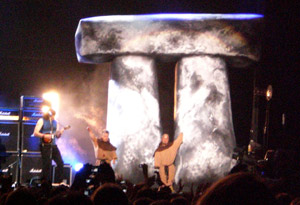
It is not at all clear what the little Stonehenge replica, actually a mere trilithon, in the movie This Is Spinal Tap, is made of. Some say it was inflatable, some say it was made of foam. We dedicated our 100th post to that one, the only Stonehenge replica most people have ever seen. But there have been others.

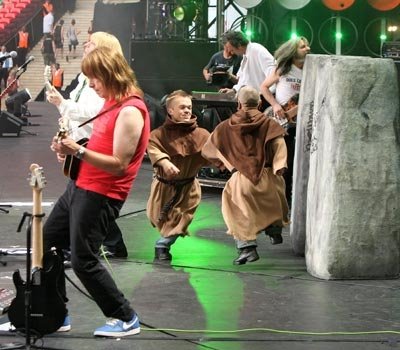
Spinal Tap, although a mock band, also tours, and on some but not all of their tours they have had other Stone’enges, at least one of which, and possibly all of which, were inflatable. Inflatable but apparently not always inflated. People who attended their concert at the Wembley arena in July report that they had trouble, um, keeping it at attention . . .

Spinal Tap - StonehengeAt a Glastonbury concert in June they had a rather smaller one, but it appears to have been closer to 4 feet than 18 inches high.

The inflatable Stonehenge is in general a much rumoured but rarely seen item. It is said one was commissioned a few years ago for a high end party in Manhattan, but if there are pictures of it online, we have not found them. There may be others, too, rentable for paint ball skirmishes and the like, but those, too, we cannot find.

We think it is an unfilled niche! Why doesn’t every party place have inflatable Stonehenges to rent for garden parties and village events? We can imagine them at fairs, music festivals, all kinds of gatherings. And, of course, eventually someone would be seized by the urge to fill them with helium. A floating inflatable Stonehenge! It would be something the world has never seen. And we don’t just mean a trilithon, people! Think of it!

Score for the Spinal Tap touring trilithons: 5 druids. And it’s that high only because they’re funny and because, let’s face it, they put Stonehenge replicas on the map. We want to thank Emma Harrison, bigmollusk, of World Before Wireless, for pointing these out to us. Emma, we await that inflatable Stonehenge you promised us. Deadline is December 21!

Rock On, dudes!

Share