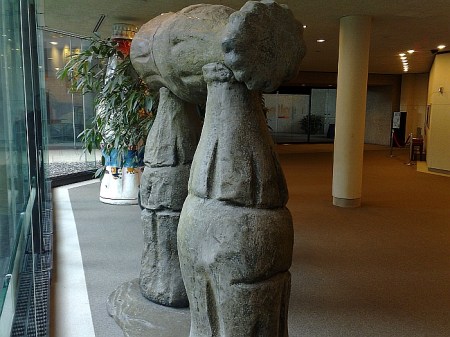
Coca Cola Stonehenge, Atlanta, Georgia

coke-stonehenge

photo by Jeff Crites, with permission

The word you’re looking for is gratuitous–gratuitous use of the Stonehenge idea in a trilithon of imitation-stone Coca Cola bottles. This piece of art was donated by the U.K., one of many Coke-related artworks given to the Coca Cola company by countries around the world. We’re sure the kindness offered by their friend and ally overseas will not be forgotten by a grateful nation.

But it’s a bit of fun for us and another illustration of the pervasive nature of the Stonehenge/trilithon image. The implied assumption is that everyone knows what this is meant to represent. This is not the only soda (or pop) Stonehenge image, of course. You can see another here. Score: Does it even deserve 5? We’ll give it 5 druids–as an international gesture!

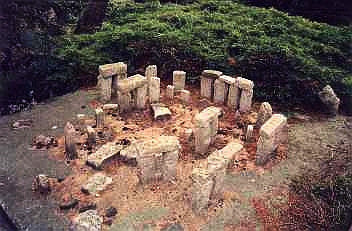
Dowdell Stonehenge Model, Wiltshire

earthwood-near-stonehenge

photo by Rob Roy of the Big Stones Website, with permission

From the book Stone Circles by Rob Roy, “A number of years ago, a very accurate model of Stonehenge was built by Albert Dowdell, now deceased, just five miles from the real thing. Jaki, Darin, and I managed to track it down from an old book. The new owners, a young couple who had only owned the place for a year or two, were delighted to show us the model, and have us in for a cup of tea. We were very surprised to hear that we were the first people to stop and ask about Dowdell’s model. The ‘stones’ were cast in concrete in just the right shapes, the tallest not much over six inches in height.

We’re not certain whether this nice little model of Stonehenge still stands, but we are grateful to have a picture. We think it’s very well done for a small garden model, full of detail and with a sort of grace. Score: 8 druids!

Getting permission to use this picture put us in touch with the interesting people at the Earthwood Building School in upstate New York. More from them another day, but this passage on their site seemed to go straight to the heart of the phenomenon we chronicle here:

After visiting Stonehenge, I knew that someday I would have to build a stone circle of my own. Why? The only explanation I can give is that I was compelled to build it, just as the Richard Dreyfuss character in Close Encounters of the Third Kind was compelled to build a large replica of the Devil’s Tower mountain in his front yard. Incidentally, compulsion is a reason I have heard given by at least two other modern stone circle builders.

Aha! Compulsion does seem to be the key. And the Dreyfuss comparison is one we often think of as we work on this blog. Maybe the aliens are going to meet us at Stonehenge!

Dubhenge, Several Locations, U.K.

dubhenge

photo by Ian Lloyd, with permission (kombi trilithon here)

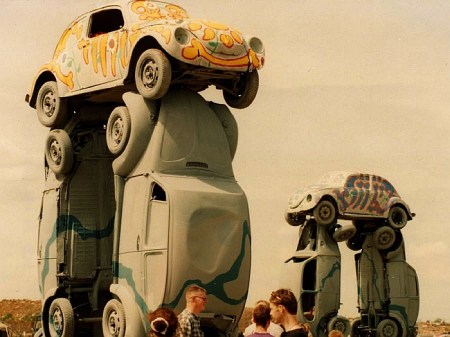
In 1996, a group of artists who call themselves Hugh Jart (get it?) set up this henge for the Beetle Bash at Avon Park Raceway for summer solstice. It was a Stonehenge replica made of donated junk VWs, both VW beetles and buses or kombis. More pictures: the whole replica, Hugh Jart’s Dubhenge photos, MTV’s video of solstice sunrise at Dubhenge. And the poster used to solicit the cars needed for the sculpture (we like this!).

The installation was moved to the Glastonbury Festival that year, to the Park Festival in Scotland and then to the V’97 Festival at Leeds before being scrapped.

What’s not to like? Score: 7 druids for the bug-ly henge. We like the happy hippy vibe and the idea of a monument to such a beloved piece of transportation!

Taipei’s Interactive Larval Stonehenge, Taiwan

larval-stonehenge

photo from the Taipei Public Art section of the Taiwan government site

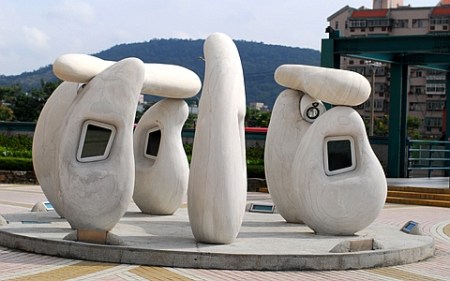
♥ ♥ ♥! Never before have we been so excited about a replica that we held it for a week not wanting to post it, just because we knew once we posted it nothing else would ever come close! Well, we were pretty excited about one other one once, but that was back when we were n00bs, people. We are n00bs no more!

This is the real thing! In fact, it’s probably the only thing we will ever post on this blog that could also be posted on Cute Overload. Or as close as we’ll get, anyway! And look at its functions. It has sensors to sense your approach, speakers so it can talk to you, mirrors . . . we’re not sure what they’re for. Maybe they’re one way mirrors and someone stands inside and talks–who knows? There’s even a hologram involved somehow! Go to this page and click on the right-hand square that has VR in it, and you can get a better look.

Taipei has some great public art. We had no idea. A giant chess board with chess pieces, for example. We can’t help but wonder what got into whom in order for this Stonehenge (yes, that IS the work’s title) to happen. We’re in awe, the kind that includes humourous disbelief! Scoring? Seriously? How? We’ll give it 6 baby druids–that’ll have to do.

Alton Towers Stonehenge, Staffordshire

alton-towers2
photo from TowersTimes.co.uk, with permission

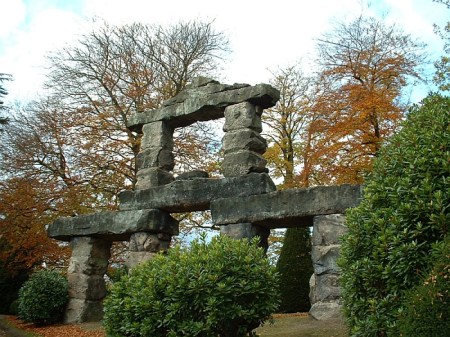
Lest we think Stonehenge replicas that barely resemble Stonehenge at all are  a phenomenon limited to clueless Statesiders, today let’s look at one of the older so-called Stonehenge replicas in the U.K., the one in the gardens at Alton Towers in Staffordshire (shown here in the English Heritage National Monuments Record). These days Alton Towers is best known as an amusement park and resort, and a pretty rockin’ one at that, but at one time the estate was best known for its gardens and conservatories.

In the early 1800’s one of the eclectic fancies added to those gardens was this odd construction which is still characterised,  when it’s mentioned at all, as a Stonehenge replica. Hmmm . . . We would guess that they built the smaller faux trilithons, connected them with the higher lintel, stood back, decided it just wasn’t grand enough for those gardens, and went on to add the un-Stonehenge-like fancy at the top just for style.

We weren’t sure whether this belonged on our list of the large permanent replicas, it is so odd. But if the Guidestones are on there, then this should be, too, right? Score: 5 druids. Don’t grumble and say that’s too high. It was built by Brits–maybe they knew something we don’t!

Lonnie Hamargren: Las Vegas Nevada’s Stonehenge

hamargren

photo from Rare Visions & Roadside Revelations, with permission

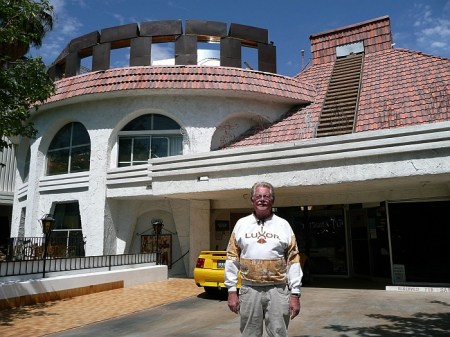
Imagine that you are the neurosurgeon to the stars and that as you work with stars the concept of celestial stars begins to fascinate you. You have money and a place on your roof beneath the dry clear skies of Vegas that has room for a planetarium, and–hey, why not?–a pyramid, and–what the heck!–Stonehenge. What do you know: you must be Dr. Lonnie Hamargren!

Of course, there are a lot of other random, amazing, bizarre pieces of culture in his collections, but we leave others to reveal those. For us the point of interest is what we believe to still be  his work in progress on the roof: a Stonehenge replica. When we last checked, it was unfinished, pending a shipment of copper plates (!?).  You can see what exists of the replica so far on the roof in the photo above. A little short of halfway down the page at this [link], you can see his hand with a sign saying, “Stonehenge wasn’t built in a day!”

It’s always difficult to score an unfinished replica. We’ll give him 5½ druids util he can show us a completed structure. We are happy, though, to post our first Silver State Stonehenge replica outside of Burning Man!

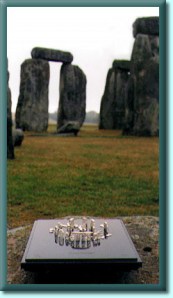
Stonehenge in Silver

silversculptatsiteThis replica is a meticulous copy of Stonehenge rendered in sterling silver. A page on the site says “The replica was on display at the English Heritage visitor’s center at the Stonehenge site for three years. It is now available in a limited edition to interested collectors.
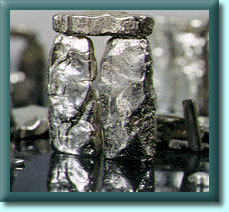
Believe me, we would like to make fun of this tiny silver Stonehenge. But it’s hard for us to deny that it is a beautiful thing. The minutely detailed stone-for-stone silver model of the monument is mounted on a base of gleaming black granite so that it looks like a piece of exquisite jewellery.

Yes, we know that it is still rather peculiar that people would bother to do this. And, yes, we know that the thing has no real use or reason for being. But that could be silver-draketrilithionsaid of most of the things we post on this blog.  Our inner magpie was aroused as soon as we laid eyes on this.
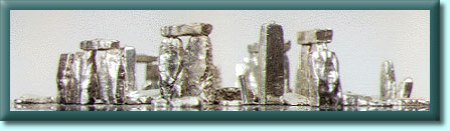
The artists, Drake and Waldon Lewis, are brothers from California. They don’t say on their website how much a copy of this replica would cost, but we imagine it is a pretty penny. It would make a great centerpiece for your Stonehenge collection. Score: 8 druids. It would be hard to resist placing tiny red ants among the ‘stones’ and taking pictures!

silver-sh

A Couple of Museum Replicas

hong-kong1

photo from the website of the Hong Kong Space Museum

We found a couple of partial replicas that should be mentioned, but neither is complete enough, nor do we have good enough pictures, to warrant a full post for each. The one above is in Hong Kong’s Space Museum, part of a demonstration of ancient astronomical history.

The site says it “has a special effects projection of the midsummer sunrise over the Hell [sic] Stone of Stonehenge to gradually recreate the illusion of dawn.” Yes, we know the Hell Stone is a dolmen in Dorset, but who are we to correct such a delicious misspelling?

clock-museumThe second is a trilithon (Yes, we have learnt to spell it properly!) at The National Watch and Clock Museum in Pennsylvania. In this case it is part of their Ancient Timepieces Gallery.  It is rather a handsome thing, from what we can see, but not proportioned accurately to the trilithons at Stonehenge itself.

We’ll give the Hong Kong structure 5 druids for now, and the Pennsylvania trilithon 4. What is interesting is how their juxtaposition underlines the why behind the “surprising” finding archaeologists are always making that this or that ancient or “primitive” culture had a very detailed understanding of the movements of the bodies in the heavens. Astronomy, for millennia, was timekeeping, and every society, even the simplest, had a need for it.

(second photo from the website of the National Watch and Clock Museum)