Esperance Update

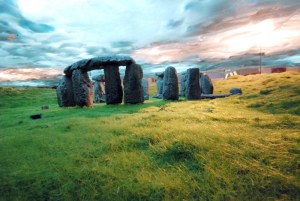
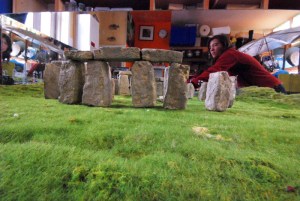
Latest news on the Esperance, Australia Stonehenge replica including a video with the Beales discussing it can be seen here.

In the video, Jillian Beale, one of the builder/proprietors,  says that some visitors had recently been to Stonehenge in England and “said it was a pile of old rocks. They’d paid seventeen pounds and it was rubbish. And in my book he’s written ‘It’s brilliant. Better than the original!’ ” Worth a watch.

Meanwhile we’re still fretting over whether lintels will ever appear on the outer circle.

Small Henges and a Henge Spotter’s Time Out

photo from modelermagic.com

Today–more small Stonehenges for the home. Above is the Larson Designs 1/72 scale Stonehenge model, a pre-made resin model that sells for between $50 and $75.

It has its faults but over all it is not a bad model. Many stones are in the right places including the trilithon horseshoe faces the three-lintel segment of the outside circle, always a sign that someone actually looked at Stonehenge before making it. And that IS desirable. (We learned that Larson Designs makes or at least made a Firefly Class freighter model. Also desirable.)

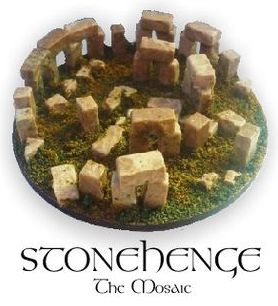
And this little set is made by Mosaic Mad Romans, a UK company that makes simple mosaics for children. This kit does need assembly. The company claims it is made of marble, which outclasses the real monument to a considerable degree. We are not certain how this qualifies as a mosaic, but it is charming, and once again the trilithon horseshoe/three-lintel stretch thing happens, so we’ll overlook that small detail.

There is no shortage in the world of Stonehenge sets and kits for home use. How many households include one (or more), we wonder? Stonehenge continues to proliferate its offspring by infecting and re-infecting the human mind in a natural reproductive process. It is awe-inspiring to watch, although we could do with David Attenborough to do it justice.

While the creation of Stonehenge replicas never takes a rest, Clonehenge will be going on hiatus for a month or so. (Unless we receive or stumble upon an example we cannot resist posting. We’re weak like that!) We don’t even plan to post the Friday foodhenge for a while. It even could be longer than a month until we return to the task. We shall see. We stand confident in the conviction that we will not be missed.

If you do get a twinge, the world is full of materials for making Stonehenge replicas. Go to it! Or just keep your eyes open. You know they’re out there. Always take a camera. So until next time, friends, happy henging!

Cheswardine: Another Long-Sought Henge Attained!

photo by Mia Robinson

Well, we survived the flood and gales. Many thanks to those who sent us good wishes, silent or otherwise. Irene let us live to henge another day.

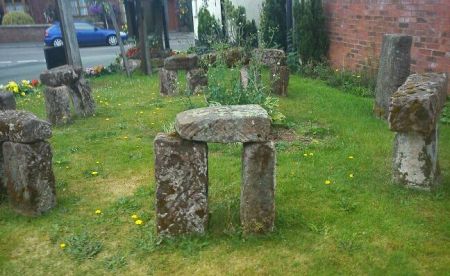
We have long sought a picture of this little trilithon circle in Cheswardine, Shropshire. Looking at it, you may well ask, “Why?” but the fact is, once we know something like this is out there, we desire to list it, just as a collector wants that Mickey Mantle rookie card or that Black Lotus card, or any special little knick knack that completes a set. If there is a Stonehenge replica out there, we want it on Clonehenge!

We know very little about this one. Tinker, our photograph provider in this case says, “i recently moved to cheswardine and was thrilled when i randomly found the henge!!! i drove past it lots of times it wasnt until i stopped for the post box that i saw it as its hidden from the main road its on small ground next to a house but it is very lovely!!

And a site on the interwebs says, “On our way back home we happened to pass through the Shropshire village of Cheswardine, and having spotted what looked like a miniature Stonehenge, we had to stop and photograph it. The structure is on the grass verge of a street called Symon’s Way, which leads off the main road through the village, and it is made of rough stone blocks.

As for score,we can’t give it more than 5 druids, charming as it is. Very cute, but not very Stonehenge-like. The ideal picture of this henge would include at least one cat. Possibly wearing a tie or hat.

The point of this post, however, is to laud, trumpet, and otherwise praise our alert reader and contributor for finding this henge in Cheswardine and sending us the picture! Well done, Tinker! If we gave out awards, we would send you one. Alas we do not, however. You will have to be content with the admiration of a grateful nation (the Henge Nation), and the not-inconsiderable honour of having made us happy. Well done, you!

We hate to post and run, but we watched Ancient Aliens last night and now are all worked up about mica at Teotihuacan, the stonework at Ollantaytambo, and the precise and symmetrical carving at Luxor.  So we are going to cut this post short and go do hours of pointless Googling which will lead us to countless flaky sites that all quote the same, probably dubious, source(s).  Oh, what fun!

We wonder when Ancient Aliens will get around to discussing the mystery of countless people building Stonehenge replicas around the world. Alien mind control?  I’m sure that the guy with the intense tan and weird hair is on task as we speak.  Stay tuned!!

And until then, happy henging!

Woolhenge: At First We Weren’t Sure How We Felt About It

photo by Thea on Etsy

Ooh, ha ha ha! First we have to catch our breath from laughing at our clever title. I’m sure that’s why we’re alone all of the time–people are afraid they would die laughing because of how funny we are.

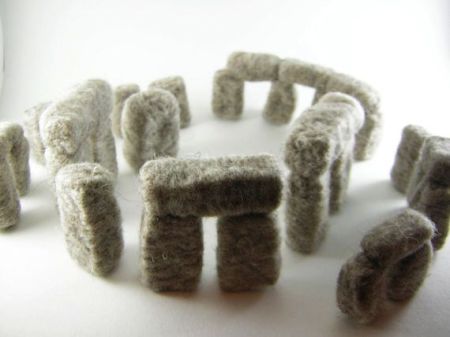
Anyway, apparently there is this. When you think Stonehenge replica, it’s true that you don’t think of wool right away as a suitable material, but there is a certain logic to it. So many people who go to Stonehenge end up taking at least one picture of sheep, or making a joke about the sheep henge that is set up right near the stone henge. Sheep are very much a part of the Stonehenge experience.

The Etsy page says, “…what you see here is a model of Stonehenge depicted in wool, I used photographs from a book and my own pictures to try and depict many of the rocks’ crevices. The real Stonehenge is 24 feet (7.3 m) tall and made of stone but the tallest of these stones is 2.5 inches (3.5 cm) tall and made of wool, so it’s lightweight and portable.

 These “stones” are hand-sculpted and made out of eco-friendly North Ronaldsay wool (from British sheep that eat mainly seaweed). They are made using a technique called needle felting where I sculpt wool into a solid form using a little barbed needle and comes in a box, ready for gifting.

We have to enter the modern world, we know, and get used to things like seeing the word gift used as a verb. But once we’re past that there are the sheep who eat mainly seaweed to distract us. Visions of aquatic sheep arise, with webbed hooves and gills, herds of them bobbing on the waves like rubber duckies… Does this have to do with the Japanese radiation? No? Too soon?

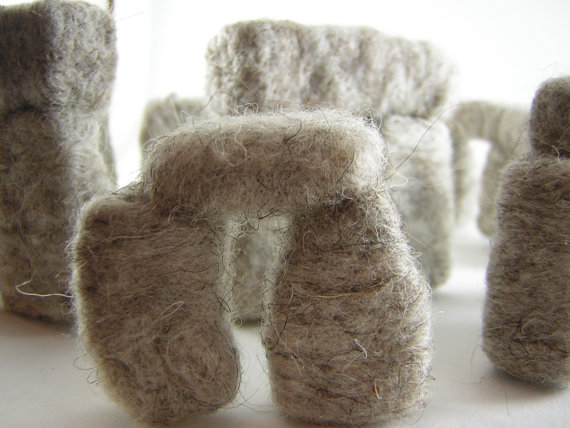
But the part we need to focus on here is “I used photographs from a book and my own pictures to try and depict many of the rocks’ crevices.” Not only has she taken care to place the stones roughly as they stand today (inner trilithon horseshoe facing the three consecutive extant lintels. We look for that in a replica), but she noticed their shapes and made a stab at that as well. We believe we recognise the individual stones in the second picture above. That is rather advanced for a very small replica. We also note that she nowhere mentions druids! Well done.

All in all, a superior small replica. Score: 7 druids. Although as Faithful Reader Simon Burrow pointed out, we should almost have a separate category of druid for the small henges, which tend to be scored lower just because they’re small. Okay, Simon, this would get 8½ druid dwarves! And a spell of transmutation. No, no. This is not an RPG. Yet.

Wool–another material added to the list, taking us ever closer to Rule 34S. If you think of some odd new way or place to make a Stonehenge replica, let us know. And until then, friends, happy henging!

Pinhole Stonehenge Model: It’s All About The Car Park

photos by Bethany de Forest, used with permission

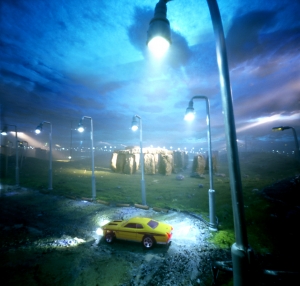
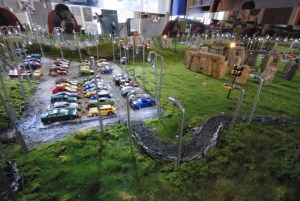
The idea for this work started when I saw an aerial picture of Stonehenge and noticed that the parking space is bigger than the monument itself. Tourist-horror!

Bethany de Forest (lovely name!), the pinhole photography artist who made this nicely rendered model, is not the first person to notice the problem with the Stonehenge landscape as it stands today. English Heritage (EH) itself says, “The dignity of Stonehenge is severely compromised.” (more on this below)

But while EH has dithered, with frequent changes of status for the project of building the new visitors’ center and altering the landscape, Ms. de Forest has gone ahead, as artists will, and created engaging art from the cognitive dissonance between the tacky car park and related facilities on one hand, and the ancient and mystical world treasure that is Stonehenge on the other.

What is the question we’re waiting for, class? Yes, you over there in the “Give Me That Old Time Religion” t-shirt with a picture of people dancing around Stonehenge–Very good. The question is, what is pinhole photography? You can find a very thoughtful explanation by Bethany de Forest here. Or you can read ours as follows: Well, you kind of like, stick a hole in something, ya know? And then ya like put it in a little box, then make a little model, then you, like, let the light in or whatever. And then it looks like Stonehenge. Or, like, whatever, ya know?

We’re thinking of going into technical writing. Ms. de Forest (no relation to Bones from Star Trek) tells us of this particular model, “The model is made in a mirror-box of about 150x150m in contour. Materials I used for my Stonehenge are Styrofoam, flock-grass, sand mixed with wood glue, led-lights, model cars. cotton wool and color foils (for the sky).

We’re pretty certain that 150x150m measurement was a typo, but then her website does say that, “Being a pinhole photographer, Bethany’s view of the world is quite deformed.” AND she lives in Amsterdam, so all bets are off.

The picture at the top is the finished product, but we like all of the pictures on her Stonehenge page. Her process is fascinating. (Read this and you’ll see!) This is one our favourite small Stonehenge models of all time. She may not have included details like the ditch and bank, but she makes up for it with the car park. And the Stonehenge itself has the feel of accuracy and that grey huddled look that so few hengers manage. She has captured or rather conjured an indescribable feeling in the final work. Score: 7½ druids! (See the comments for Simon’s appropriate suggestion on scoring.)

As for English Heritage, the proposals given on their site for returning to Stonehenge some of its dignity sound brilliant, in our not-nearly-as-humble-as-it-should-be opinion. That nearby overly-large car park would be gone. Whether any of those changes ever happen is another matter. We got stuck in buffering limbo just trying to see the last 30 seconds of the EH video on that page. It may be an omen.

Someone said to us that as December 21, 2012 approaches, more and more people will be compulsively building Stonehenges. Apparently it has to do with vibes coming out of the earth and others reflecting back from the future or something. We don’t understand all of that, but we warn everyone to remain alert. The Stonehenge brain virus is pandemic, and so far the medical profession is treating it as if it is a tick disease, by which we mean ignoring it altogether. No one is safe.

But if it should get to you, then we wish you, until next time, happy henging! (And send pictures!)

Walkerhenge: Not Quite the Kind of Exciting Innovation It Sounds Like

photos by Michael H. Walker, Jr., used with permission

Walkerhenge. When we heard the name, it conjured up a vision of a Stonehenge replica robotised to be able to walk about, a peripatetic henge, or maybe a fleet of them… Yes, dozens, no, hundreds of Stonehenge replicas roaming the countryside, eating and reproducing, everything from little baby henges in the care of their mothers to huge bull henges bellowing and running the young single male henges away from the females. Wow, wait until David Attenborough gets hold of this one!

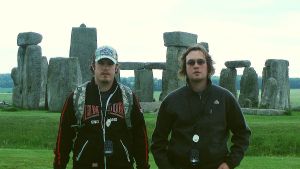
But no, Walkerhenge is named after its creators, Edith and Barry Henge. Oops, no! That should be Michael and Tim Walker, seen here being infected with the Stonehenge brain virus on a typically sunny warm day in Wiltshire.

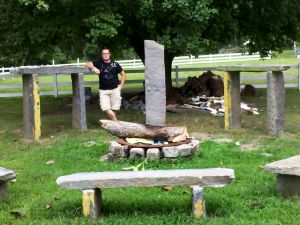
Mike tells us, “…my brother and I went to Stonehenge a few years ago and when we got back I acquired these rocks. We decided to build a mini Stonehenge. We built it by hand in 2009 and its made out of old granite curbs from the 1850’s from Camden, NJ.” Another cautionary tale illustrating the Clonehenge Effect. (But the bit about the old curbs is brilliant, of course, even if it is Camden.)

Most people don’t understand the risks when they visit Stonehenge. They think, “Chevy Chase went there and he’s fine” or “The Doctor went there and he hasn’t been going around building henges.” Ah, but they are both Gallifreyans! Humans are different. They go home and then the worms in their heads make them build Stonehenges. So far there is no cure.

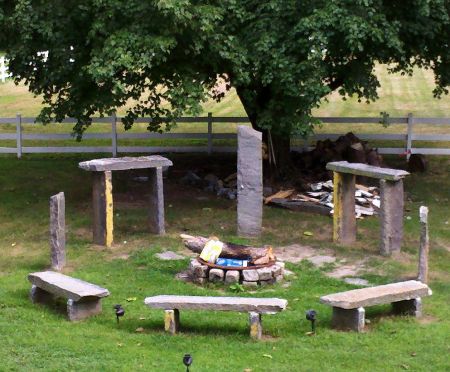
But on to the matter at hand. This belongs to the category of personal garden henges, like the  paved structure in Red Oak, TexasTremont Henge in Cleveland, or  the circle in Kennewick, Washington. Typically these are not large and sport only one or two trilithons. They often include benches in the form of very low trilithons. This one, like the Tremont, adds standing stones, representing, we suppose, the blue stones and maybe a stray sarsen. Its unique touch is the fire pit, which we are inclined to think is a touch the original Builders at Stonehenge would have recognised.

Another for our list of Large Permanent Replicas! As for score, well, we like this. Well suited for celebrating the Four Festivals, for marshmallows and story telling, or just drinking beer and howling at the moon, all of which except the marshmallows probably took place at the original. Score: 6 druids. (It is actually a 5½ druid henge, but I think readers will understand when we remind them that this poor fellow lives in New Jersey. If an extra half druid will give a little glow to his sorry life, how can we deny him?)

And anyway, we don’t live all that far from Juliustown, New Jersey, home of Walkerhenge. We don’t want to risk a whole herd coming after us. This time of year they are in rut and their horns are very sharp!

Many thanks to Monsieur Walker for his photos and his patience. And until next time, friends, happy henging!

How Can You Bring Stonehenge into Your Life? Let Us Help.

photo from daddytypes.com

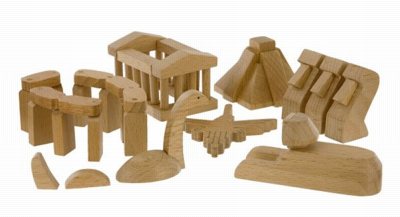
So many people wonder (apparently), “How can I bring Stonehenge into my life?” Luckily for them, there are so many ways! Above you see Muji’s Mysteries in a Bag, a small wooden set that includes not just Stonehenge but a pyramid, the Sphinx, the Parthenon, Nessie, one o the Nazca line drawings, and, oh yes!, Easter Island heads or moai. Moai, despite coming from the other side of the world, are associated with Stonehenge replicas with alarming frequency.

We quote daddytypes.com‘s comments, “Forget Stonehenges in danger of being crushed by a dwarf; now you can have a Stonehenge in danger of being swallowed by a toddler. [And yeah, it’s worth noting that all these things have small-to-tiny pieces. Personally, I worry less about easy-to-swallow than I do about choke hazard, but either way, heads up.]” We see the tiresome crushed by a dwarf reference all the time, this fellow used it well, in our (not so) humble opinion.
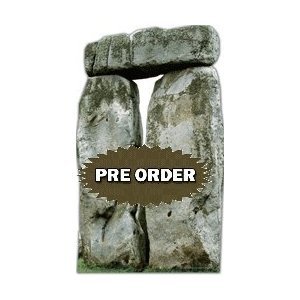
Another way to acquire a Stonehenge for your home or business can be found on Amazon (what can’t?). This piece is advertised as a “StoneHenge 180cms Lifesize Cardboard Cutout” but, let’s face it, 180 cm is not half the height of the shortest sarsens and this is just a trilithon. (StoneHenge–capitalisation of that H grates a little, doesn’t it?) The most striking thing about this Stonehenge is the £34.99 price for cardboard, even if it is “photo-quality” and has a “fold-out strut to the rear, which means its entirely self supporting”. Not everyone who has a strut to the rear is entirely self supporting…
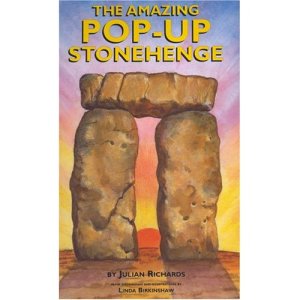
This is another children’s Stonehenge, this time produced with the help of someone who actually knows something about Stonehenge, Mr. Julian Richards (We’ve mentioned him before, here. This is a clever book with good information to help you introduce your child, or someone else’s, to Stonehenge. (It almost hurts us when something is too good to make fun of.)
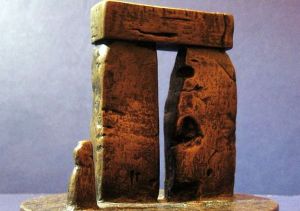
And this is a resin Stonehenge trilithon replica, 8 cm high and painted to look, not like stone, but, curiously, like metal. We spotted it on ebay some time ago, but its time has since expired. Striking looking.

No scores in this post. We’re just biding our time until our reader in New Jersey sends us the photograph we’re waiting for. We also have a nice pinhole picture Stonehenge model, complete with parking lot, in the works. People are making Stonehenge replicas much faster than we can post them.

Other ways to bring Stonehenge into your life, of course, many of which we have posted here in the past, include pre-made and make-it-yourself models, jewellery, cakes, small garden henges, photographs and more, including, of course, subscribing to Clonehenge or following it on Twitter or Facebook. When we remember we post a foodhenge to Twitter on Fridays.

There you have it. We managed to cop out and strike 4 items off our lengthening list at one blow. Someone recently told us that they think numbers of Stonehenge replicas will increase faster as we approach December 2011.  We need a young padawan. Does anyone want to send us their child to have him or her learn the Stonehenge-replica-posting trade? Calling for a Clonehenge apprentice! We promise to pay as much as we pay ourselves.

The New Jersey photo has just come in. Look for it next week. Until then, as always, happy henging!

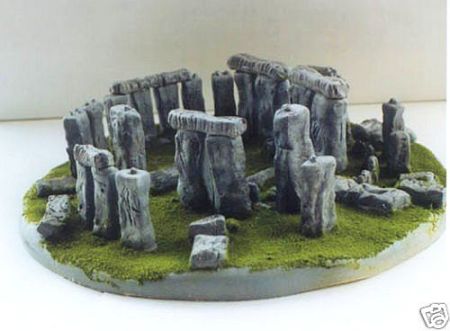
Citrus-Henge in the Riviera, Comes with its Own Druid!

photo from archaeology.co.uk

There are certain Stonehenge replicas that cause us to let out little chirps of sheer joy. The best example of one that made us insanely happy is, of course (as we are sure you will recall) the Taipei interactive Stonehenge sculpture. While the replica in this post doesn’t detect your approach or talk to you the way that one does, it is still squeak-worthy. Allow us to present to you… (drumroll) Citrus-henge!

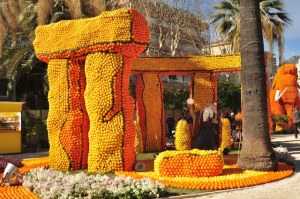
Yes, ladies and germs, that is a Stonehenge replica made of lemons, limes and oranges. In France. We don’t ask for these things. Honest. People just can’t help themselves.

The story is, the French town of Menton, on the Riviera very near the border with Italy, has a lemon festival every year in late February and early March, featuring large floats with structures made of citrus fruit. Each year it has a different theme,this year’s being Great Civilisations. And there amidst the Babylonians, the Vikings, the Mayans and the Greeks, voila! someone did a Stonehenge.

Come to think of it, we may be burying the lead story here. Someone in France decided that something English represented a great civilisation. Of course the original was built over four thousand years ago, so it can’t be construed as a straight-on compliment. Wouldn’t be French if it were.

We would be content just to post a life-sized partial Stonehenge replica made of citrus, but there’s more. Oh, yes, my friends–your eyes do not deceive you, as much as you may wish they did. That is indeed none other than–a druid!!! Ya gotta love it. (these two photos courtesy of the carpe annum blog. Many thanks to them!) Clearly the message that druids did not build Stonehenge has not gotten through to people worldwide just yet. They did do a nice job on it, though, didn’t they? We wonder who got to keep that druid.

As to scoring, we are looking at a surprisingly well put together partial Stonehenge. The replica includes the three-lintel stretch from the outer circle, a slightly larger trilithon from the inner horseshoe, some bluestones, and what appears to be an altar stone. Someone also took time to give appropriately uneven shapes to the “sarsens”.  Considerable care and observation went into this. Well done. Score: 7 druids! We are even considering adding another half druid for the wackiness of it all. But they do have a druid already, don’t they?

Our thanks to friend-of-the-blog David Raven of Elmet Garden Services in West Yorkshire.  Thank you, David!  He’s very good with plants, everyone, and we encourage you to hire him to work the garden. A man in touch with the spirit of the land.

And until next time, folks, happy henging!

The “Better Than Stonehenge” Henge: Esperance’s Replica Rises at Last!

photo from The Esperance Express, showing Kim and Jillian Beale at the henge

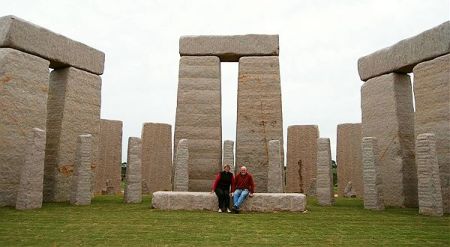
Was ever an erection so eagerly awaited? Well, yes, probably, but still we have been watching these stones since almost before they were cut, so it is delightful to see them standing at last! This is the Stonehenge replica in Esperance Australia, made from the stones cut for the much ballyhooed Ross Smith replica that died, so to speak, in utero with the stones still in the quarry because of money problems.

Then we got news that some enterprising individuals in Esperance, a town in southwestern Australia famous for beautiful beaches and for things like birds and bits of Skylab falling out of the sky, were going to buy the stones from the nearby quarry and build their very own tourist mecca/modern monument. They got a discount–there isn’t a huge market for unused life-sized Stonehenge pieces. The names Kim and Jillan Beale started to float into view. (Yes, the Jillian Beale in that racy Rotary calendar, but that’s another story.)

Our last update came in February, assuring all that plans were going forward. Then apparently we missed an article in March, in which, well, here is a quotation from it: “Mrs Beale was confident StoneHengeEsperance would be more visually striking than the mysterious English prehistoric monument. “It will beat it hands down,” she said. “We hope it will become a major attraction for Esperance and WA. It will be absolutely fantastic.”

We could do a whole post just on that, discussing the merits of the spelling of StoneHengeEsperance, whether this is in fact “the world’s first full-size stone replica of Stonehenge” and just how likely it is that the new structure is more beautiful than and will beat the real Stonehenge “hands down”, but time and news have moved on and so must we. We trust that our readers are of the sort who can make up their own witty remarks in a pinch.

Today we are celebrating the long awaited construction of the monument and discussing instead the more recent article which begins promisingly with this sentence, “JILLIAN and Kim Beale’s construction of what is thought to be the world’s only life-size replica of the ancient Stonehenge Druid ruins on their 1,066 acre Merivale Road property has taken another step forward with the addition of a new outer circle.

Let’s start with a discussion of whether this is the world’s only life-sized replica. No*. Then we go on to the phrase “ancient Stonehenge Druid ruins”. And when we are done LOLing we ask where did they do their research–on a forum for people who always dress in Renaissance Faire clothing? Someone needs to send a strikeforce into that sentence to take out the word Druid. Regular readers know, but we repeat: druids could not have built Stonehenge. They didn’t even arrive (or develop)  in England until 1000 years after it was completed. And, for the conspiracy theorists, is there any hidden meaning in that 1066 number??

We have tried to read the rest of the article but can only conclude that the reporter misinterpreted her own notes when she wrote it. There is talk of “horseshoe stones” and “an outer circle of 19 trilithon stones, surrounded by a circle of 30 sarsen stones”.  The right words are there but it doesn’t sound as if they are in the correct order.

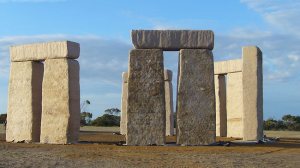
All in all, what we see in the top picture looks very good, although the lack of lintels on what we can see of the outside circle naturally concerns us. Despite the strange reporting it is getting, we think the replica (we can’t bring ourselves to call it StoneHengeEsperance) will be awarded quite a few druids (our tongue-in-cheek scoring units) once we get a complete account and view of it. We’ll try to keep you posted, but if you see something about it before we do, please let us know. Meanwhile it is time we add it to the list of large permanent replicas.

Our thanks for alerting us again go to the lovely and talented @salisbury_matt , aka Matt Penny, who is still slogging away at SalisburyandStonehenge.net. Poor lad. And thanks to you if you have read all this way, or even just skipped down here from the beginning. Until next time, happy henging!

* Life-sized replicas other than the Montana replica linked above include the cement replica in Washington State, the Circle of Life in Connecticut (of  granite as this one is), and the BBC’s Foamhenge, which, alas, no longer stands.

Cakehenges and Word Fields: the Plight of the Carbon-Conscious Blogger

photo from TheSugarSyndicate.com’s Flickr account
Believe it or not, we are swamped with new Stonehenge replicas of all sorts and you might think, if you were not in possession of all the facts, that we should be posting here at least a couple of times per week, if not every day. You could be forgiven for assuming we are just lazy.

But nothing could be further from the truth! What people don’t realise is that unlike other bloggers, who just use mass-produced letters and words, often imported from countries where they have been grown with pesticides by people who are paid sub-subsistence wages and who have no access to health care despite their crippling work, here at Clonehenge we personally grow every letter and every word ourselves, nurturing them with great care and at much expense.

This labour of love gives us precious little time for the fun of producing these posts for our adoring public, but because we know you are waiting breathlessly we tear ourselves away from the Palabra beanfields to craft these posts like drystone walls, turning and fitting each word and each letter until somehow they fit and balance to make the august edifice that is Clonehenge.

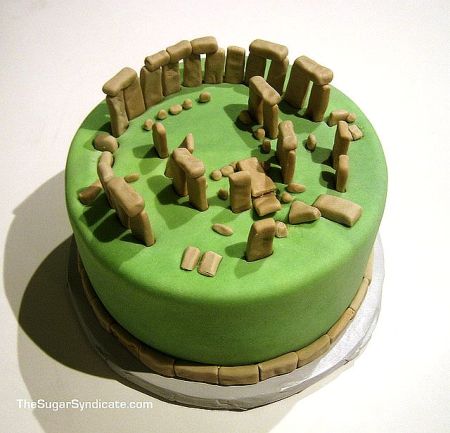
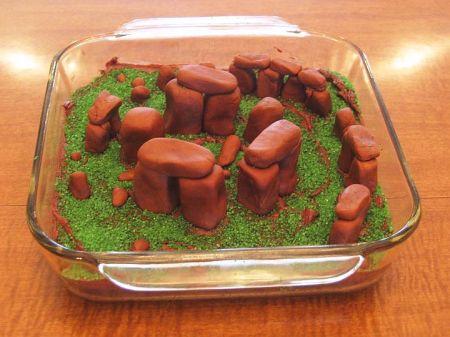
Today our topic is Stonehenge cakes, or cakehenges. The example above, beautifully done, was the 2007 creation of a Chicago-based bakery, The Sugar Syndicate, which is, alas, no longer a going concern. It is an outstanding example of the cakehenge genre, second only to our favourite, the mom-made cakehenge from New Zealand’s Vanda Symon.

photo by Siobhan Jess Sarrel

The confection in the pan above was posted on the Clonehenge Facebook page by reader Siobhan Jess Sarrel, about whom we know nothing, especially not how to pronounce her first name. She baked gluten-free brownies, used fondant to fashion the Stonehenge on top, and took it to a friend’s solstice party. (We do not know if Ms. Sarrel is in the northern or southern hemisphere, so we don’t know if it was a summer or winter solstice party.)

These henges have many things right with them. First, they are our preferred type–replicas of Stonehenge as it stands today. In both cases the builders looked at pictures of Stonehenge to guide their modeling. Both show the trilithon horseshoe and the three remaining adjacent lintels. Both show fallen stones.

The top cake is more accurate in scale and placement and also includes the bluestones. It is impeccable and professional looking. The brownies, on the other hand, are gluten-free.

This may not mean much to the average reader, but for us this is a huge factor. Not only are we at Clonehenge among those who are required for health reasons to eat gluten-free foods only, but it is a little-known fact that the original Stonehenge on Salisbury Plain IS IN FACT GLUTEN-FREE!!! Well caught, Lady S. J. Sarrel!

Scores? We give the Syndicate henge 7 ½ druids and Ms. Sarrel’s brownie henge a solid 7. We figure we don’t want to run afoul of any syndicate out of Chicago!

Well, it looks like we’ve just about run out of words that are developed enough to pick. We’ll have to let the fields grow a bit before we can post again. Here’s hoping the aliens don’t come by and ruin things with crop circles!

If you’re still hungry for cakehenges, find more here. And until next time, happy henging!

P.S.: What the hell is fondant, anyway? Yes, we know we could google it but the truth is we’re far too lazy. Oops.