Stent Henge–and A Happy 2010 to All!

photo from ADAMANT, used w/o permissions–permission pending

Happy New Year, Gentle Readers! The first henge of the year is one that will be hard to top. It’s made of stents of the sort used to prop open coronary arteries. The copy accompanying it reads:

A reader reports one of his dearly departed co-workers spent a great deal of time creating a scale model in stents of Stone Henge. Stent Henge was created with pieces of scrap Nitinol self expanding vascular stents embedded in cured Sylgard 184 elastomer. It is a nearly perfect reproduction of the layout of the famous stone circle in England in a compact package just about the perfect size for a paper weight. It took nearly a year of work during slow periods. ” [links added by us]

We wonder, how do you even do something like this over a year? Do you add the clear silicone slowly, layer by layer? We don’t know, but the outcome is impressive and accurate. See the section that has retained its lintels? And the inner trilithon horseshoe?

Whoever made this used a photo of Stonehenge as it stands today as a guide. Perhaps he kept it in his chamber–or maybe he knew it by heart! I suppose we shouldn’t go on in that vein. (Don’t beat us!) Heh. Our New Year’s resolution is to actually be funny. Wish us luck!

Score: 7½druids. It’s made of unusual materials, and someone has taken pains to make it accurate. That’s what we like here in Clonehenge country. Posthumous kudos to the builder of this eccentric beauty!

Share

Stonehenge of the Orchids, South Africa

photos by Jim of Cal Orchid, with permission

At Clonehenge we scour the earth for replicas so you don’t have to! Today we bring you an entry from the exotic land (unless you’re from there!) of KwaZulu-Natal in South Africa, the east coast city of Durban, where the South African Orchid Council held their orchid show in September.

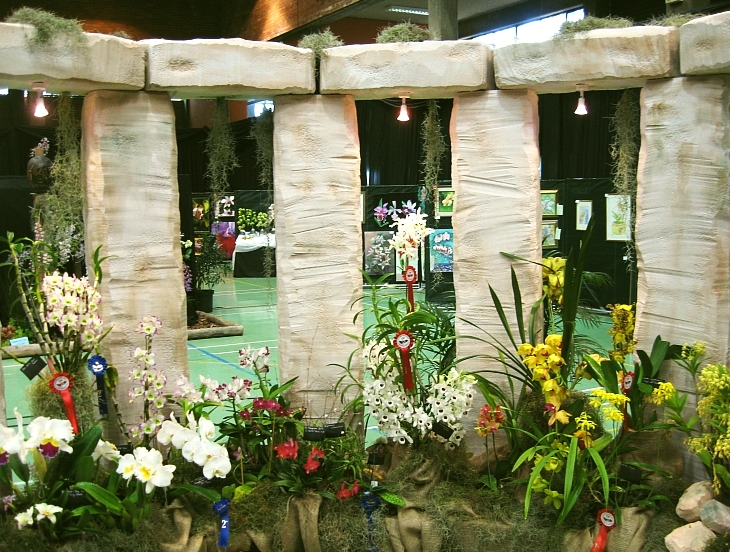
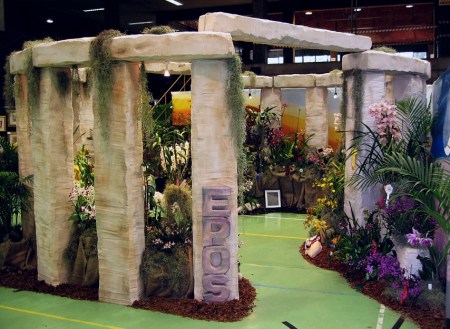
The winning stand in that show, created by the Eastern Province Orchid Society, was (Ta da!) Stonehenge! Scroll down a little at this link for more pictures. We offer our congratulations.

Very early on, we thought of miniature golf courses as likely Stonehenge replica sources, but we can’t believe we didn’t think of flower shows until now. It seems so obvious! The beauty of it is, flower show people have that tendency to be meticulous and to do things right. Hence this rather nice ring with the Spanish moss draped over the lintels.

And who knows–maybe they’ve hit upon something here. Not that orchids were associated with Stonehenge necessarily, but what about plants? Could certain plants have been associated with and planted around certain megalithic sites? Perhaps research has been done, analysing pollen from certain levels of excavations, but we haven’t heard of it. We can imagine medicinal herbs or others regarded as powerful in other ways transplanted there to add to the mystique of the site.

Or maybe not, but these days Stonehenge replicas are often associated with gardens and plantings. The graceful curves and gentle chaos of ephemeral plants are shown off to great advantage against the solid ageless stones, or at least their imitators.

Score: 6½ druids for Stonehenge of the Orchids. It manages to be both humourous and stately! A combination we could all aspire to, especially as the holidays come on.

Note: In the Durban area, evidence of human occupation goes back 100,000 years. Stonehenge, by comparison, would be modern there.

Share

Nesshenge: The Stonehenge Rope Experiment

photo from John Hill’s article on the Antiquity website, with permission

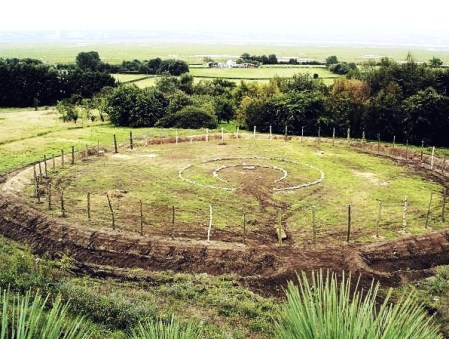
We had this bookmarked for quite a while, uncertain whether it belonged on the blog, but then a friend of Clonehenge (Mr. P.G.) sent us the link asking if we’d done it yet, so here it is. Last year, 2008, Liverpool was designated European Capital of Culture by the European Union. As a contribution toward that, John Hill and others from the University of Liverpool by a very simple method including a rope, simple counting and the sun’s shadow, laid out the pattern of positions that would be necessary for a model of Stonehenge.

They then measured out a smaller pattern to suit the site and proceeded to dig a ditch and bank and mark the sites of the Aubrey holes. You can see a diagram of this stage of the original Stonehenge here. A fuller explanation of what Hill and the others did can be read in the article we mentioned. You can see the result above.

This construction certainly qualifies to be posted on Clonehenge, going by Rule Number 6 of our Rules of Henginess,  and is in fact the first henge to qualify on that basis alone. A Stonehenge replica without uprights or trilithons–we were waiting for this. Well done! They placed the earthen bank on the inside of the ditch, too, another distinctive feature of Stonehenge, as other henges tend to have the ditch on the inside.

These things may seem minor, but they are pleasing to find in a world where one trilithon of anything is called a henge.  This is a true Stonehenge replica, a replica of the developmental phase of Stonehenge called Stonehenge 1 (the phases are described on this Wikipedia page).

So how do we score this? We haven’t even found anything to mock or be silly about, but we don’t deduct points for that, tempting as it might be. Score: 8 druids. Because if druids had been involved in building Stonehenge instead of coming at least a millennium later, this is very much like what they would have built at this stage.The article points up that even the astronomy and celestial/landscape relationship have been painstakingly provided for.

What more could we ask? Well, there’s the question of ambiance. The spot is perfect for what its creators were doing, but here at Clonehenge, Stonehenge is not just a work of engineering and astronomical precision. We have learned that some people see it as sculpture, some people see it as a sacred site, and many people regard it with awe. (Let’s face it–gigantic looming stones–ftw!*) If Stonehenge looked like this, there wouldn’t be so many replicas and we wouldn’t be talking here, but this is brilliant and we will add it to our list of large permanent replicas!

*(we mean that to stand for for the win, not free the whales, or f*** the world, which would be, well–sort of humourous in that sentence, actually, now we think of it . . .)

Share

Mountain View, California–It’s a Mystery!

photos by Ghostly Penguin Display (aka Khoi), with permission

We said we weren’t going to post any more but we can’t stand knowing of large permanent replicas and not posting them! People count on us for their Stonehenge replica information. Well, in our dreams, anyway!

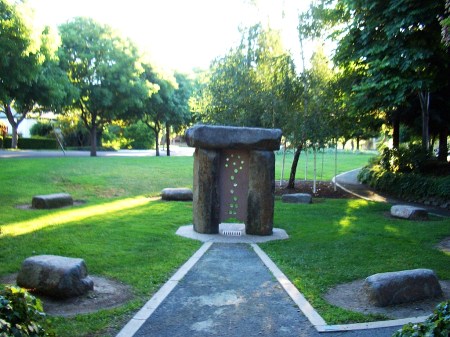
We actually knew there was some kind of little Stonehenge in Mountain View, California, but until now we had never seen a picture of it. Then one day recently we were idly searching the interwebular thing-a-majiger and, voilá! Here is this odd little sculpture/replica trilithon/circle in a park. With photos by a fellow of the excellent name Ghostly Penguin Display. (No, sorry, we don’t know why either.) Well, obviously we have to post it.

But what is it? We have stared at these pictures for a while, before and after doig searches to see if there’s any info online about this. We found nothing Perfect! That leaves us free to make up whatever we want.

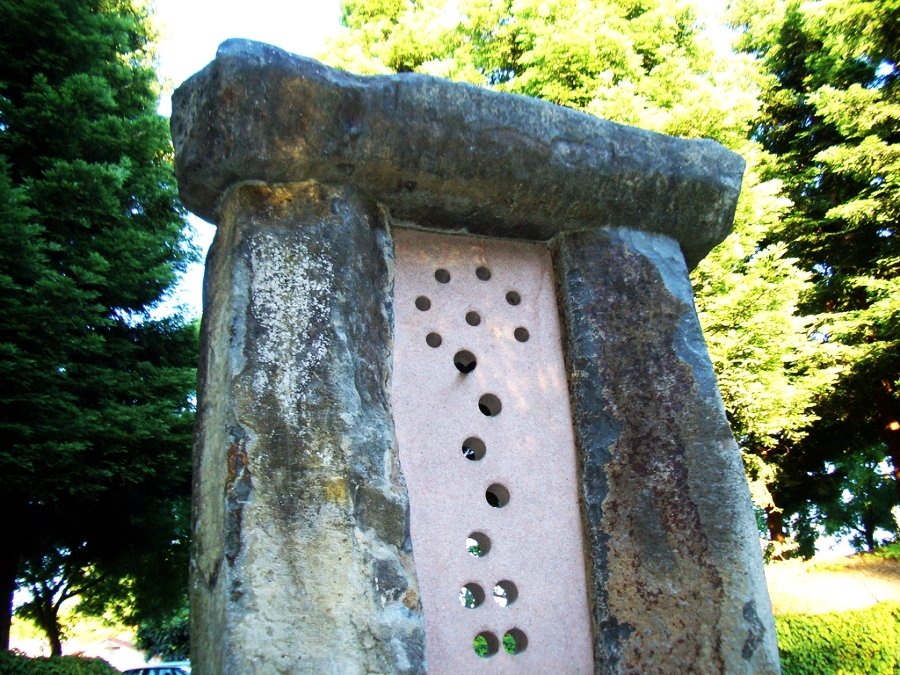
The most alarming thing about this one is that grate under the trilithon. We had to reject out of hand (so to speak!) the theory that it might be an outdoor urinal. Even California is not that funky. And then there’s that strange screen between the uprights, with the pattern of holes in it. Astronomical sighting holes, lining up with sunrises and sets? Stars? The moon? Unlikely with that configuration, although it’s likely that at least one of them will line up with something.

No, the conclusion we have come to, and we plan to stick to it even if the designer or someone points out that we’re wrong (which is not unlikely), is that this piece, although dry now, was designed as a fountain.

Which makes it our third Stonehenge fountain–fourth if you count one built on an old fountain. There was the Falling Water Designs replica, the Warwick University replica (small and temporary), and, of course, the first replica that caused us to use the word lameness in a post, the Waterfall Stonehenge, for sale now. There’s actually another, since one of the trilithons at Caelum Moor in Texas is a fountain, too, although most photos don’t show it running.

Clearly there’s a pattern here, and we think this is the best explanation for this odd yet charming construction. We like the circle of low stones around it, suitable for people to sit on and listen to the falling water while reading or just thinking, or trying not to think. We want one of these in our town’s park!

Score: 6 druids. We may have been influenced by the nice light captured by our Ghostly Penguin friend. We admit we’re a little mysified, too, by that tree or trees just behind it. A young flowering tree with supports? A small grove with some young white birches? We can’t quite figure it out, but that’s okay. Stonehenge is supposed to be a mystery.

And, yes, we have a couple more to come including a nice German one we had somehow missed. See you soon. Happy Thanksgiving to our Stateside readers!

Stonehenge at Elf Fantasy Fair 2008

photos by Anneliez, from Flickr by Creative Commons License

We aren’t going to score this one. It’s just a trilithon, squarish and non-ancient-looking. But fun! We hadn’t heard of the Elf Fantasy Fair before, but believe us, if we were real people and not just soul-less blog bots, we would definitely make a point of going to Elf Fantasy Fair 2010!  If nothing else, on the power of this photo alone:

(Even though it seems only in 2008 did they have a Stonehenge.)

And believe us, there are more where that photo came from, whether you fancy the costumes or the girls! Look at this fellow, and these two. Many more photos scattered about the net, and some of the greatest costumes we’ve ever seen! Do an image search and you’ll see.

What? Oh, yes, the Stonehenge. First take note of what appears to be Ogham, a medieval Irish alphabet, cut into the  “stone” on the right side of the trilithon. An odd detail, but there’s always a new wrinkle in any Stonehenge, it seems.

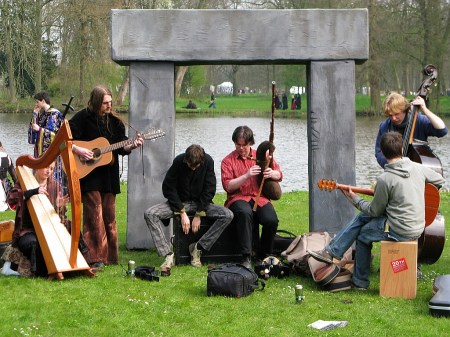
We like this photo, with musicians making music around the stones. The connection between Stonehenge and music seems natural. Research has been done about that, but since it was done at the Maryhill replica, we’re not sure how accurate it is. People say the Maryhill replica is a lot like the real Stonehenge, but you only have to look at it to know it’s not. The stone shapes and the concrete materials are too different.

The music connection, however, is unavoidable. Many albums and CDs feature Stonehenge on the cover. Of course there’s Spinal Tap. And Oxegen in Ireland, the music festival we would most like to attend, features a Stonehenge-like portal for its entrance way.

Portal is perhaps the operative word. The trilithons at Stonehenge look like portals, as if one could stand in the center and walk out into a different world or another different world, depending which one you walked through. Music at its best serves a similar function, opening temporary new worlds or sometimes new doors in our everyday world, bringing the transcendent to the mundane.

Or–that could be hogswallop. After all, we’re just bots!

Stonehenge of Roanoke County, Virginia

stonehenge roanoke

photo by D. R., with permission

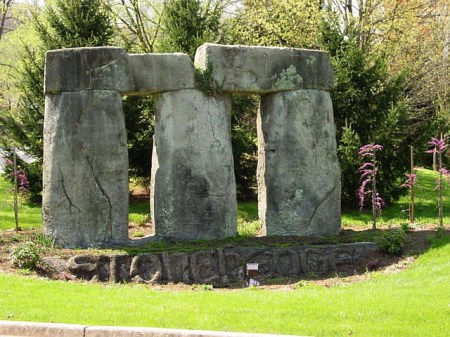
Many, many companies and businesses–consulting services to pavers to home builders to golf courses and many others– are named Stonehenge. You may well ask why. But curiously, most do not build any Stonehenge-ish thing to put outside their headquarters. In Roanoke County, Virginia, however, a community of homes that calls itself Stonehenge had an artist create this very nice twenty foot high monument in 1978.

The artist, George Solonevich, was from Soviet Russia [obligatory joke: In Soviet Russia, henge stones you!] and had spent time in a concentration camp because his father was a dissident, eventually ending up in Roanoke County with his wife, Inge, also an artist. How it came about that he was selected to create this sculpture we do not know, but it was a happy accident!

Gone are the stiff straight lines of most American replicas, gone is the monotone look and the obsession with the simple trilithon. In these five faux stones (quintithon?) made of wood, wire, and stucco, he has captured that elusive ancient feel most replicas miss. Mr. Solonevich is with us no more, but maybe he can hear us when we say, Well done, sir!

And, yes, it does have the word Stonehenge just below it. But that’s better than the one in Athens, Georgia. Remember that one, with Stonehenge written across the lintel? Have a look at this link and then tell us Mr. Solonevich didn’t take the concept to a higher level!

Score: 6½ druids! You can see a brief video interview (no mention of this sculpture) with George Solonevich here. [In Soviet Russia, view inters you! Hmmm, we just can’t seem to catch on to that meme!] As far as we know, this Stonehenge isn’t on any of the other Stonehenge replica lists out there. Another Clonehenge exclusive, and another large permanent replica!

Share

Takino Stonehenge With a Buddha—in Japan!

takino 2photos by kamome, used according to Creative Commons License A-NC 2.0

below–the center of the photo above, enhanced to show the shrine

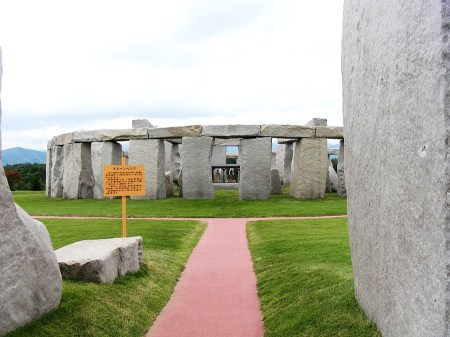
takino buddha shrineYokoso! (Welcome!) On Japan’s northern island, Hokkaido, the Makomanai Takino Cemetery Park hosts, among other impressive stone sculptures, a full sized Stonehenge replica. A striking element of this replica is that the ditch and bank that make Stonehenge a henge have been included. See the bottom photo at this link. Nicely done!
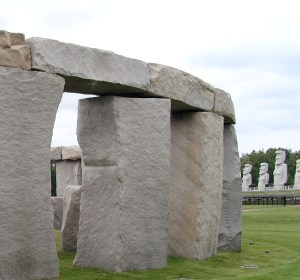
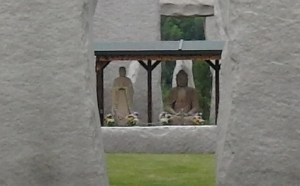
Of course, the authentic feel ends in the middle, at the Buddhist shrine. There’s also a giant Buddha nearby, and a row or two of Easter Island moai.

takino moai 2See them there? They and Stonehenge often seem to end up hanging out together. We can think of five replicas we’ve posted or linked to that had moai, too. ( Texas Stonehenge II, Raven Hill Discovery Center in Michigan, Harry Rossett’s in Indiana, Kennewick in Washington State, and someone’s  Obama Gardens of Hope. There may be others.) Weird, considering the originals are on opposite sides of the world, but okay, we’ll go along with it for now.
Do you think it looks like a pretty gaudy cemetery? But not everyone wants to rest in piece, right? Some are hoping to rock on!

It’s a great replica: made of real stone, cut unevenly (leave it to the Japanese to get it that cutting the stones in perfect rectangular prisms detracts from the monument!), bluestones included, ditch and bank included. It is true that they may have added things here and there. There probably wasn’t a buddha in the center 5000 years ago, but there may have been a shrine. Who knows?

Score: 8 druids. We would give it more if it weren’t rubbing shoulders with the moai and the huge Buddha. Good ambience requires space.

What a replica! Maybe we should have saved it for Clonehenge’s one year birthday, which is coming up soon. We’ll end with a sentence we like from  a Google Translate page of a blog post about a trip to this cemetery. (Google Translate makes us lol!) “Why the road to heaven is like this?” A koan to ponder . . .

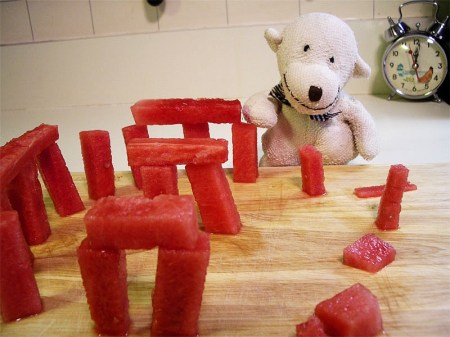
Watermelonhenge, or, Where the So-Called Monkey Gets His Smile

watermelonHenge 2

henge and photo by monkey, with permission

The season is over in the northern hemisphere, but here it is–watermelonhenge, or, as monkey (a white stuffed monkey who looks curiously like a dog) calls it, watermelon stonehenge. And as monkey says, “everybody loves a good henge.” Especially when it’s tasty! He offers a tutorial here. And we belatedly discovered he has his own website here.

Of course this is not the only watermelonhenge on teh intarwebs (here’s one),  but it is the nicest. Monkey seems to benefit by being a world traveler and possibly having influential friends. It’s hard to tell about someone who uses a vague etymological term for his name. He’s not our first monkey with a henge, by the way. Some of you may remember this sweet children’s henge with a mother and child monkey pair along with a dog, which is, frankly, what monkey still looks like to us!

But on to the henge–nicely done for a foodhenge. Only two trilithons in the middle and not many fallen uprights, but at least he got the outer circle and didn’t just make it a ring of trilithons. That’s so last century! Anyway, we make allowances for foodhenges, as you know. And that incredible smile on monkey’s face tells us he is very happy with how the whole thing turned out.

Score: 6½ druids. We can see how someone clever with a knife could make quite a nice little watermelonhenge for a party plate. We recommend tapering the uprights so they’re smaller at the top. Why not give it a try? Look how well this fellow did and he just has fingerless stumps for hands! Well done, monkey! Let us know if you do a bananahenge. We already have a dog bone henge.

[And if you want to serve a non-henge watermelon plate for Halloween, we suggest this.]

Share

Spinal Tap–The Other Stone’enges!

Stone_Henge_tapphoto by Peter Renn, from the BBC

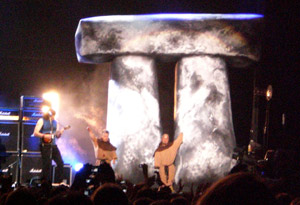
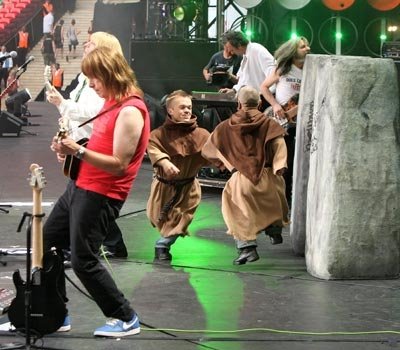
It is not at all clear what the little Stonehenge replica, actually a mere trilithon, in the movie This Is Spinal Tap, is made of. Some say it was inflatable, some say it was made of foam. We dedicated our 100th post to that one, the only Stonehenge replica most people have ever seen. But there have been others.

Spinal Tap, although a mock band, also tours, and on some but not all of their tours they have had other Stone’enges, at least one of which, and possibly all of which, were inflatable. Inflatable but apparently not always inflated. People who attended their concert at the Wembley arena in July report that they had trouble, um, keeping it at attention . . .

Spinal Tap - StonehengeAt a Glastonbury concert in June they had a rather smaller one, but it appears to have been closer to 4 feet than 18 inches high.
The inflatable Stonehenge is in general a much rumoured but rarely seen item. It is said one was commissioned a few years ago for a high end party in Manhattan, but if there are pictures of it online, we have not found them. There may be others, too, rentable for paint ball skirmishes and the like, but those, too, we cannot find.

We think it is an unfilled niche! Why doesn’t every party place have inflatable Stonehenges to rent for garden parties and village events? We can imagine them at fairs, music festivals, all kinds of gatherings. And, of course, eventually someone would be seized by the urge to fill them with helium. A floating inflatable Stonehenge! It would be something the world has never seen. And we don’t just mean a trilithon, people! Think of it!

Score for the Spinal Tap touring trilithons: 5 druids. And it’s that high only because they’re funny and because, let’s face it, they put Stonehenge replicas on the map. We want to thank Emma Harrison, bigmollusk, of World Before Wireless, for pointing these out to us. Emma, we await that inflatable Stonehenge you promised us. Deadline is December 21!

Rock On, dudes!

Share

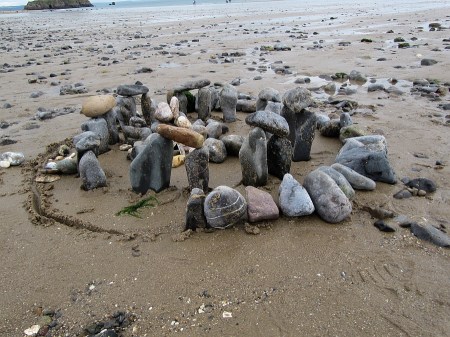
Okay, Don’t Make Us Come Over There! (Beach Stone Henge, Wales)

beach 5photo by Thelma June Jackson, with permission

It’s the Welsh. Well, it may not be the Welsh, but it is Wales. Remember this one? Well, the madness continues as the force emanating from Carn Menyn in the Preseli Hills forces people to reproduce Stonehenge everywhere all the time. In Wales, all children’s blocks are shaped like sarsens and every garden has at least one Stonehenge. Police patrol the roads to stop people building Stonehenge replicas on them at all hours. In restaurants everything is served in little trilithons. People even wear little Stonehenges on their heads!

Okay, well, we may be exaggerating just a wee bit. But, look, there’s no denying this is a second beach pebble henge. Two is more than one! We rest our case.

This is clearly a holiday henge. The builder did that ring of trilithons inside but then made a cairn of small stones in the middle and a partial ring of stones that he or she just laid flat around the outside, drawing a line, probably with a finger, to complete the circle. To us this says someone intended to build a Stonehenge replica and then when it started to get complex said, “Bugger this, I’m on holiday!” and did the rest in a hurry.

Still, it caught the eye of a passerby and here it is, an example of what you can do when you’re on a beach and the weather (or the water) is not nice enough for swimming. Beach stone henges are one of the most common types of Stonehenge replicas, but they can be a gateway henge, leading to a henge obsession that can disrupt your life and your relationships! Be forewarned.

Score: 6 druids. Looking at that beach, on second thought, please do make us come over there!

[Here’s another pebblehenge.]

Share