Butterhenge II: Stonehenge on a Plate

butterhenge 2photo and henge by Dave and Janet Burt, with permission

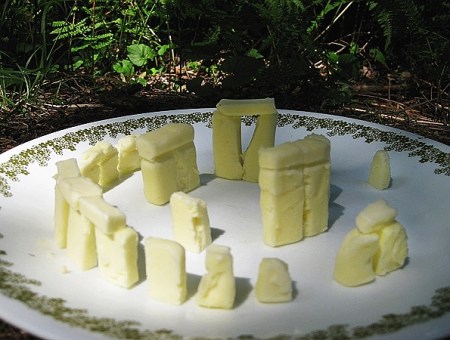
Finally the sculpted butterhenge we’d hoped for! To use a quip from a comment on the last butterhenge we posted, I can’t believe it’s not Stonehenge! We were interested to learn that Dave and Janet Burt, its creators, were not inspired by our request for a sculpted butterhenge, but were forced to sculpture by a lack of enough sticks, not even aware of the pioneering butterhengers before them.

But in henging as in real life sometimes difficulty breeds excellence. It is not perfect, but unlike many replica makers these two actually took time to look at a picture or model of Stonehenge. Some of those sarsen shapes do look familiar!

One of the hengers writes “I think the plate makes a nice outer ring, and placing it in the ferns gives it a magical kind of look (although not reminiscent of the stark English countryside). Seems to match most of your criteria, although am hoping size doesn’t matter in this instance.” So they have given thought to the ring and ditch and even to the plain itself, if only to note that it is not accurately represented. *nod of approval* In all things, folks, attention is key. And does size matter? We leave that question to greater minds than our own. There is room for every size in the world of Stonehenge replicas.

Score for this bovine-sourced replica: 7 druids. Maybe even 7½. And Dave and Janet say they’re already put their thinking caps on for the next henge project. If this one’s any indicator, we’re sure it will be the cream of the crop!
Mosaic Fruit Jelly Stonehenge: Celebrating Our 200th Post!

stone-hengephoto by Paula of The Cookie Shop, with permission

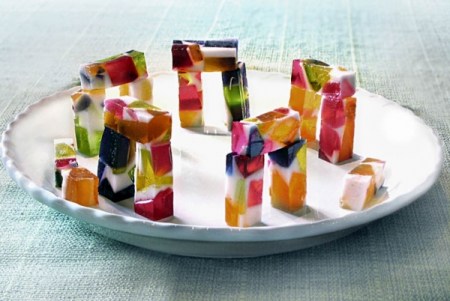
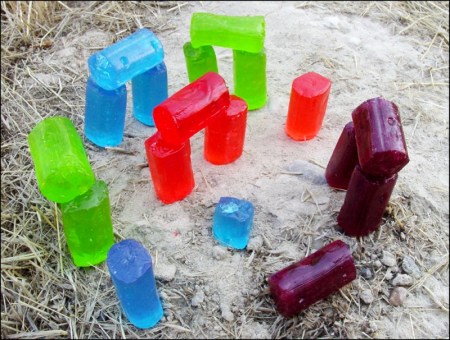
Doesn’t this look like a party? Today we celebrate our 200th post on Clonehenge and our biggest month ever, stat-wise, with this colourful and yummy-looking Stonehenge all the way from Brazil. If we could we would send out a dessert like this to everyone who has supported us, contributed to the blog, or just read it over the last 9 months. Many thanks to all!

We’re not sure what possessed Paula to rebuild Stonehenge with the leftovers of her candy, but she created a neat little beginner’s henge, a circle of trilithons with a couple of fallen uprights. Nothing in the form that we haven’t seen before, but it just goes to show that the mysterious force that makes people build Stonehenge replicas hasn’t waned since this blog began. We encourage playing with your food!

And, yes, we’re back in South America. This is our first Portuguese-speaking henge. Doesn’t it seem like people are more colourful in Brazil? It must be that yerba maté they drink. Score: 6½ druids. Thank you for helping us celebrate! Many happy returns to us all.

Candy Corn Henge: Our Sweet Tooth Acting Up Again

candy corn hengephoto by erne the ferle, with permission

As if you needed proof that we aren’t the best at what we do, now we’re posting a photo that good bloggers would set aside and post at Halloween. Nine or ten weeks from now, a classic trick-or-treat candy henge would be just the thing to post. To be honest, we did consider waiting. But then we thought, what if we never get to? Things happen–the world could end or else we could die, even before we finish this post! Life is so uncertain!

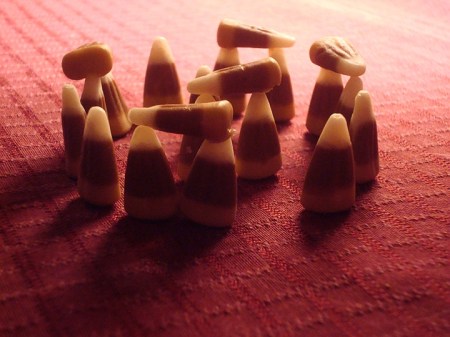
Ahem. Not only that, but we were running low on things to post and we did have this on hand . . .  All that aside, here’s another candy henge, made mostly of sugar and corn syrup and honey and food colouring. We like the touch of leaving some uprights un-linteled. Even without fallen stones, it gives that desired ruined flavour to the photo, helped out by the red Salisbury plain.

candy_corn_dancing_lg_whtIf you had asked us, we would not have guessed that candy corn would stand up like that. The ones without legs, we mean. We know the others can stand up–and even dance!
Score: 5½ druids. We’re getting soft in our old age. But look–we are nearly finished the post and we’re still alive after all. Sweet!

Candyhenge, or The Little-Known Druid Years of Queen Frostine

candyhenge

photo by Toy Master, with permission

[note: it has come to our attention that our British friends may not have shared the joys of CandyLand as children. It is a board game peopled by fantasy characters like the beautiful Queen Frostine and the evil Lord Licorice. It was often the first game for children because the characters advanced by colored cards matching to colored spaces, with no numbers. And the story inside the lid of the game was some people’s first introduction to the fantasy genre.]

So here’s the plot: Queen Frostine makes an impulse marriage with the Jolly Rancher and together they decide to memorialise their love with a Stonehenge replica. Little do they know that over in the next kingdom a jealous Lord Licorice is breeding a race of sugar-eating bats . . .blah, blah . . . and then everything went horribly wrong! . . . blah, blah . . . happily ever after.

Who says we can’t write a screenplay? The truth is, plans for a Candyland movie do exist, and we doubt they’ll think of the exciting henge angle without our help. When someone sent us a link to this candy replica, we saw our chance to do some hinting. (We wanted Terry Gilliam to direct, but sadly it is not to be.)

Back to the henge. Ann from Heritage Key sent us the link to the picture, which is probably the most recently-made item in the Heritage Key Flickr group. We do like the colours and of course the juxtaposition of food on the ground adds that bit of squeamishness that can substitute for drama in a pinch. Score: 5½ druids. It’s just a ring of trilithons, after all, and it doesn’t quite have the charisma of sausage henge.

We think Hugh Laurie would make a great Lord Licorice! When you read this post, Hollywood movers and shakers, give us a call. We have more henge-movie ideas you’ll love!

BrickHenge at Last!

CD3brickhenge

photo and henge work by Dr. Thomas Grier, with permission

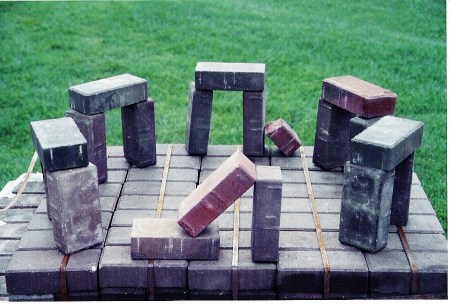
Somehow we got through 187 posts on Clonehenge (yes, 187. We’re as surprised as you are, believe me!) without posting a brickhenge. To quote an authority on Stonehenge replicas–that is to say ourselves–“anything vaguely rectangular and three-dimensional eventually becomes the material for a henge,” so brickhenges inevitably happen. Friend of the blog Simon Burrow blogged one, and there are others, even an album cover.  So how we managed to avoid posting one until now is hard to say. That is, unless you have no trouble pronouncing the word laziness.

But now, with the help of Tom Grier, professor at Winona State University in Minnesota, admirer of ancient sites, and, when it comes to visiting Stonehenge replicas, a spectacular repeat offender, we have a brickhenge to post without actually having had to type the word brickhenge into a search engine. Dr. Grier’s story goes like this:

One day while crossing campus, camera in hand, I saw a neatly stacked pile of bricks, with one or two resting against each other. For some reason, it reminded me of Stonehenge. I spent a moment or two rearranging a few bricks– with students and faculty walking by and snickering– then took a few photos. This was done just to amuse myself.

This is common in the afflicted. The henge form is able to manipulate the volition centers of the brain in a way that fools the victim into believing that he or she thought of and executed the construction of his own free will. This usually works more efficiently with alcohol, but some very sensitive individuals, especially those who look at too many replicas or photos of Stonehenge, can be made slaves to the henge parasite while in a sober state. (Of course, we don’t know Grier and we may be making a false assumption there!)

Yes, it is the traditional circle of trilithons often resorted to by the less serious replica builder, and, yes, that three-brick construction closest to the camera is unorthodox, but we don’t always subtract druids for that. And of course there is the courage exhibited by persisting despite the snickers of students and other faculty. Score: 6½ druids.

You will hear from Dr. Grier again. He has promised us an overview of his visits to several of the replicas we have listed, and we await them eagerly. Meanwhile, we recommend you visit his remarkable and beautiful photo gallery.  We end with this post script: “By the way, sadly, BrickHenge stood proudly on campus nearly a full week, until some stone mason used the resources to finish a stone paver base for a wrought-iron campus bench. Ironic, isn’t it?

Wrought-ironic, we would say . . .

Let’s Call It Cakehenge

giraffe cakehenge

photos and hengery by Bill Bevan, with permission

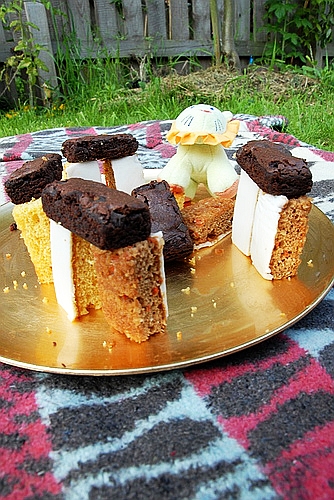
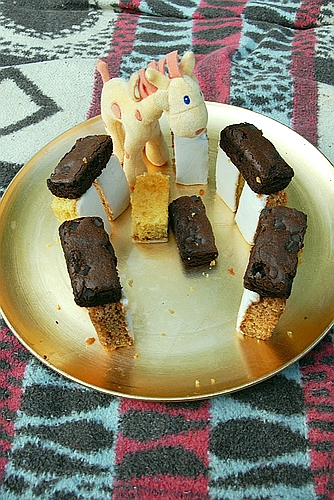
Oh, why don’t people take ancient monuments seriously?! The way we do. Heh. Well, here is a stuffed giraffe examining a Stonehenge replica (of the just-a-few-trilithons variety) that was made of lemon slice, carrot cake, and chocolate brownies, set on a golden plate, which is set on . . . is that a faded beach towel?

Our studied analysis: While he projects a mood of play, the henger here has a serious agenda, suggesting that the toppled stones at Stonehenge were toppled by the curiosity of ancient northern woolly giraffes that lived in the times of the mammoths. This discovery pushes the age of the building of Stonehenge back to the ice ages. The alternative at which he barely hints is that the stones were actually erected by ancient sentient giraffes, a branch of the family which has since gone extinct!

Exciting stuff. Almost too controversial for our humble blog, which is simply a bit of light entertainment. But wait, there’s more.

lionGiant crosses between lions and daisies also appear to figure into the theory! This is way over our heads. Could Stonehenge have been a corral for megafauna? And what about the cake? He gives some cryptic explanation here. Warning: one or two of the close-ups of trilithons seem barely decent!

Score for this henge: 6 druids. Why six, you say? Sometimes things are just so bad that they’re good. And we think he knows it. Quote: “My 14 week old daughter thought Spongehenge was pretty funny, though that might have been wind!

Bill Bevan’s impressive photos of the real Stonehenge can be seen here, and are worth a look. Click on the word Gallery at the top for more amazing photos from around the world.

Miniature Stonehenge Garden

stonhenphoto from Two Green Thumbs website, with permission

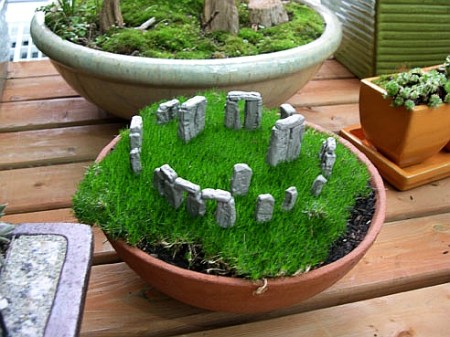
Oh, Seattle, how we love you! From Washington State once again we bring you Stonehenge, this time in a tiny form. It is advertised by Two Thumbs Miniature Garden Center (Grow Your Own World). Their company policy: “If it’s not fun and cute,we don’t want anything to do with it!” And what’s more fun and cute than Stonehenge?

Janit from Two Green Thumbs tells us she used the mini-Stonehenge from Running Press, drilling and staking the pieces so they would stay in place. She adds that she has “since told countless other mini gardeners how to make their own. I suspect there are dozens in and around the States!” We don’t doubt it. We laud her for helping would-be hengers to realise their aspirations! And it is kind of cute, isn’t it, although we feel an urge to go in and add a bunch of fallen stones. You could always buy a second kit and fill in a little.

Leave it to the Stonehenge State to make it possible to put a henge in every pot! Score for this simple but charming take on the replica: 7½ druids, despite the lack of bluestones. Hurry–you still have time to set one up for solstice!

Celtic Cabinet Stonehenge, Wiltshire Heritage Museum

BrittonCabinet stonehenge 2photos by Pete Glastonbury, with permission

The plaque on this cabinet in the Wiltshire Heritage Museum reads:

The Britton ‘Celtic’ Cabinet [Clonehenge thanks whoever is responsible for those single quotation marks!] The cabinet was originally made in about 1824 for G Watson Taylor, MP for Erlestoke. It is made in the shape of one of the trilithons at Stonhenge [sic], with pollarded elm and birds eye maple veneer, and contains inset watercolours by contemporary artists including Cotman. By 1832 it had been acquired by the historian John Britton (1771-1857) and stood in his library, where it housed manuscripts and drawings. It was bought by the Wiltshire Archaeological and Natural History Society in 1853.

BrittonCabinet chThe replica at the top of this post, seen in glass on top of the cabinet, is one of the cork models by Henry Browne, whom we have mentioned before. On the left side of the ‘trilithon’ you can see a charming watercolour of an aerial view of Stonehenge. A similar picture of Avebury is on the right. The other painted panels are hard to make out, but the bottom right is Stonehenge again. Others seem to represent a concession that Wiltshire doesn’t own the megalith franchise.

This is an absolutely fabulous bit of megalithia, in our not-all-that-humble opinions. So much so that we are giving the Avebury model inside the cabinet a post of its own, to follow in a few days.

BrittonCabinet2 ch

Score: 8½ druids. It might have been 9 if it weren’t for that word Celtic in its name. Our thanks to Pete G. for bringing this amazing item to our attention!

War-Game Terrain Stonehenge

wargame2

photo from War-Game Terrain promotional website

We’ve featured virtual war games’ versions of Stonehenge, but what about table-top war games? You know there had to be some. Fantasy games all eventually come around to needing a Stonehenge, don’t they?

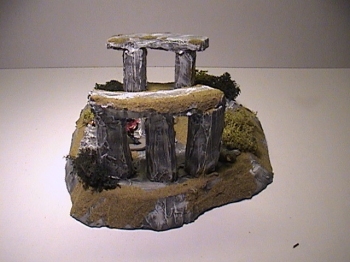
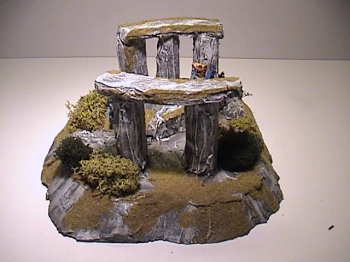
wargame1Wargame Terrain or War-Game Terrain–spelled a couple of ways–can supply you with your wargame Stonehenge needs. “Each terrain piece is carefully hand crafted from insulation and or beveled 1/8″ hardboard, foam, strengthened with filler, flocked with gravel, grass or sand and hand painted.

This one includes one trilithon and one, well–quadlithon? But they’ll work with you. Each piece is custom-made.

Score: 5 druids for the wargame Stonehenge. But keep war well away from the real stones.

Personal Stonehenge: Mushroom variety

mushroom-stonehenge

photo from VivaTerra promotional website

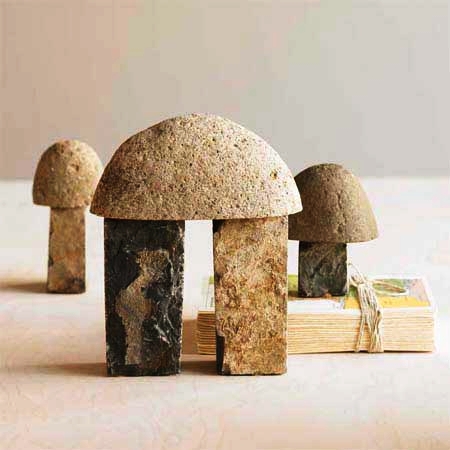
Calling all druids”, the advertisement says. But we’re thinking this Stonehenge replica is actually aimed at the garden gnome demographic. And what is the little one standing on? A tarot deck? The ad copy continues: “Arranged on desktop or shelf, they conjure up ancient rites while gently reminding us to trust in our own inner power as we explore the mysteries that lie ahead.” If they truly conjure up ancient rites, then they are a bargain at the sale price of $49, but please excuse us if we have our doubts . . .

But whatever. Far be it from us to belittle anything that helps someone get through the day feeling good about life. Anyway, we have heard from certain sources that the connection between Stonehenge and mushrooms is a longstanding one. For some people having this on their desk in the office might help them recall rites of their own!

Score: 5 druids. And that’s a stretch, to be honest. But it is made of stone, unlike many, and their calling it Personal Stonehenge tickles our funny bone (as does the price!). And it’s a great concept. Shouldn’t everyone have their own personal Stonehenge? No? Admit it–you know you want one!