Bandage Henge 2.0: Anatomically Correct Medi-lithic Site!

photo and henging by Kirsten Shield
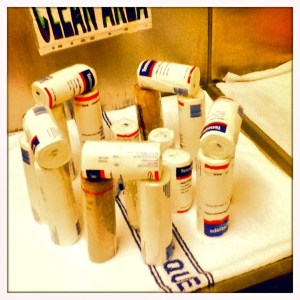
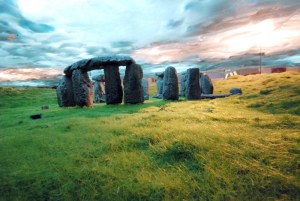
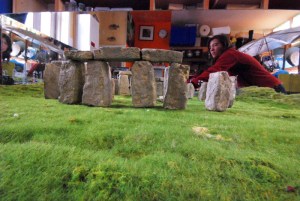
Back on January 27, we received the photo on the left with this explanation: “G’day [Clonehenge], After a particularly stressful day in the Burns Unit I was restocking bandages when the different sizes reminded me of the uprights with the lintels. Next thing I knew I had a Henge on my hands!” Of course she was being metaphorical (mediphorical?). It wasn’t on her hands, but was, as we can see, in the Clean Area.

If we had received that henge photo two days earlier, even as elementary as it was we might nonetheless have posted it immediately as it seemed like the perfect thing for Burns Night. Alas, it was not to be! By the time we received it, it was too late for us to delight in yet another dreadful pun for the blog.

The letter, however, also contained this glint of hope: “I plan to do a proper and anatomically correct Bandage Henge in the near future. ” and it was signed, Kirsten, Brisbane Australia. Well, we have now received Kirstenhenge 2.0 and we have to say that it is the nicest bandage henge anyone ever sent to us.
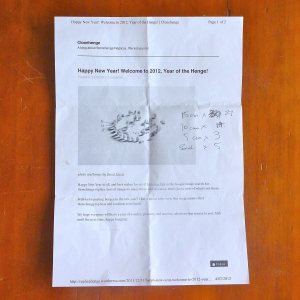
Interestingly, Kirsten confesses that instead of Stonehenge itself or a plan of it, she used as a model for her bandage henge Brock Davis’s brilliant rice krispy henge (or rice krispyhenge) that we posted for New Year’s and that was since featured on National Public Radio in the States. We love when Stonehenge replicas make the news!
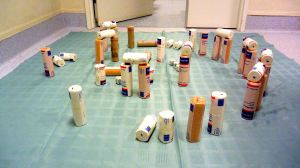
The result is admirable, as you can see in the top picture and the one to the left. No, the inner trilithon horse shoe does not quite open to the three-lintel sequence in the outer circle, but, hey–she was working from a photo of a tiny inaccurate model. Other than that it is quite well done.

What concerns us slightly is the doors in the background. In what room did she set out her carefully crafted henge? We have an image of a coma patient spread out on a bed behind her as she takes the photograph. Anything for art, and especially henging!

Score: 7 druids! It is clear that this was a labour of love. LOVE! that is the word of the day. Happy Valentine’s Day to all, with or without a real lover. We all know you singles have your dreams and fantasies. You may be doing as well or better than many who face the challenge of the real thing (our own partner, for example, has us to put up with…).

You know what your Valentine wants: a Stonehenge replica, of course! Make it from biscuits or chocolate candies. Hide that ring and its glittering rock among the stones. There are few things more romantic and at the same time subliminally sexual than that shaft of light streaming in between a pair of uprights! If you make one, send us pictures. Of the henge only, please. There are plenty of sites for those other photos.

And so to all, happy henging!
Small Henges and a Henge Spotter’s Time Out

photo from modelermagic.com

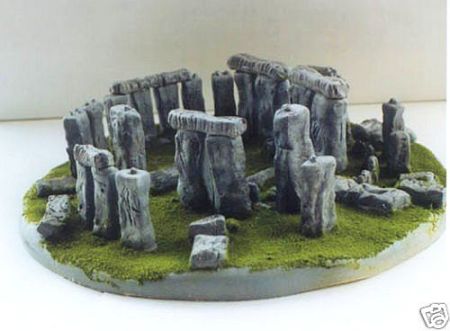
Today–more small Stonehenges for the home. Above is the Larson Designs 1/72 scale Stonehenge model, a pre-made resin model that sells for between $50 and $75.

It has its faults but over all it is not a bad model. Many stones are in the right places including the trilithon horseshoe faces the three-lintel segment of the outside circle, always a sign that someone actually looked at Stonehenge before making it. And that IS desirable. (We learned that Larson Designs makes or at least made a Firefly Class freighter model. Also desirable.)

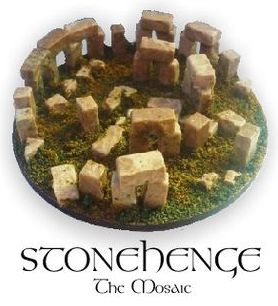
And this little set is made by Mosaic Mad Romans, a UK company that makes simple mosaics for children. This kit does need assembly. The company claims it is made of marble, which outclasses the real monument to a considerable degree. We are not certain how this qualifies as a mosaic, but it is charming, and once again the trilithon horseshoe/three-lintel stretch thing happens, so we’ll overlook that small detail.

There is no shortage in the world of Stonehenge sets and kits for home use. How many households include one (or more), we wonder? Stonehenge continues to proliferate its offspring by infecting and re-infecting the human mind in a natural reproductive process. It is awe-inspiring to watch, although we could do with David Attenborough to do it justice.

While the creation of Stonehenge replicas never takes a rest, Clonehenge will be going on hiatus for a month or so. (Unless we receive or stumble upon an example we cannot resist posting. We’re weak like that!) We don’t even plan to post the Friday foodhenge for a while. It even could be longer than a month until we return to the task. We shall see. We stand confident in the conviction that we will not be missed.

If you do get a twinge, the world is full of materials for making Stonehenge replicas. Go to it! Or just keep your eyes open. You know they’re out there. Always take a camera. So until next time, friends, happy henging!

Cheswardine: Another Long-Sought Henge Attained!

photo by Mia Robinson

Well, we survived the flood and gales. Many thanks to those who sent us good wishes, silent or otherwise. Irene let us live to henge another day.

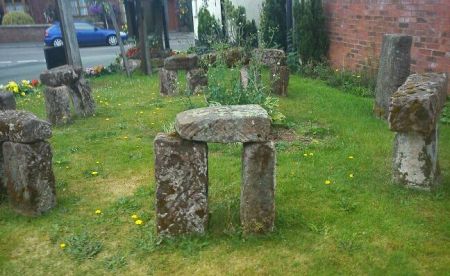
We have long sought a picture of this little trilithon circle in Cheswardine, Shropshire. Looking at it, you may well ask, “Why?” but the fact is, once we know something like this is out there, we desire to list it, just as a collector wants that Mickey Mantle rookie card or that Black Lotus card, or any special little knick knack that completes a set. If there is a Stonehenge replica out there, we want it on Clonehenge!

We know very little about this one. Tinker, our photograph provider in this case says, “i recently moved to cheswardine and was thrilled when i randomly found the henge!!! i drove past it lots of times it wasnt until i stopped for the post box that i saw it as its hidden from the main road its on small ground next to a house but it is very lovely!!

And a site on the interwebs says, “On our way back home we happened to pass through the Shropshire village of Cheswardine, and having spotted what looked like a miniature Stonehenge, we had to stop and photograph it. The structure is on the grass verge of a street called Symon’s Way, which leads off the main road through the village, and it is made of rough stone blocks.

As for score,we can’t give it more than 5 druids, charming as it is. Very cute, but not very Stonehenge-like. The ideal picture of this henge would include at least one cat. Possibly wearing a tie or hat.

The point of this post, however, is to laud, trumpet, and otherwise praise our alert reader and contributor for finding this henge in Cheswardine and sending us the picture! Well done, Tinker! If we gave out awards, we would send you one. Alas we do not, however. You will have to be content with the admiration of a grateful nation (the Henge Nation), and the not-inconsiderable honour of having made us happy. Well done, you!

We hate to post and run, but we watched Ancient Aliens last night and now are all worked up about mica at Teotihuacan, the stonework at Ollantaytambo, and the precise and symmetrical carving at Luxor.  So we are going to cut this post short and go do hours of pointless Googling which will lead us to countless flaky sites that all quote the same, probably dubious, source(s).  Oh, what fun!

We wonder when Ancient Aliens will get around to discussing the mystery of countless people building Stonehenge replicas around the world. Alien mind control?  I’m sure that the guy with the intense tan and weird hair is on task as we speak.  Stay tuned!!

And until then, happy henging!

Spamhenge–May Last Longer Than the Original!

photo by Jedimentat44 on Flickr

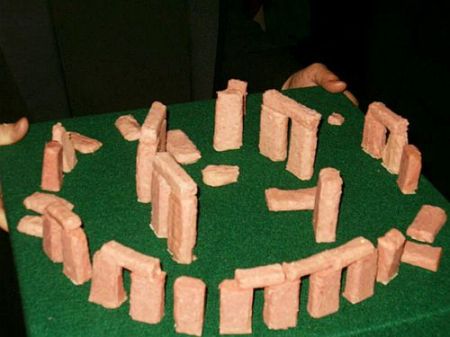
This is not the only spamhenge, but it is a famous spamhenge, famous enough to have been a clue on the television game show Jeopardy. Yes, that’s right–Alex Trebek broached the esoteric topic of Stonehenge replicas on his show one fateful night! And we heard it.

Considering it is a spamhenge, it is rather well done. The stone shapes are correctly proportional and they have aimed the opening of the inner trilithon horseshoe toward the three lintel stretch in the outer circle. That counts for a lot as we said last week. We give this 7  druids, partly for the choice of material. Odd materials are in the Clonehenge tradition!

We believe this was created for the 7th Annual Chicago Spam Sculpture Contest. Which raises a lot of questions in itself. But on to our next Speedpost©!

Cornwall World in Miniature Replica: A Clonehenge Speed post

photo by Lizard-Lady

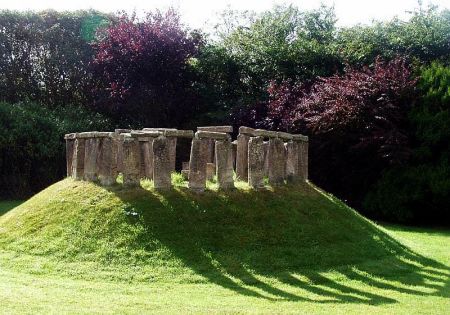
OMG! We have a hurricane headed straight for us! This made us stop and think–what if we perished? What Stonehenge replicas would we be most sorry about not posting? A few came to mind, so today instead of doing a long post, we’ll do a few short ones. This is a long-sought miniature Stonehenge that we saw a picture of when we first started out, a picture that did not say where this was. We finally know this is part of another park full of miniature world landmarks and buildings, Miniature World, formerly Miniatura Park, in Cornwall. The park is now closed, but people are working to reopen it to tourists.

We can’t see this replica well enough to judge it, but it looks like a 7½ druid circle, give or take a half druid. Not sure why, but we like that it’s on the little hill. Yay! Finally posted it.


Woolhenge: At First We Weren’t Sure How We Felt About It

photo by Thea on Etsy

Ooh, ha ha ha! First we have to catch our breath from laughing at our clever title. I’m sure that’s why we’re alone all of the time–people are afraid they would die laughing because of how funny we are.

Anyway, apparently there is this. When you think Stonehenge replica, it’s true that you don’t think of wool right away as a suitable material, but there is a certain logic to it. So many people who go to Stonehenge end up taking at least one picture of sheep, or making a joke about the sheep henge that is set up right near the stone henge. Sheep are very much a part of the Stonehenge experience.

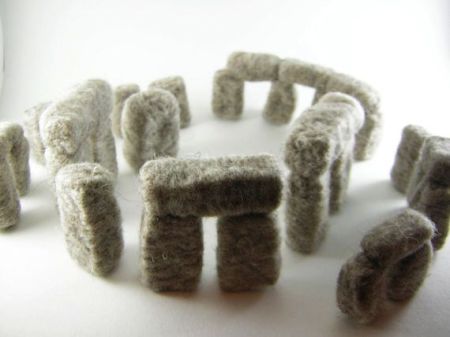
The Etsy page says, “…what you see here is a model of Stonehenge depicted in wool, I used photographs from a book and my own pictures to try and depict many of the rocks’ crevices. The real Stonehenge is 24 feet (7.3 m) tall and made of stone but the tallest of these stones is 2.5 inches (3.5 cm) tall and made of wool, so it’s lightweight and portable.

 These “stones” are hand-sculpted and made out of eco-friendly North Ronaldsay wool (from British sheep that eat mainly seaweed). They are made using a technique called needle felting where I sculpt wool into a solid form using a little barbed needle and comes in a box, ready for gifting.

We have to enter the modern world, we know, and get used to things like seeing the word gift used as a verb. But once we’re past that there are the sheep who eat mainly seaweed to distract us. Visions of aquatic sheep arise, with webbed hooves and gills, herds of them bobbing on the waves like rubber duckies… Does this have to do with the Japanese radiation? No? Too soon?

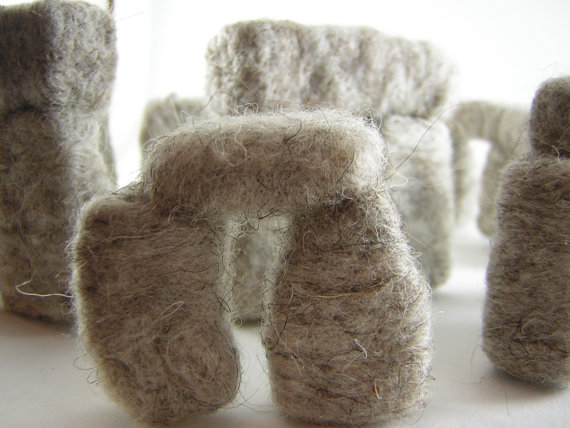
But the part we need to focus on here is “I used photographs from a book and my own pictures to try and depict many of the rocks’ crevices.” Not only has she taken care to place the stones roughly as they stand today (inner trilithon horseshoe facing the three consecutive extant lintels. We look for that in a replica), but she noticed their shapes and made a stab at that as well. We believe we recognise the individual stones in the second picture above. That is rather advanced for a very small replica. We also note that she nowhere mentions druids! Well done.

All in all, a superior small replica. Score: 7 druids. Although as Faithful Reader Simon Burrow pointed out, we should almost have a separate category of druid for the small henges, which tend to be scored lower just because they’re small. Okay, Simon, this would get 8½ druid dwarves! And a spell of transmutation. No, no. This is not an RPG. Yet.

Wool–another material added to the list, taking us ever closer to Rule 34S. If you think of some odd new way or place to make a Stonehenge replica, let us know. And until then, friends, happy henging!

Pinhole Stonehenge Model: It’s All About The Car Park

photos by Bethany de Forest, used with permission

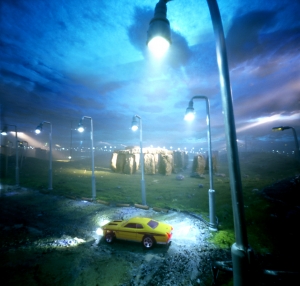
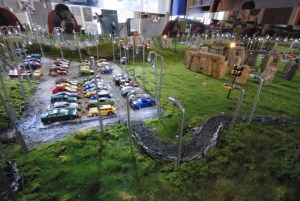
The idea for this work started when I saw an aerial picture of Stonehenge and noticed that the parking space is bigger than the monument itself. Tourist-horror!

Bethany de Forest (lovely name!), the pinhole photography artist who made this nicely rendered model, is not the first person to notice the problem with the Stonehenge landscape as it stands today. English Heritage (EH) itself says, “The dignity of Stonehenge is severely compromised.” (more on this below)

But while EH has dithered, with frequent changes of status for the project of building the new visitors’ center and altering the landscape, Ms. de Forest has gone ahead, as artists will, and created engaging art from the cognitive dissonance between the tacky car park and related facilities on one hand, and the ancient and mystical world treasure that is Stonehenge on the other.

What is the question we’re waiting for, class? Yes, you over there in the “Give Me That Old Time Religion” t-shirt with a picture of people dancing around Stonehenge–Very good. The question is, what is pinhole photography? You can find a very thoughtful explanation by Bethany de Forest here. Or you can read ours as follows: Well, you kind of like, stick a hole in something, ya know? And then ya like put it in a little box, then make a little model, then you, like, let the light in or whatever. And then it looks like Stonehenge. Or, like, whatever, ya know?

We’re thinking of going into technical writing. Ms. de Forest (no relation to Bones from Star Trek) tells us of this particular model, “The model is made in a mirror-box of about 150x150m in contour. Materials I used for my Stonehenge are Styrofoam, flock-grass, sand mixed with wood glue, led-lights, model cars. cotton wool and color foils (for the sky).

We’re pretty certain that 150x150m measurement was a typo, but then her website does say that, “Being a pinhole photographer, Bethany’s view of the world is quite deformed.” AND she lives in Amsterdam, so all bets are off.

The picture at the top is the finished product, but we like all of the pictures on her Stonehenge page. Her process is fascinating. (Read this and you’ll see!) This is one our favourite small Stonehenge models of all time. She may not have included details like the ditch and bank, but she makes up for it with the car park. And the Stonehenge itself has the feel of accuracy and that grey huddled look that so few hengers manage. She has captured or rather conjured an indescribable feeling in the final work. Score: 7½ druids! (See the comments for Simon’s appropriate suggestion on scoring.)

As for English Heritage, the proposals given on their site for returning to Stonehenge some of its dignity sound brilliant, in our not-nearly-as-humble-as-it-should-be opinion. That nearby overly-large car park would be gone. Whether any of those changes ever happen is another matter. We got stuck in buffering limbo just trying to see the last 30 seconds of the EH video on that page. It may be an omen.

Someone said to us that as December 21, 2012 approaches, more and more people will be compulsively building Stonehenges. Apparently it has to do with vibes coming out of the earth and others reflecting back from the future or something. We don’t understand all of that, but we warn everyone to remain alert. The Stonehenge brain virus is pandemic, and so far the medical profession is treating it as if it is a tick disease, by which we mean ignoring it altogether. No one is safe.

But if it should get to you, then we wish you, until next time, happy henging! (And send pictures!)

Let Me Tell You About My Stonehenge (Model Kit)

Our own photo

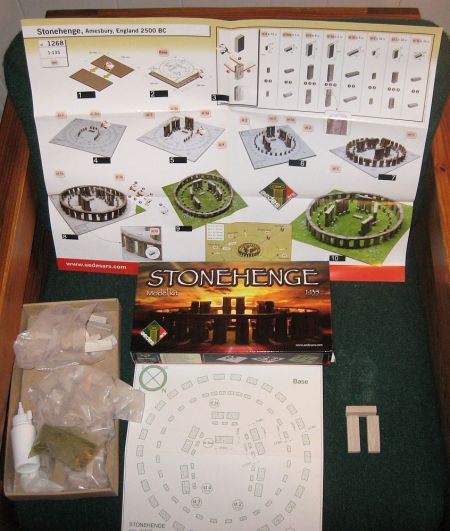
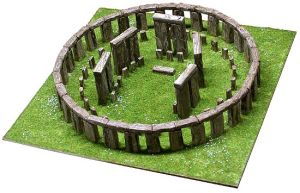
Recently we were pleased to receive our very own Stonehenge model kit from the Spanish company Aedis Ars. Apparently the post took its good old time getting it here, as it had been sent as much as two months ago, but all’s well that ends well, as they say, and here it is at the Clonehenge offices.

The set is quite impressive. It comes with a nice little history of the building of Stonehenge  and a large poster with pictures and diagrams showing how to assemble the kit. This is not a ready-made kit that requires only that you set the stones upright, but a kit for a serious hobbyist, preferably someone with a shed and extra work table where the set can remain while the modeler works at refining and constructing it over time. It seems perfect for the sort of British hobbyist who spends much of his time at the allotment or in a shed in the back garden, taking pains to perfect the finest detail in anything he fiddles with.

In other words, the end result would completely depend on how much time and finesse one wants to put into it. So far, I am sorry to say, ours remains in the box. Still, it looks like a fine model kit, with key details included.

For example, although the base provided is only big enough to include the main circle at Stonehenge, the construction poster shows an expanded view including the positions of the Slaughter Stone, the Heel Stone, Station Stones, and the Z, Y, and Aubrey Holes with distances and dimensions given, so that if said eccentric enthusiast wants to make his own expanded base in order to include more of the landscape, the information and extra stones he would need are there. We like to think that Clonehenge had something to do with that bit. If you know otherwise, please allow us our modest delusions of grandeur.
We can’t score this kit as we do complete replicas, but if we replace our usual druid scoring, as a set we would give it as many as 8½ anoraks. If we ever get our model made, we’ll post a picture. But don’t hold your breath. The new Stonehenge visitor center will probably be built first!

Many thanks to Aedis Ars for our complimentary kit. Nice to get a little loot for all of our thankless labour over the keyboard! When blogging about Stonehenge replicas becomes a lucrative business (any minute now), we’ll have an employee built the model (and we’ll expand those offices). Until then, gentle readers, happy henging!

Cakehenges and Word Fields: the Plight of the Carbon-Conscious Blogger

photo from TheSugarSyndicate.com’s Flickr account
Believe it or not, we are swamped with new Stonehenge replicas of all sorts and you might think, if you were not in possession of all the facts, that we should be posting here at least a couple of times per week, if not every day. You could be forgiven for assuming we are just lazy.

But nothing could be further from the truth! What people don’t realise is that unlike other bloggers, who just use mass-produced letters and words, often imported from countries where they have been grown with pesticides by people who are paid sub-subsistence wages and who have no access to health care despite their crippling work, here at Clonehenge we personally grow every letter and every word ourselves, nurturing them with great care and at much expense.

This labour of love gives us precious little time for the fun of producing these posts for our adoring public, but because we know you are waiting breathlessly we tear ourselves away from the Palabra beanfields to craft these posts like drystone walls, turning and fitting each word and each letter until somehow they fit and balance to make the august edifice that is Clonehenge.

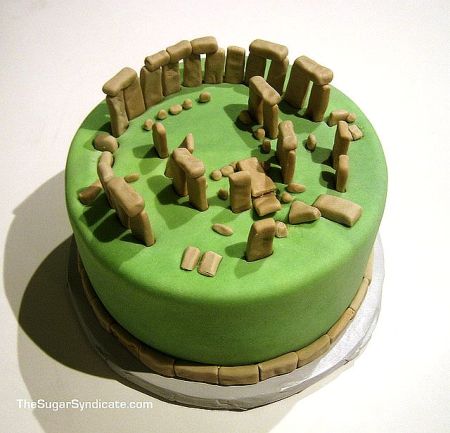
Today our topic is Stonehenge cakes, or cakehenges. The example above, beautifully done, was the 2007 creation of a Chicago-based bakery, The Sugar Syndicate, which is, alas, no longer a going concern. It is an outstanding example of the cakehenge genre, second only to our favourite, the mom-made cakehenge from New Zealand’s Vanda Symon.

photo by Siobhan Jess Sarrel

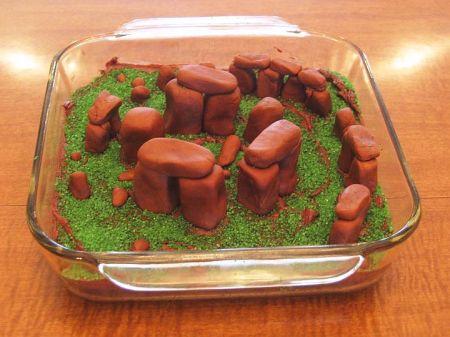
The confection in the pan above was posted on the Clonehenge Facebook page by reader Siobhan Jess Sarrel, about whom we know nothing, especially not how to pronounce her first name. She baked gluten-free brownies, used fondant to fashion the Stonehenge on top, and took it to a friend’s solstice party. (We do not know if Ms. Sarrel is in the northern or southern hemisphere, so we don’t know if it was a summer or winter solstice party.)

These henges have many things right with them. First, they are our preferred type–replicas of Stonehenge as it stands today. In both cases the builders looked at pictures of Stonehenge to guide their modeling. Both show the trilithon horseshoe and the three remaining adjacent lintels. Both show fallen stones.

The top cake is more accurate in scale and placement and also includes the bluestones. It is impeccable and professional looking. The brownies, on the other hand, are gluten-free.

This may not mean much to the average reader, but for us this is a huge factor. Not only are we at Clonehenge among those who are required for health reasons to eat gluten-free foods only, but it is a little-known fact that the original Stonehenge on Salisbury Plain IS IN FACT GLUTEN-FREE!!! Well caught, Lady S. J. Sarrel!

Scores? We give the Syndicate henge 7 ½ druids and Ms. Sarrel’s brownie henge a solid 7. We figure we don’t want to run afoul of any syndicate out of Chicago!

Well, it looks like we’ve just about run out of words that are developed enough to pick. We’ll have to let the fields grow a bit before we can post again. Here’s hoping the aliens don’t come by and ruin things with crop circles!

If you’re still hungry for cakehenges, find more here. And until next time, happy henging!

P.S.: What the hell is fondant, anyway? Yes, we know we could google it but the truth is we’re far too lazy. Oops.

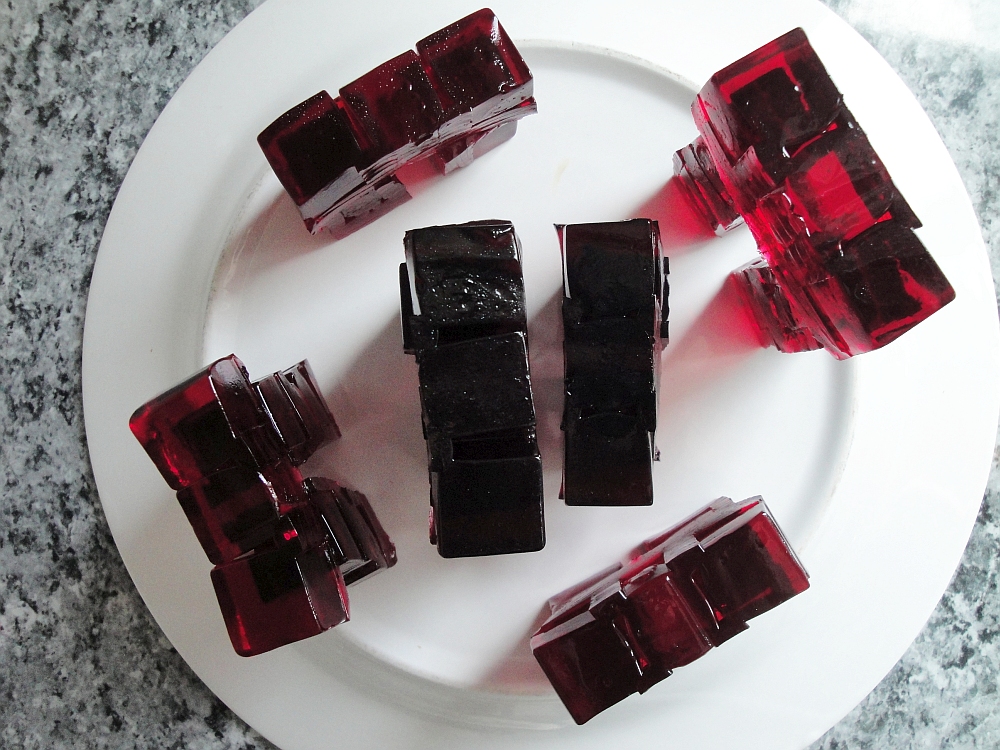
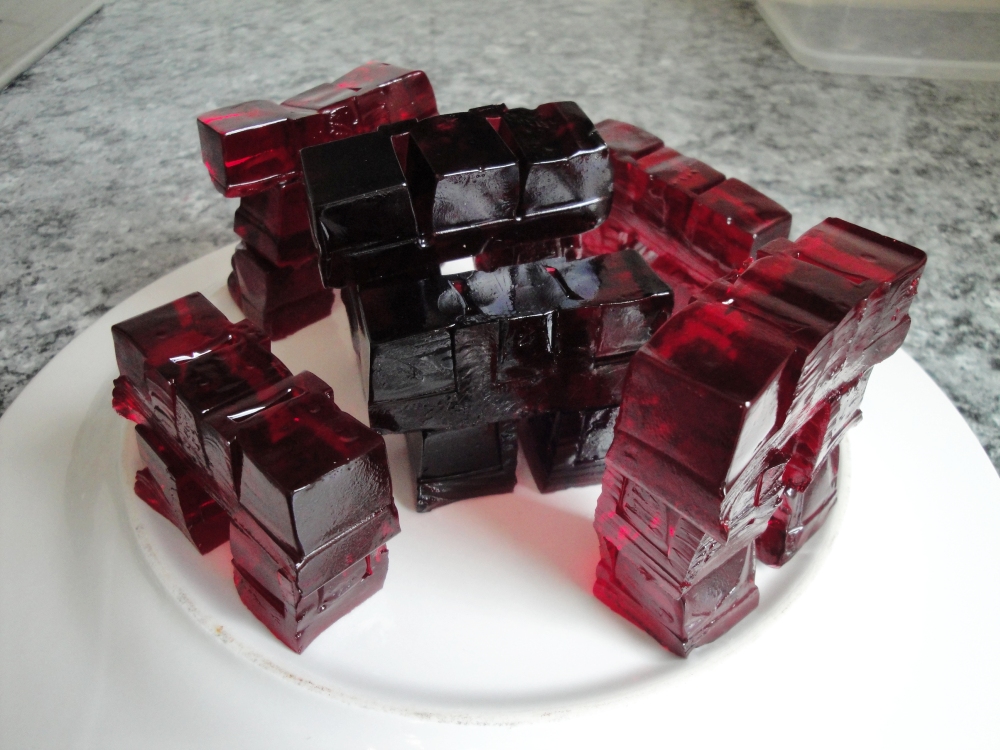
Jellyhenge: Why Shouldn’t Stonehenge Be Red, Transparent, and Edible?!

photo by Dan French, used with permission (at least until he reads this)

This henge was presented to us by Dan French. We assume he or someone he knows created it, but who knows? The man does not seem to be trustworthy. For one thing, he gives his name as Dan French, but–get this–he IS NOT ACTUALLY FRENCH!!!1!! Like we wouldn’t notice that!

Also, he is a Bruce Springsteen fan. From Baldock, Hertfordshire. Does that seem right to you? Baldock, we happen to know (because we just read it on Wikipedia) was founded by THE KNIGHTS TEMPLAR!!!!1!(one)! and was the site of a leper colony in medieval times. How are lepers and the Knights Templar connected with Bruce Springsteen? And jelly? (We will again take up the topic of Baldock in a future post!)

Whew! There. Two solid informational paragraphs–and at first we were afraid we wouldn’t be able to write anything thoughtful about this henge. Pshaw. This is why we are the best Stonehenge replica blog going!

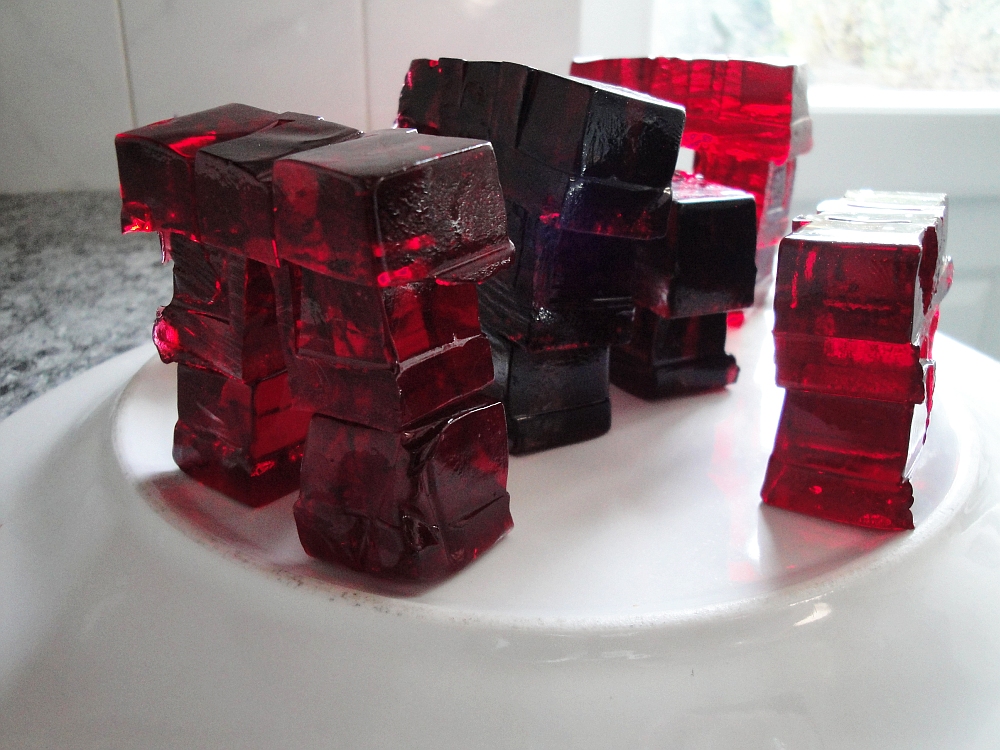
Which reminds us, what about the Stonehenge replica? We do love our Gentle Readers but they constantly work to get us off topic, as if we were an eccentric secondary school physics teacher. What we have here, Class, appears to be four outer trilithons and two inner trilithons. A little short of the real thing, but we have to take into account the superior materials. This is the henge the ancients wanted to build, but they didn’t have the advantage of modern gelatin technology.

Mr. “French” (Lestat?) claims the outer trilithons are raspberry and the inner are blueberry, cleverly giving a nod to the bluestones. But we all know how dependable he is. This could well be the ultimate blood sacrifice henge, with the blood incorporated directly into the megaliths!!

Not to get off the subject (heh), but have you seen this srsly awesome slow motion video of jelly (or Jello or Jell-O) cubes being dropped onto a hard surface? We do not use or advocate drugs, but if you are already smoked up or tripping, you will have a distinct advantage in enjoying this. And for the jelly-shot types, did you know that if you make them with Bacardi 151, they are so strong that they can kill you, but they can also be lit on fire?! DO NOT try this at home, especially if you have a couple of them first, even though that IS when you’re likely to be tempted!

What’s that you say? Henge? Oh, right. Let us address the score. The stone shapes are not right. There is no continuous linteling on the outer circle. The inner trilithons are not higher than the outer and there aren’t enough of them. No outliers or altar stone, no Aubrey holes… The list goes on and on.  But–it IS clear and wobbly. Think of the sunrise shining through this one, people! Think of the rare lichens. (?) We have carelessly given decent scores to much worse replicas than this.

Score: 6 druids! Congratulations, Mr. “Dan French”, but we’re still onto you. Millions of people would do anything to penetrate the prestigious world of Stonehenge replicas, including assuming false identities. Our nanotechnological insects are seeking you out as we speak. This isn’t our last post concerning you, sir!

To all of the rest of our Gentle Readers, know the chapter on vectors by Thursday. And until then, happy henging!