Sconehenge

cover1

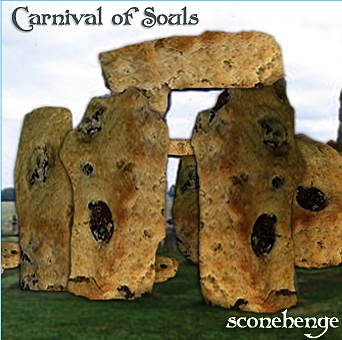
The perfect convergence of shape and name make the lowly scone a favoured choice of henge material. Zazzle.com advertises a poster of a sconehenge, complete with ancient gingerbread Flintstone ( NOT one of the F4J, we trust!), and a search for sconehenge on Google yields bakeries, a bed and breakfast and actual scone henges of varying degrees of complexity.

The one pictured above was made virtually–a quick look reveals the same scone being used in different positions. Still, it makes a nice cover for this album by Celtic musical group Carnival of Souls. Few scone henges we’ve seen have the benefit of a landscape background and we think it takes this one up a notch.

We will try to separate our rating of this henge from the group’s inclusion of the song Queen of Argyll, written by Andy M. Stewart with whom we shared a few ales back in the days when he toured with Silly Wizard. Ah, fun times and a great song!

Score: 6 druids for the henge of scone!
Odessa Henge, Texas Rocks!

odessa

photo by Texas Bob, with permission

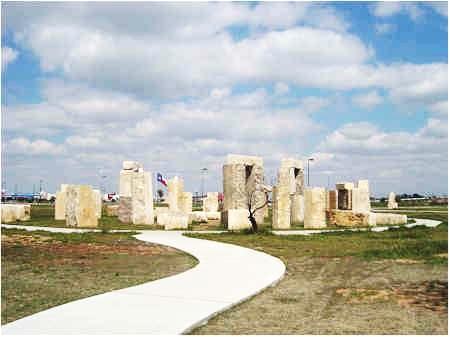
When you talk about Stonehenge in Texas you have to specify which one. There are two–that is, two that are well-known–in the Lone Star State: one of stone and one we’ll get to another day. The Odessa Stonehenge, shown above, seems to us the nicer of the two.

Built in 2004 of limestone slabs, the monument is truer to the original than many and great care was taken in aligning it. As this article says, “The replica is across the street from society’s monuments of Home Depot, OfficeMax and Starbucks.”  Note the Texas flag waving behind the stones.

More nice pictures of Odessa’s Stonehenge can be seen here (winter comes even to Texas) and here (as does the moody dusk). While its proportions are a little off and the replacement of one slab with two detracts from the look a little, this is a remarkably impressive monument to be stuck in suburban America.  Some replica builders could learn much from it. Score: 8 druids!

Cheesehenge

cheesehenge

photo by Scott Weichert

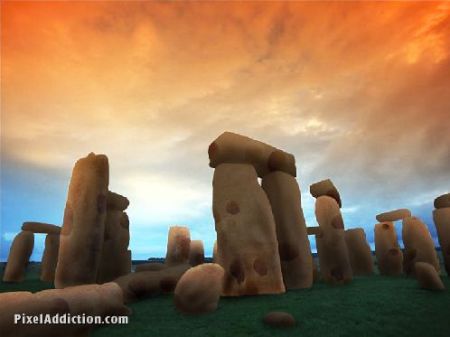
As we insinuated in an earlier post, cheesehenges may be the most numerous Stonehenge replicas on the web. Virtual cheesehenges abound on Youtube, seemingly because it’s an exercise used for teaching a computer language called Maya 8.5.

Scott Weichert’s picture above appears to have been made with real cheese, but in fact no cheeses were harmed in the making of this henge. Images of cheese were plugged into a dramatically enhanced picture of Stonehenge. Still, we like the picture and it’s a good example of a Swiss cheesehenge, Swiss inexplicably being the most popular kind of cheese with which to build a henge.

How to score what is really a sample of a type? The person who made this did use Stonehenge,and we like the inclusion of the bump on top of one stone lacking a lintel. Not everyone knows that the lintels were kept in place with tongue and groove joints and it is always a nice touch. Score: 7 druids for this surreal photo. Keep on henging that cheese, people!

Cockington Green Stonehenge

cockington-green1

photo by Julie Anderson

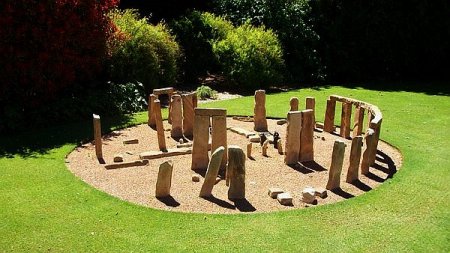
Today it’s off to Canberra in Australia and Cockington Green Gardens, beds planted around crafted miniature buildings that portray places around the world, with the original section based on Great Britain. And you can’t have Great Britain without a Stonehenge replica, in this case complete with tiny tourists. (It must be a view of the past. When were tourists last permitted to wander among the stones?)

It’s a fascinating little replica, with its disproportionally tall and slender stones. Clearly the attempt is to portray Stonehenge as it now stands with some stones fallen. The tiny people seem to get moved around. Every picture we’ve seen shows them posed differently. The interesting thing here is seeing Stonehenge portrayed as a part of England and not as the timeless, placeless array of stones most replicas try to depict.

The nearby hedges certainly dampen the effect (one website calls it Stonehedge), but we allow for the fact that everything is more difficult to do in the southern hemisphere because it has to be done upside-down. We award 7 druids to the Stonehenge that could easily be crushed by a dwarf!

Carhenge, little henge on the prairie

carhenge

photo by Rich Koele, used by permission

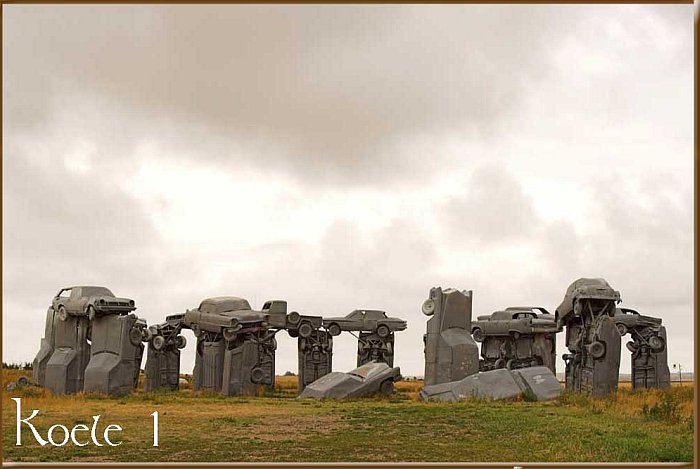
Out in the Nebraska prairie one weekend in 1987 this mighty, prototypically American monument was raised by Jim Reinders and members of his family attending a reunion. Celebrated in news stories and in many elements of pop culture, it may be the best known of all the Stonehenge replicas. It certainly stands as a brilliant example of the Clonehenge principle: there is a human imperative to build Stonehenge replicas of anything vaguely resembling the original’s sarsen stones.

Unlike some builders of henges, Mr. Reinders had some knowledge of Stonehenge and did go to the trouble of duplicating features such as the heelstone, the inner trilithons, and the slaughter stone (Aubrey holes are still being placed). That and the grey paint used to protect the cars from rust give this henge a surprisingly authentic look considering the materials used. (This is unlike Cadillac Ranch, which is just a row of cars dug part way into the ground.)

carhenge-model

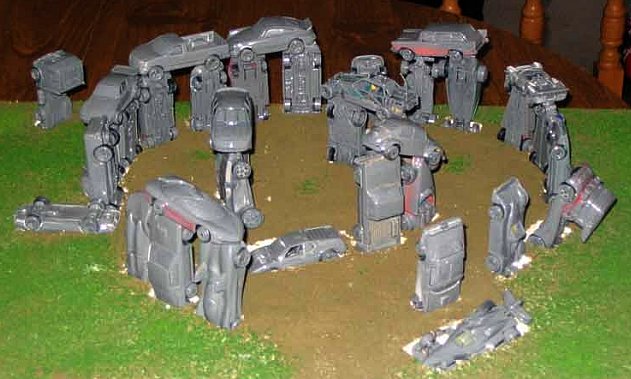
Click around the official Carhenge website, and you can see pictures of Carhenge in many weathers and from many angles, plus the picture above, of a model Carhenge brilliantly made by ten year old Ryan Ceason of Farmington, MN, entirely from pictures without ever seeing the monument, for a social studies project on landmarks. We couldn’t resist asking permission to post this replica of a replica of Stonehenge, and we’re grateful to his mom, Mara, for getting back to us. It’s a Clonehenge to the second power!

Many thanks to Hallie Widner of the Carhenge website, to Rich Koele, and to the model maker and family. We score Carhenge itself a solid 8 ½ druids, and to the model of Carhenge we award 9 1962 Cadillacs!

Here it is on Google Street View. Not very clear, but it’s there!

And, sent in by friend of the blog David Raven, a Nebraska show’s video about Carhenge, with a little history.

Soaphenge

soaphenge

photo by mj*laflaca on Flickr

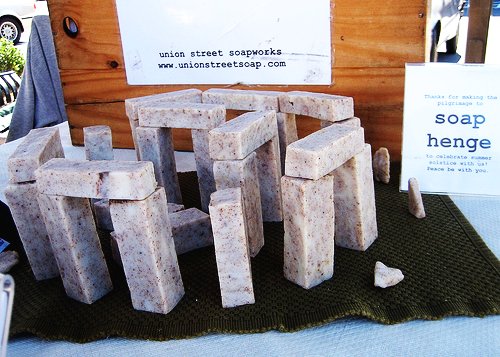
One of the commoner substances used for home henges is soap. (It doesn’t rival cheese, but that’s a subject for a time when we’re less hungry.) The sign on this example says, “Thanks for making the pilgrimage to soaphenge to celebrate summer solstice with us! Peace be with you.” We checked the website of this soap company, but this display seems to have been the whim of the moment rather than a company policy. No sign of Stonehenge on that site.

We will post more good soaphenges if they’re offered. It’s hardly fair to score this, since it seems to have been off the cuff. Taking into account the little soap chips for stones and the fallen uprights, we’ll give it six druids for demonstrating the spirit of Clonehenge–how people just can’t resist building a trilithon!

Cardboard Stonehenge, the blog

nightime

photos from Cardboard Stonehenge, taken by Soo Martin

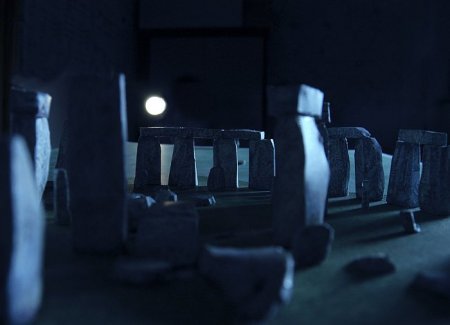
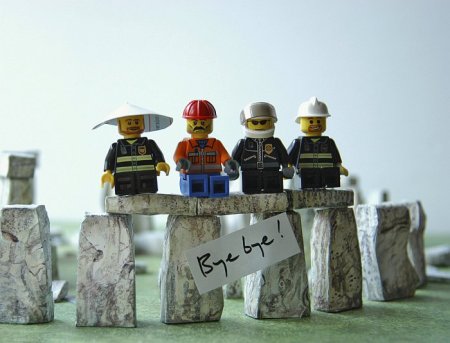
It’s a whole world we never dreamed existed, the world of the cardmodel kit. Moduni.com offers a great many of them, along with other kinds of models for building. Two people, Alan A. and Soo Martin, who work for a British archives service bought a Stonehenge cardmodel kit, decided to build it during their lunch breaks, and, to our good fortune, chose to blog about it for over 3 months as they did. The results are remarkable, as shown by the pictures above and below.

goodbye

(Is that the bunch from Fathers 4 Justice? Love the hat on the left!)

It’s not easy to make this post short, even more than with some other subjects we’ve tackled. We urge anyone with an informed interest in megaliths and Stonehenge to read the blog. It’s short. Many interesting points are made and musings noted, all in a mood of bemused fascination. Take, for example, their Meditations on Underground Access. These are people who have spent too much time thinking about sacred sites. Unlike us. Heh heh.

Anyway, scoring this one is difficult. This blog, with its interim models of glaciers moving  bluestones and of the Stonehenge underpass, with the taping off of the center stones by the Lego constabulary for solstice, with office leylines drawn, and photoshopped lines showing the forms said to be visible in the stones, etc., has completely bowled us over and it’s all we can do to keep from looking sappy by giving it a 9 ¾. It’s a manufactured model, for Sol ‘s sake! After a very cold shower, we give it eight Lego druids . . . maybe 8 ¾! Okay, someone click on Publish, quick!

Maryhill Stonehenge: the first major American replica, Washington state

maryhill-stonehenge-war-memorial

photo from this site

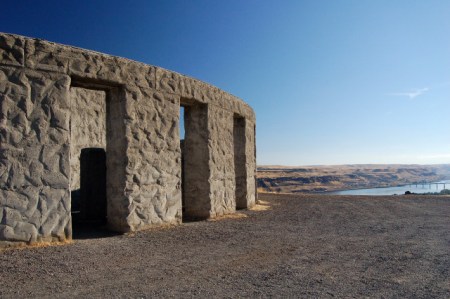
The subject of this post, the Maryhill, Washington State Stonehenge replica, has a longer and less whimsical history than other Stonehenge replicas. Building of the monument began in 1918 and was completed in 1929. The builder, renowned Quaker Sam Hill meant it to commemorate local men who died in World War I and to remind people throughout the ages of the sacrifices of war. An excellent account is given at this link, and you can see an aerial perspective here.

We included the Youtube video both to add a little levity (the superior Stonehenge? sacrificial virgins?) and because it gives a sense of the hush that seems to come upon people inside the circle. This replica more than any other can leave visitors with a sense of awe and of the uncanny when they enter the arc of its concrete uprights. Maybe the spectacular siting and the sincere intent of the builder created the right environment for a gathering of the spirits that once lay beneath the land.

For perhaps the only time, we award the coveted 9 druids score to this haunted henge.

Note: We thought this was the earliest of the large henges, but we received this information from an alert and friendly reader:

I’m afraid the Washington replica is 200 years after the first known
example, at Wilton House, erected for the Earl of Pembroke.

The historic importance of the Washington replica is though in my
opinion, that it was the first to be erected after actual stones were
raised (‘restored’) at Stonehenge (1901) and at Avebury in the
K.Avenue (1911).

Thank you! Our apologies. Perhaps we’ll post that older replica once we find out more about it.

Share

Tamponhenge (apologies in advance!)

tampon

As we say in our “Why?” page, Stonehenge replicas are often made of the most unlikely materials. We saw our first tamponhenge on the web some years ago, but its web address now goes to a 404 page not found page on the University of Nottingham website. Fortunately (?) another tamponhenge has been posted on a Czech website [now sadly no longer with us, and anyway, we’ve since been told it was the same one.]. Translated, the site title, Slunecní hodiny (add a carat above the c), means something like sun clock or sundial.

tampon-2

What sets the site for this homemade henge above the rest are several photos that are visual portrayals of how the ancients achieved the movement and erection of the tampon “stones.” Above, for example, we see two oxen pulling a megalith across the landscape. We don’t know the significance of the mysterious face on the paper plate above the scene in some shots. Perhaps it represents the sun?

If you know us at all by now, you may guess that the megalithic-moving dioramas are likely to translate into some big druids for this henge. And you are right. Score: 8 druids and some big applause, which requires no translation!

[An interview with the maker of tamponhenge can be found here.]

Foamhenge, the U.K. version

foamhenge

Foamed polystyrene, often known by one of its brand names, Styrofoam, makes an attractive material for Stonehenge replicas. It is light and can be formed into any shape. Lintels no doubt help to keep the light uprights in place.

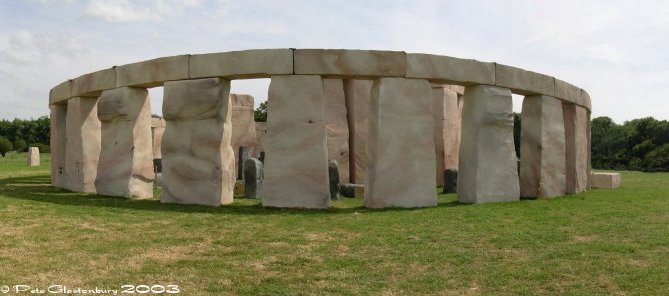
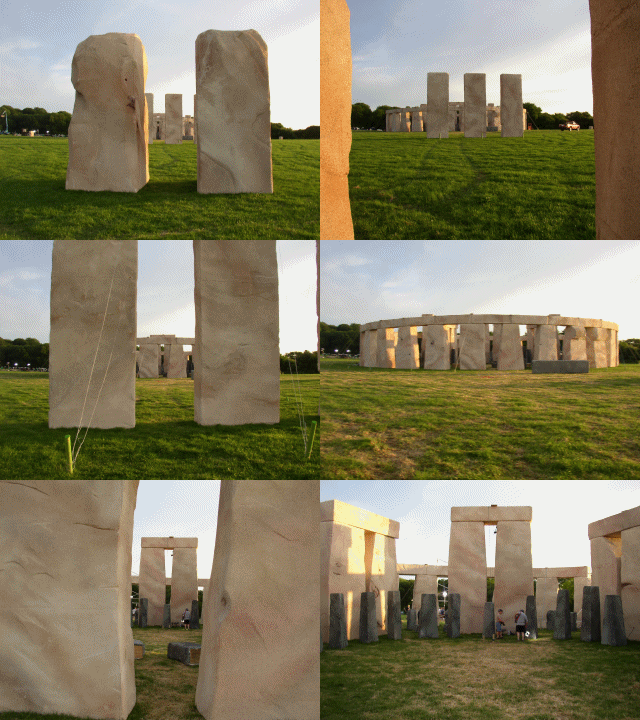
We know of two Foamhenges. One is in Virginia in the States (to be covered later), and one was a temporary construction, built on the Wiltshire Downs by Channel 5 TV in the U.K., and then sold on Ebay. This was a full-sized careful reconstruction of the monument at its height, rather better-looking than many because the real shapes and irregularities of the stones were taken into account. Is the odd pink cast meant to be the colour of the megaliths when they were first cut?  We welcome any information that would shed light on the mystery of the flesh-coloured stones!

foamhenge

Many thanks to brilliant photographer Pete Glastonbury for permission to use his pictures. Permission to use them elsewhere must be given by him. Our original score for this henge replica was a solid (well, as solid as they can be, made of carpet tubes and polystyrene) 8 druids, but recent conversation has caused us to reconsider and this entry’s score has been increased to 9, with a future possibility. Very nice!

Just found this: a Youtube video [link] showing the research done at this Foamhenge. Brilliant! Stonehenge has always represented midwinter to us, and this bears that intuition out.