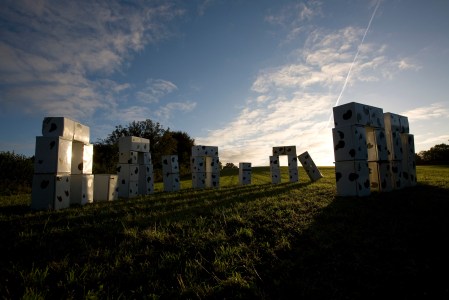
Okay, Don’t Make Us Come Over There! (Beach Stone Henge, Wales)

beach 5photo by Thelma June Jackson, with permission

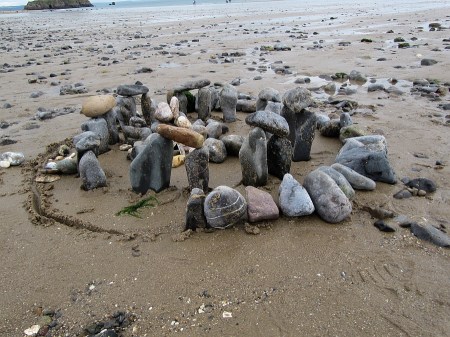
It’s the Welsh. Well, it may not be the Welsh, but it is Wales. Remember this one? Well, the madness continues as the force emanating from Carn Menyn in the Preseli Hills forces people to reproduce Stonehenge everywhere all the time. In Wales, all children’s blocks are shaped like sarsens and every garden has at least one Stonehenge. Police patrol the roads to stop people building Stonehenge replicas on them at all hours. In restaurants everything is served in little trilithons. People even wear little Stonehenges on their heads!

Okay, well, we may be exaggerating just a wee bit. But, look, there’s no denying this is a second beach pebble henge. Two is more than one! We rest our case.

This is clearly a holiday henge. The builder did that ring of trilithons inside but then made a cairn of small stones in the middle and a partial ring of stones that he or she just laid flat around the outside, drawing a line, probably with a finger, to complete the circle. To us this says someone intended to build a Stonehenge replica and then when it started to get complex said, “Bugger this, I’m on holiday!” and did the rest in a hurry.

Still, it caught the eye of a passerby and here it is, an example of what you can do when you’re on a beach and the weather (or the water) is not nice enough for swimming. Beach stone henges are one of the most common types of Stonehenge replicas, but they can be a gateway henge, leading to a henge obsession that can disrupt your life and your relationships! Be forewarned.

Score: 6 druids. Looking at that beach, on second thought, please do make us come over there!

[Here’s another pebblehenge.]

Share

Kansas State Fair Crinoid Stem Stonehenge Models

crinoid 4photos by Ace Jackalope, used with permission

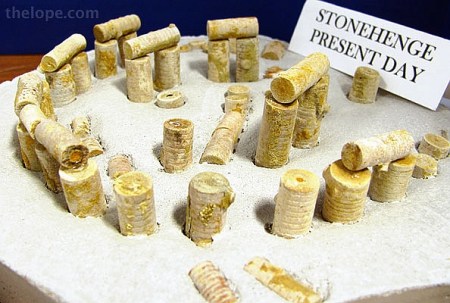
Well, it was going to be watermelonhenge today, but after encountering some technical difficulties we decided to go with this brilliant entry from the 2009 Kansas State Fair: Stonehenge models made from fossil crinoid stems (crinoids are a kind of sea animal that resembles a lily, more or less, many of them anchored to the sea floor by stems). As our new friend Mister Jackalope posted, “Morgan Reves of Pottawatomie County, Kansas, treated the public to this special exhibit: two models of Stonehenge – past and present – made of fossil crinoid stems.

Why fossil crinoid stems? We don’t know, but they are common. Presumably Morgan had a bag of them sitting around and was struck one day, as people are, with the idea that she (or he?) could make little Stonehenges with them. What we love is that the two models on display show the monument as it was, or is thought to have been, at its fullest stage, and in its modern, partially toppled condition (seen above).

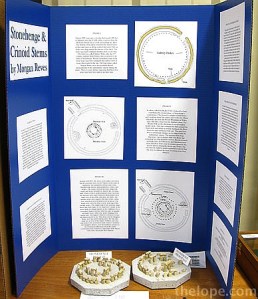
crinoid 2As you can see on the left, diagrams and explanations of Stonehenge, and possibly of fossil crinoid stems, accompanied the models. Was this a science fair project or some other kind of display? We can only speculate, but we’re glad it was there to add to the weird materials list for Stonehenge replicas!
As relatively common and obvious as fossils are, they were bound to be noticed and used by the megalith builders at least once. While there may be others, the most famous real megalithic site to feature a fossil is the long barrow at Stoney Littleton (yes, they really give places names like that over in Great Britain–Tolkien didn’t make that up!). You can see a photo of the fossil ammonite on a stone at the front of it here. There is no chance that the builders didn’t see it, but what they thought of we can never know.

Score for these crinoid stem henges: 6½ druids. Fine work, Morgan Reves! The diagrams pick up the features, like the bluestones and the ditch and bank, that the models don’t show.

We end with a quote from an email we received from Ace Jackalope himself: “There’s a blog just for Stonehenge replicas? Surely the Internet has now fulfilled its greatest possible potential!

Yes, it’s true. Just as in the Vonnegut book The Sirens of Titan humans were created in order to build a replacement part for a Tralfamadorian spacecraft that had broken down near Earth (and Stonehenge is a message in Tralfamadorian), so these internets were built  for this and this alone. Everything else is simply an outgrowth of this ultimate process. Enjoy!

Rillito Sun Circle: They Call it Stonehenge

rillito 2photo by Rachel Aschmann, with permission

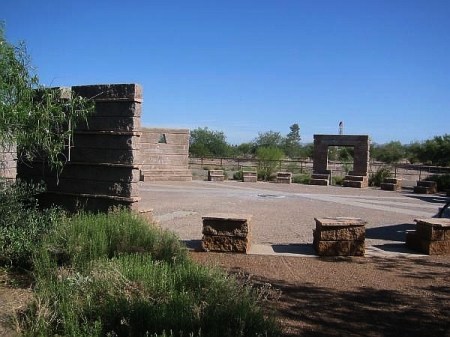
Well, we’ve held out as long as we can to keep the Newark, Ohio post at the top, but today is the celebration at the earthworks there, so we will move on to another site. The cultures in North America before Columbus opened the place up for exploitation were in some cases as different from one another as the English from the Chinese, but since we’ve been thinking about indigenous Americans this week, we present the Rillito Sun Circle, a curious and wonderful Stonehenge/kiva hybrid located in Arizona.

All prehistoric cultures were aware of the movements of the son, moon, planets and stars. They were their clocks, their calendars, part of their entertainment and one of the ways the world/spirit/gods spoke to them. For a leader, building something that channeled those movements was basically a way to impress the pants off the people and make it seem as if you were connected to the divine. Even today people flock to these constructions to observe the movement of light at certain times of year, some as a part of their spiritual practice.

Two of the many places people go to see prehistoric structures that have this function are Chaco Canyon and Stonehenge. Chaco’s Casa Rinconada has a reputation, right or wrong, for being a sort of sundial, with light passing through a hole on one side to strike a niche on the other at summer solstice (certainly other parts of the Chaco complex did mark out celestial movements). The Rillito Sun Circle, above, cleverly combines the look and functions of Stonehenge and Casa Rinconada, adding a few tricks of its own. The fullest explanation of it that we could find is, alas, only available on a cached page, which you may see here.

Its name is the Rillito Sun Circle, but of course people call it Stonehenge, even though only one structure in the circle even resembles a trilithon. We like the benches set around the circle and the open space around it, which will have to be kept open in order for it to function as it should. Our score: 6 druids! It doesn’t look like Stonehenge, but marks out the sun and its movements elegantly, actively relating to its landscape and the area’s history.

Note: You don’t need to build a structure to do this, you know. Start observing the sun as it loves through your house. Note where it strikes, for example, on winter or summer solstice at noon, or on your birthday or anniversary for that matter. Find a way to mark that, subtly or with something obvious like a picture or a crystal on a string, and then remember to check it next year on that day. All who care to can make this kind of observance a part of their lives and their homes. That is, if the sun shines enough where they are. (Sorry, Scots and Seattle-ites! 😉 )

[Programming for Indigenous Peoples’ Day ends here and we will return to our regular silliness with the next post.]

Share

Ohio’s Earthworks and Stonehenge for a Day

ohio

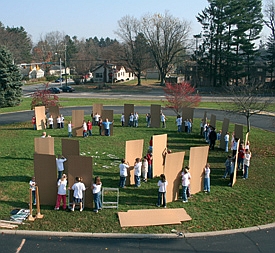
Miller Elementary in Ohio, creating ‘Cardboard Stonehenge’ © Ray Picton 2006

It’s a big week for the Newark Earthworks Center in Newark, Ohio. A pilgrimage (Walk with the Ancients) is taking place along a long-lost 60 mile road that runs straight as an arrow across the Ohio landscape, to end at the Newark Earthworks, the largest geometric earthworks complex in the world, with a day of celebration. We’re so glad to see this amazing site and its native builders getting notice. We lived there for a short time 20 years ago and couldn’t believe it wasn’t internationally famous. Maybe its time has come.

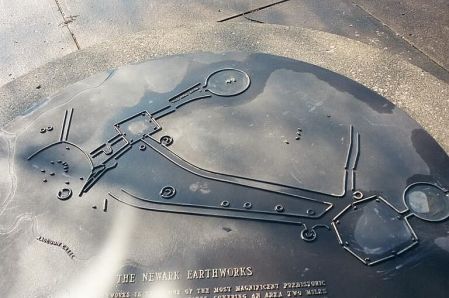
Newark_map

(our own photo–please ask permission) This is a partial map of the original earthworks at Newark, Ohio. The Great Circle is in the center at the top.

So how can that tie in with Stonehenge replicas? It’s more likely than you think! And that is because of one Ray Picton, whose Newark/Stonehenge story can be seen here. He wound up in a Fulbright teacher exchange that took him from Salisbury, England to Newark Ohio. Inspired by Stonehenge and the amazing site at Newark, he and his exchange teacher had their primary school classes do comparative studies of the sites. And of course for the classes in Ohio this inevitably meant Stonehenge replicas.

Apparently many were made, but we could only find photos of this unique effort in which students went out o the lawn with large pieces of cardboard and created a Stonehenge replica formation. (Why couldn’t we have done things like this when we were in school?!!!?) Needless to say we love Mr. Picton’s picture at the top. What a great effort!

The Ohio students became more aware of the significance of the site in their own community. Meanwhile children in Salisbury, too, were learning about the amazing earthworks at Newark as well as their own great monument.

Having been at Stonehenge and Avebury and Newark, we can tell you that there is a striking simlarity especially between Avebury and one part of the Newark complex called the Great Circle. In fact the Great Circle qualifies as a henge in the strict sense, which involves ditches and banks rather than stones. It’s not as large as Avebury, of course, but it is a sizable circle with a mound in the middle, presumably for ceremony. When we lived there, native wildflowers bloomed on the grounds within the circle in  spring.

We heartily applaud Mr. Picton’s successful efforts “to embed the comparative study of the two sites into the curriculum at both schools.” This shows what a difference one person can make. And we cannot leave the topic of the Newark Earthworks without mentioning Dr. Brad Lepper who has been involved at Newark since we lived there and heard him speak many years ago.  It is largely by his work that the road of pilgrimage being walked this week was discovered.

Score? Are you kidding? We award the rare 9 druids to this living Stonehenge made of cardboard and children. We know that in recent news people have been complaining that some awards are given undeservedly, but we think that work that gives hope and paints a better future for our children deserves the highest rewards of all!

P.S.: Newark Earthworks Day is this Saturday, October 17, 2009. If you can be there, we highly recommend it!

Share

Gingerbreadhenge: An October Classic

gingerbread 2henge and photo by The Dude, with permission

Cold weather is arriving here in Clonehenge Land. We may have our first frost tonight, and may have to run the furnace for the first time when we get up in the morning. And as the cold nights and chilly mornings roll in, thoughts run to warming comfort foods like gingerbread. Not the cookie kind, mind you, but the nice spicy cake kind, served warm with homemade whipped cream and maybe a cup of cocoa or Irish coffee for those so inclined.

What’s that? We’re wandering off the subject of Stonehenge replicas? Sorry, we were carried away by cozy reminiscing! Gingerbread is not an unheard-of henge material (what is?). Other gingerbreadhenges do exist, but most are the cookie kind. This appears to be a nice straightforward cake type. We think it took a little work.

It’s just the sarsens, rather too many, with a circle instead of a horseshoe of taller trilithons in the center. Still, a nice one as foodhenges go. Something like this could be decorated with some leaves and berries for a holiday centerpiece this Christmas. Keep it in mind and send us a photo!

Score: 6½ druids. Thus do we welcome the colder days!

Share

Henge Shui: A Garden Henge in Red Oak, Texas

Thos 3

photos and henge by Thomas, and Power Feng Shui, with permission

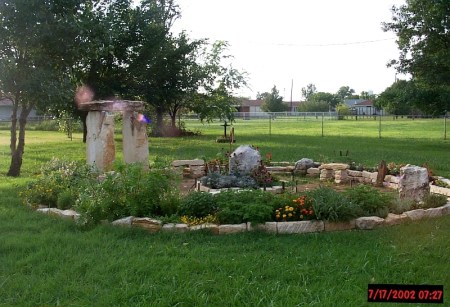
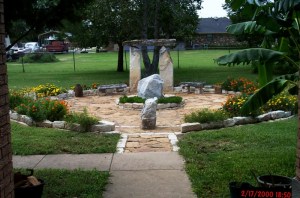
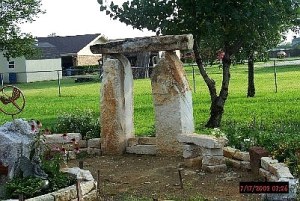
Building a large trilithon of stone is no easy task. The stones  have to be much larger than the portion visible above ground, and stone weighs a lot. We bring this up in order to underline the respect due to anyone who manages to build a large stone replica, no matter what the motivation.

And we bring that up because we suspect there are some among our readership who may be inclined to jeer, to cavil, indeed even to scoff, at the stated motivations of Thomas, the man who imagined and then built the replica above. He gives an explanation at this website, and in it he mentions Celtic magic and power and a bridge to the underworld, spirits and elementals–even white robes.

Thos 5Now we know that these topics rub many of our readers the wrong way, but they are, as inevitably as archaeology, engineering and astronomy, tied up in people’s perception of Stonehenge. And when the henge parasite hatches in the mind, it goes straight as if by instinct for the most vulnerable area. Sometimes it’s art, sometimes it’s science, sometimes it’s tourism, sometimes it’s bravado, sometimes it’s nostalgia, sometimes it’s play and sometimes it’s a mystical inclination. That last is the case here.
We’ve made the argument often that the Celts and druids could not have built Stonehenge, having arrived at least a millennium too late, but that does not technically preclude the possibility that those descended from Celtic peoples have some blood of the megalithic builders in their veins.  Celtic culture could have arrived as a style embraced by the indigenous people of the isles, rather than as a race who arrived to exterminate them–and some DNA testing suggests that is precisely the case.

Thos 7So scoff if you must, scoffers, but in the henging world there are many mansions and all who henge are welcome. You can read more by and about Thomas and his henging inspiration here.

Score for this nice garden trilithon and stone circle: 6 druids. He included a heel stone and a few small bluestone-like uprights. And to be honest, we would be thrilled to have this in our garden, an intimation of a magical world. We’re also thrilled to have another large, permanent replica!

Share

Asian Cupboard Henge: Stonehenge-Generated Art

syjuco stonehenge

“Pacific Super (Stonehenge),” by Stephanie Syjuco, used with permission

Stonehenge as a basic form for art is a recurring theme on Clonehenge. The Whitney-exhibited artist whose work this is, Stephanie Syjuco (her website is here), was born in the Philippines and lives in San Francisco, and one of her themes is the interplay of eastern and western cultures as it manifests in the marketplace as the average person experiences it. Her statement for this artwork:

Description: downloaded an image of Stonehenge from the internet and used it as a template to go shopping at Pacific Super, a chain of Asian supermarkets in Daly City. I chose products based on how their shape and size would “fit” into my own recreation of Stonehenge. The resulting model is made of mainly inexpensive food products imported from China, Japan, the Philippines, and Thailand. ‘Pacific Super’ addresses issues of global production, consumption and cross-cultural translation, using the familiar image of a world-famous ‘mystical’ European landmark and everyday Asian goods.”

We’re willing to bet that the original builders of Stonehenge never saw this one coming! Little did they know the multitude of messages they would someday help people communicate.  If only we were the direct inheritors of their estate. Think of the royalties!

Looking at this as a structure, we can tell Stephanie was working from an image (*applause* sadly, many people don’t bother). We can see the outer circle and taller inner trilithon horseshoe. There are fallen stones and even a hint at bluestones. This one is very nice for what it is, rising above the average trilithon circle made of cupboard boxes (and oh, yes, there are some!).

Score: 6 druids, maybe 6½ because we like that clean photograph look, plus–we sometimes use that kind of soap!

By the way, a friendly wave and hello to any readers blown our way by search-engine winds while navigating for more about the newly discovered bluestone circle near Stonehenge. We invite you to have a look around the blog. We’ve posted photos or links to well over 200 Stonehenge replicas and there are more to come. We suggest a look at our interview and the list of Large Permanent Replicas for a start!

Share

Fridgehenge in Wiltshire: Organics on the A303

fridgehenge

photo from Mirror.co.uk

We’re late with this one. It’s already gone. Unlike the other Stonehenge on the A303, this replica built of refrigerators was a temporary construction, unveiled on the morning of September 22, 2009, and removed on the 29th. Our thanks to a number of people, including Andy Burnham of the Megalithic Portal and Pete Glastonbury, ancient-sites photographer and friend of Clonehenge, for bringing it to our attention!

The Organic Milk Cooperative stated: “Fridgehenge is a monument to organic farming and is intended to symbolise the natural goodness of milk that’s been produced on farms that don’t use artificial chemicals and pesticides.” In an added whimsical gesture they painted each of the more than 30 recycled fridges with a cow-like spot pattern. Which, despite its non-circular design and simple trilithon construction, makes this a unique and likeable replica in our opinion!

Promoting organic milk is still another new reason for building a henge. Communications manager for the group said, ““We are very proud of ‘Fridgehenge’ and hope it helps to inspire more people to drink organic milk . . .” To be honest, we’re not sure it works for that sort of thing. But we do know how it is when you’re struck with the compulsion to build a henge–you’ll reach for any rationalisation that allows you the illusion that it was your idea. No ancient monument tells us what to do, eh?

We’re inspired by the placement of this fridgehenge. Immediately we begin to imagine the A303 becoming a sort of avenue of the henges with people building replicas of every size and description along the highway leading to and away from the real thing. True folk art of the most peculiar kind–archaeologists would have a cow!

Score: 7 druids. We wish the builders well and hope the Old Gods hear their plea.

[Other fridgehenges have also been temporary: one in Santa Fe, New Mexico and one in New Zealand (outside link with no photo). And we doubt we’ve seen our last!]

Share

Clonehenge Classics, In Our Absence

Due to life concerns offline, we may not be able to post for a week to a week and a half, so here are some links to posts of the past that you might enjoy.

phonehenge1Phonehenge or phone box henge, a now-defunct replica in South Carolina. (Wonder what they did with all of those phone boxes!)

6½ druids

carhenge

Carhenge in Nebraska, not the first of its kind. That was Autohenge in Ontario, but this is the one everybody’s heard of.

8½ druids

rotterdam-hengeBamboohenge made in Rotterdam for an arts festival. Beautiful and community-made.

8 druids

Doorhenge–it’s a video of a temporary guerilla henge installation in a park in San Francisco, complete with police arrival. 7½ druids.

Polystyrene Henge and the Topic of Henge Addiction In which Clonehenge tackles a serious modern health concern. 7 druids (seems high . . . )

korean-stonehenge1Paju City Stonehenge, South Korea, because how can you learn English if you don’t feel like you’re in England and what is more essentially English than You-Know-What?

7 druids

larval-stonehenge

Taipei’s Urban Art Interactive Stonehenge Sculpture, because shouldn’t Stonehenge be able to detect you and interact with you? And be cute?

6 baby druids

montana-rainbow

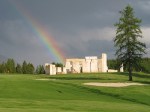
Montana’s Stonehenge, one of the most beautiful, a private Stonehenge on a golf course. What can we say?

8 druids.

And there are many more amazing, fascinating, and ridiculous Stonehenge replicas, well over 200 posted or linked to in our posts of the past, so if  you get henge withdrawal while we’re gone, have a look back through the archives (located toward the bottom of the sidebar, listed by month).

We have some terrific replicas lined up for when we get back, so stay tuned and have a great week!

Share