Last year on Christmas we posted a photo of the English Heritage Stonehenge snowglobe, the one sold in the shop near Stonehenge. So it seems fitting as the holiday approaches to post another snowglobe somewhat less official, but certainly modeled roughly after Stonehenge, as proven by the trilithons and the packaging, which includes this bit of art:
There can be no doubt that is Stonehenge. As Bob at Stonehenge Collectables says, “Had the graphics artist who produced the artwork for box and label created some stones graphically and not used an identifiable view of Stonehenge taken from the south, looking north, any commercial connection to Stonehenge could be disavowed.” True except, as we said, for the trilithons, which you won’t find in any other ancient stone circle we know of.
We’ll give this 5½ druids, partly for that little walkway spiraling up the base toward Stonehenge. It would be six if they’d used something white instead of that clear plastic glitter. Don’t they know that’s for unicorns?
We”ll end with this photo of last year’s and this year’s globes, and a warm wish for a joyous Yule season for all of our readers, wherever and whoever you are, whatever you believe, and whoever you love !
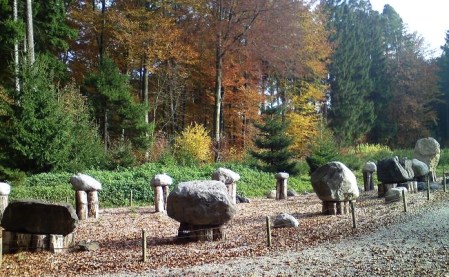
Was zum Teufel ist das? No one likes to talk about it much, but let’s face it–we all know the Swiss are a little odd. They live up there in the mountains practicing for war, drinking hot cocoa and using one tool for every job you can imagine, including carving both ornate clocks and those little holes in their cheese. What kind of life is that?
But we’re not here to judge! We’re just saying it’s not surprising that this Stonehenge-ish thing near Bern is, well, unique among things we have posted. Just look at all the little legs, ahem, we mean uprights, under some of those boulders. And even the trilithons on the far side are odd, with those cylindrical uprights beneath them. But it does seem to be a circle, more or less. The article indicates this woman has something to do with it. If she applies, we’ll give her 6 druids!
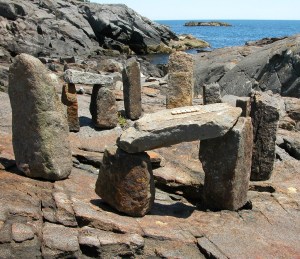
We have one more to show you today. The web is awash with photos of beach-stone and other small stone replicas. Most are similar and will never be posted because it would get too boring (for us, we mean), but this:
posted with the permission of the photographer, Kristborg Whitney, is one of the nicer ones we’ve seen. It was photographed on Monhegan Island in the state of Maine, and, no, we do not know what that thing is on top of the nearest lintel stone. Just as well–life is richer for some of its little mysteries!
These things appear all over the world. Of course we assume they’re not built by tiny druids or aliens or faeries, but who knows? It’s just an assumption. Although the fellow in New Zealand who posted the following photo on Webshots seems rather certain: Mini Stonehenge built by some douchebag with way too much time on their hands .
We’ll be posting briefly once or twice again this week, holiday things. In the mean time, we wish everyone a joyous and meaningful solstice, whether you celebrate it tomorrow (in the modern calculation), Tuesday (in the Celtic manner), or on the 25th (in the Christian manner). May the sun shine upon you and bless you!
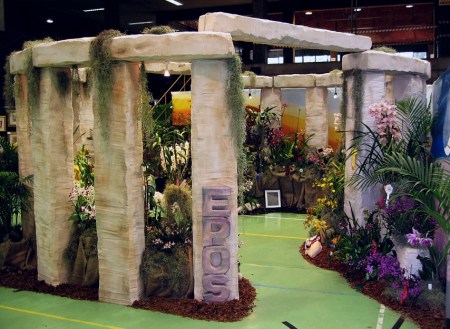
At Clonehenge we scour the earth for replicas so you don’t have to! Today we bring you an entry from the exotic land (unless you’re from there!) of KwaZulu-Natal in South Africa, the east coast city of Durban, where the South African Orchid Council held their orchid show in September.
The winning stand in that show, created by the Eastern Province Orchid Society, was (Ta da!) Stonehenge! Scroll down a little at this link for more pictures. We offer our congratulations.
Very early on, we thought of miniature golf courses as likely Stonehenge replica sources, but we can’t believe we didn’t think of flower shows until now. It seems so obvious! The beauty of it is, flower show people have that tendency to be meticulous and to do things right. Hence this rather nice ring with the Spanish moss draped over the lintels.
And who knows–maybe they’ve hit upon something here. Not that orchids were associated with Stonehenge necessarily, but what about plants? Could certain plants have been associated with and planted around certain megalithic sites? Perhaps research has been done, analysing pollen from certain levels of excavations, but we haven’t heard of it. We can imagine medicinal herbs or others regarded as powerful in other ways transplanted there to add to the mystique of the site.
Or maybe not, but these days Stonehenge replicas are often associated with gardens and plantings. The graceful curves and gentle chaos of ephemeral plants are shown off to great advantage against the solid ageless stones, or at least their imitators.
Score: 6½ druids for Stonehenge of the Orchids. It manages to be both humourous and stately! A combination we could all aspire to, especially as the holidays come on.
Note: In the Durban area, evidence of human occupation goes back 100,000 years. Stonehenge, by comparison, would be modern there.
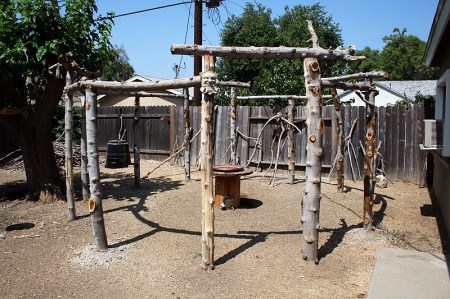
Back to California, Lake Balboa this time (Balboa, you say, why use wood there? Isn’t it Rocky? Get it? Haha? No? Sry!), for an unusual henge sent in by its builders. We may as well let them tell it.
“With the help of a Clonehenge contributor (Matt DeHaven [remember Dom Perignonhenge? –editors]), we sunk 12 Mulberry limbs (8 of which at 7 feet high, and 4 at 6 feet) 2 feet into the ground with cement, creating a Mulberry woodhenge approx. 15 feet in diameter. We then laid 12 6 foot lintels over the tops and left most of the bark the posts and lintels (except for those parts that peeled off over time due to squirrel runs). We retained as much of the natural shapes of the limbs and their respective branch stubs on the lintels to lend a more organic flow to it.
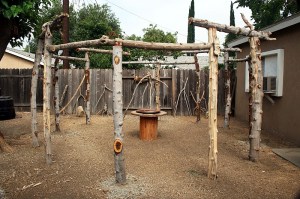
My wife is an Archaeomythologist, so she ensured that we had our henge oriented with 2 “gates” facing the Winter Solstice Sunrise & Sunset, and the Summer Solstice Sunrise & Sunset. I partially buried a wooden spindle and affixed an old satellite dish (painted in hammered copper) in the center of the spindle as our “altar” tray, doubling as a bird bath. Sorry no sacrifices, unless you count flowers, fruit, and wine. It took us 2 solid weekends to actually build it, and it was well worth the muscle aches, bruises, and blisters!”
Brilliant! If you can’t grow plants in your garden, why not have a henge? Note also what the builders call the Mulberry Ents along the fence. The top photo is the later photo, and we note the addition not only of a gnome door to the center spindle but also of a green man to one of the poles. Plus we’re told that “squirrels LOVE the henge, running all along the tops and bouncing off the posts.” See how a henge can bring life into your space? We don’t know how so many people live without them!
Score–we give it 7 druids! It would be lower if it weren’t for the careful orientation by the archaeomythologist. That takes it up a notch! Anyway, many thanks to the Emryses for sending this in. It gave us some smiles and points up what everyone should know–you can probably make a pretty decent henge from something you have around the place!
Before we go, a suggestion–we would love to have a photo of a henge made from those bags of coffee or containers of chai (those chai boxes are perfectly proportioned!) displayed at Starbucks everywhere. Just get permission (or not, but don’t blame us!) and start henging on a table at the store. If they ask, tell them it’s for Clonehenge! Be sure to put everything back–we’re not Mike Doughty!
We had this bookmarked for quite a while, uncertain whether it belonged on the blog, but then a friend of Clonehenge (Mr. P.G.) sent us the link asking if we’d done it yet, so here it is. Last year, 2008, Liverpool was designated European Capital of Culture by the European Union. As a contribution toward that, John Hill and others from the University of Liverpool by a very simple method including a rope, simple counting and the sun’s shadow, laid out the pattern of positions that would be necessary for a model of Stonehenge.
They then measured out a smaller pattern to suit the site and proceeded to dig a ditch and bank and mark the sites of the Aubrey holes. You can see a diagram of this stage of the original Stonehenge here. A fuller explanation of what Hill and the others did can be read in the article we mentioned. You can see the result above.
This construction certainly qualifies to be posted on Clonehenge, going by Rule Number 6 of our Rules of Henginess, and is in fact the first henge to qualify on that basis alone. A Stonehenge replica without uprights or trilithons–we were waiting for this. Well done! They placed the earthen bank on the inside of the ditch, too, another distinctive feature of Stonehenge, as other henges tend to have the ditch on the inside.
These things may seem minor, but they are pleasing to find in a world where one trilithon of anything is called a henge. This is a true Stonehenge replica, a replica of the developmental phase of Stonehenge called Stonehenge 1 (the phases are described on this Wikipedia page).
So how do we score this? We haven’t even found anything to mock or be silly about, but we don’t deduct points for that, tempting as it might be. Score: 8 druids. Because if druids had been involved in building Stonehenge instead of coming at least a millennium later, this is very much like what they would have built at this stage.The article points up that even the astronomy and celestial/landscape relationship have been painstakingly provided for.
What more could we ask? Well, there’s the question of ambiance. The spot is perfect for what its creators were doing, but here at Clonehenge, Stonehenge is not just a work of engineering and astronomical precision. We have learned that some people see it as sculpture, some people see it as a sacred site, and many people regard it with awe. (Let’s face it–gigantic looming stones–ftw!*) If Stonehenge looked like this, there wouldn’t be so many replicas and we wouldn’t be talking here, but this is brilliant and we will add it to our list of large permanent replicas!
*(we mean that to stand for for the win, not free the whales, or f*** the world, which would be, well–sort of humourous in that sentence, actually, now we think of it . . .)
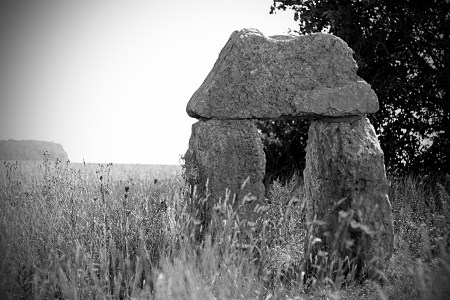
For our 57th large permanent replica, we go back to Germany, southern Germany in the state of Baden-Württemberg, near the city of Ulm, to the town of Ermingen, where there is a longstanding, possibly ancient tradition of beacon burning on the first Sunday of Lent. Since this site, on a prominence with a clear view in all directions, needs to be kept clear for the beacon, someone came up with the idea of placing stones to track the movement of the sun.
And once you bring up the concept of tracking the sun with stones set in the ground, it’s never long before someone mentions Stonehenge. Hence this rather nice if odd trilithon. That lintel looks like a little cap, doesn’t it?
We don’t know much about this one–who did the planning and building, what kind of stone was used, how it was assembled. Did they use mortice-and-tenon construction as at Stonehenge? All we know is what we found at this link from Stadt Ulm Online’s Ermingen page (a couple of good pictures there, too). [Note: the term translated there as radio beacon would be better translated as relay or broadcast beacon. Funken doesn’t mean radio on this context.]
Herr Thom has posted a nice video of the stone circle and a walk through the trilithon. Click here to see it. Nicely done! Translation of the caption there includes this: “On the days of the summer solstice and the winter sun turn within the stone circle determined points are illuminated by the stone gate through of the sun.” At certain times of the year the sun shines through the trilithon onto special points within the circle.
Ermingen, by the way, is known among fossil buffs as the site of the Turritellenplatte, a unique outcropping of rock rich with fossils of Turritella, a kind of mollusk shell. We don’t know whether any of that rock was used for this structure, but if it was, we would approve. That fossil/megalith connection is in need of strengthening.
Ermingen is also surrounded by many ancient sites, including a cave, Hohle Fels, that is thought to have been inhabited as early as 30,000 years ago. Found there so far were a Venus figurine and bone and ivory flutes, the earliest musical instruments ever found. Brilliant stuff! Let’s go visit!
Score: 6 druids. We like the site, we like the beacon, a very old way of communicating, and we like the fact that there’s a circle rather than just a trilithon. Now we wonder what new large permanent replica will pop up next!
We said we weren’t going to post any more but we can’t stand knowing of large permanent replicas and not posting them! People count on us for their Stonehenge replica information. Well, in our dreams, anyway!
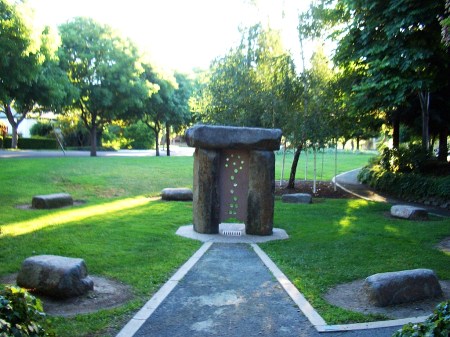
We actually knew there was some kind of little Stonehenge in Mountain View, California, but until now we had never seen a picture of it. Then one day recently we were idly searching the interwebular thing-a-majiger and, voilá! Here is this odd little sculpture/replica trilithon/circle in a park. With photos by a fellow of the excellent name Ghostly Penguin Display. (No, sorry, we don’t know why either.) Well, obviously we have to post it.
But what is it? We have stared at these pictures for a while, before and after doig searches to see if there’s any info online about this. We found nothing Perfect! That leaves us free to make up whatever we want.
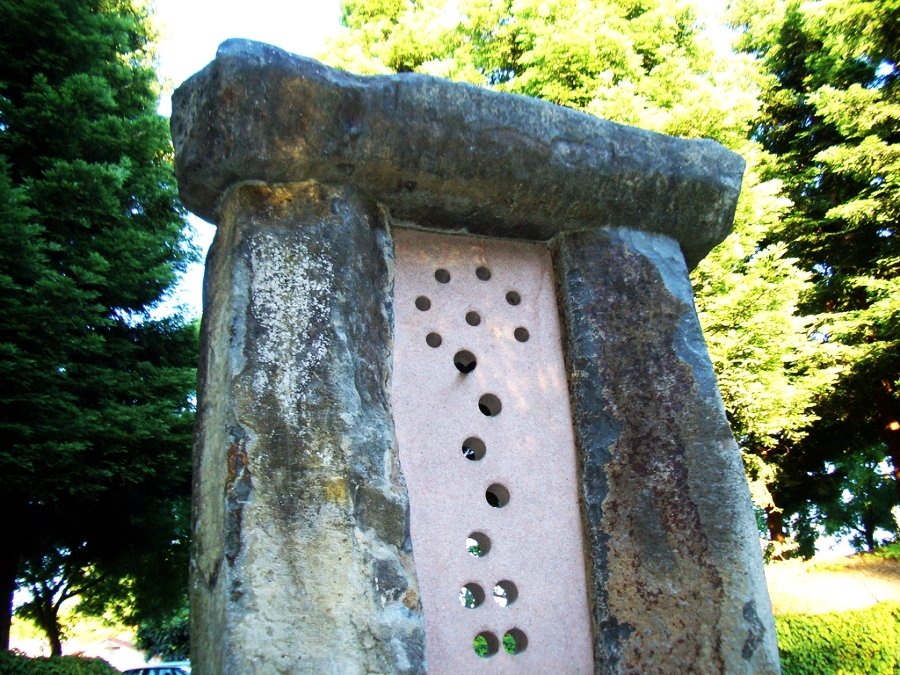
The most alarming thing about this one is that grate under the trilithon. We had to reject out of hand (so to speak!) the theory that it might be an outdoor urinal. Even California is not that funky. And then there’s that strange screen between the uprights, with the pattern of holes in it. Astronomical sighting holes, lining up with sunrises and sets? Stars? The moon? Unlikely with that configuration, although it’s likely that at least one of them will line up with something.
No, the conclusion we have come to, and we plan to stick to it even if the designer or someone points out that we’re wrong (which is not unlikely), is that this piece, although dry now, was designed as a fountain.
Which makes it our third Stonehenge fountain–fourth if you count one built on an old fountain. There was the Falling Water Designs replica, the Warwick University replica (small and temporary), and, of course, the first replica that caused us to use the word lameness in a post, the Waterfall Stonehenge, for sale now. There’s actually another, since one of the trilithons at Caelum Moor in Texas is a fountain, too, although most photos don’t show it running.
Clearly there’s a pattern here, and we think this is the best explanation for this odd yet charming construction. We like the circle of low stones around it, suitable for people to sit on and listen to the falling water while reading or just thinking, or trying not to think. We want one of these in our town’s park!
Score: 6 druids. We may have been influenced by the nice light captured by our Ghostly Penguin friend. We admit we’re a little mysified, too, by that tree or trees just behind it. A young flowering tree with supports? A small grove with some young white birches? We can’t quite figure it out, but that’s okay. Stonehenge is supposed to be a mystery.
And, yes, we have a couple more to come including a nice German one we had somehow missed. See you soon. Happy Thanksgiving to our Stateside readers!
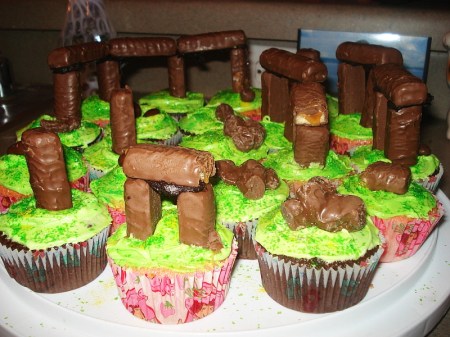
Clonehenge is one year old today. Happy birthday to us! To celebrate we will list a few of our favourite smaller and/or temporary henges, starting with the celebratory cupcakes above, which we posted back in March. Have one, gentle reader!
Another henge we liked was this cell phonehenge, a creation of the great henging enthusiast Simon W. Burrow. We would have to check, but this may be the only small henge that got 8½ druids. Unfortunately it seems that his photos and brilliant captions for this are no longer on Flickr.
Next we have to put a mention in for the smallest henge, a nanohenge made in Singapore by scientists testing a silicon micromachining process. They made a Stonehenge replica–what else?!
That was one of the first ones we posted–November 24, 2008. Seems like eons ago. It was only a few months ago, in August, that we posted the mosaic fruit jelly henge on the occasion of our 200th post. Made by The Cookie Shop, a blogger in Brazil, it has to be the most colourful and attractive to the eye of all the mini-Stonehenges we posted. Yes, it’s just trilithons, but it’s candy for the eye.
Foodhenges have been among our favourites all along. Certainly baconhenge has been popular with readers. Carol Squires, its creator, and Carin Huber, who first blogged it have made a contribution to the visibility of henging, especially home food henging, on the web. It is among the best known of online henges.
And we can’t forget the Lego Doctor Who! What a great, strange, and twisted concept! The good Doctor encounters the Secret of Stonehenge, courtesy of thegreattotemaster, up there in chilly Iceland.
And sadly we’ve found many excellent Stonehenge replicas that we haven’t been able to bring to you because we didn’t get photo permissions. Some, like Clotheshenge, were so good that we posted links, but for the most part we just let them lurk on the web for you to stumble upon one day and think of us.
For now, we’re thinking that a year is enough to dedicate to something like this. We will still post when something comes up and we certainly plan to judge and post the Clonehenge contest entries, but we plan to take a break from the long hours of searching for new things to post. We think we’ve made our point–people everywhere are making Stonehenge replicas out of everything.
Why? Maybe someday someone will do a graduate thesis on that and use Clonehenge as a resource. We hope so. People just laugh and shrug it off, but we think there’s something going on here that bears examining.
There are loads more out there. We’ll still post when someone send a good one in or when we hear of one we think bears mentioning, for example if Ross Smith in Australia ever releases photos of the one he was threatening to make. So let’s toast to a year of Stonehenge replicas. How about some Dom Perignon, Clonehenge-style? Cheers!
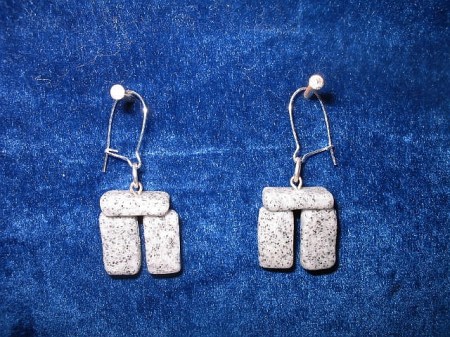
It’s getting toward the gifting season (groan!), so here’s a fun little set of items for any Stonehenge enthusiast on your gift list. We were impressed with these because most earrings out there that are being called Stonehenge earrings bear no resemblance whatsoever to Stonehenge. These are rather nice little trilithons of spotted stone (okay–in the real Stonehenge it is the short bluestones, not the tall sarsens of which the trilithons are made, that are spotted, but we’ll let that pass because we like the look).
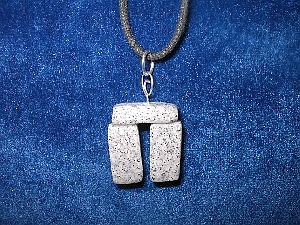
And there’s the nice little pendant to go with them. The whole set would go well with an outfit of solid black, or a wardrobe of solid black if you’re that sort.
We can’t help but imagine these finding their ways onto the ears and chests of cute little wannabe Wiccans who have glittery moon tiaras and only a dim concept of Stonehenge that somehow involves Druids and Irish music or bagpipes although they’re not sure why. But quite serious archaeologists who know about Beaker folk and the cursus and what-not might wear these earrings, too. The stone shapes and proportions are well done and there’s an off-balance sense about them that echoes the cobbled-together look of the real monument.
Score: 6 druids, because good Stonehenge jewellery is hard to come by. Sadly for our Stateside readers, the website selling them is in the U.K. So far we haven’t found anything comparable on Etsy.
By the way, this site also sells small Stonehenge candle holders and even little witches hung from strings to hang from your ceiling or perhaps your . . . ahem . . . Yule tree. And that’s only on their Stone Age/Pagan/Celtic page. Who knows what joys await? Happy winter solstice shopping, or whatever you like to call it!
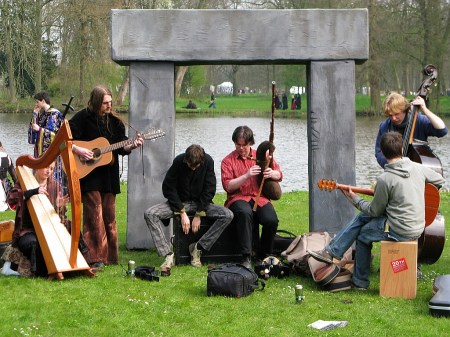
We aren’t going to score this one. It’s just a trilithon, squarish and non-ancient-looking. But fun! We hadn’t heard of the Elf Fantasy Fair before, but believe us, if we were real people and not just soul-less blog bots, we would definitely make a point of going to Elf Fantasy Fair 2010! If nothing else, on the power of this photo alone:
(Even though it seems only in 2008 did they have a Stonehenge.)
And believe us, there are more where that photo came from, whether you fancy the costumes or the girls! Look at this fellow, and these two. Many more photos scattered about the net, and some of the greatest costumes we’ve ever seen! Do an image search and you’ll see.
What? Oh, yes, the Stonehenge. First take note of what appears to be Ogham, a medieval Irish alphabet, cut into the “stone” on the right side of the trilithon. An odd detail, but there’s always a new wrinkle in any Stonehenge, it seems.
We like this photo, with musicians making music around the stones. The connection between Stonehenge and music seems natural. Research has been done about that, but since it was done at the Maryhill replica, we’re not sure how accurate it is. People say the Maryhill replica is a lot like the real Stonehenge, but you only have to look at it to know it’s not. The stone shapes and the concrete materials are too different.
The music connection, however, is unavoidable. Many albums and CDs feature Stonehenge on the cover. Of course there’s Spinal Tap. And Oxegen in Ireland, the music festival we would most like to attend, features a Stonehenge-like portal for its entrance way.
Portal is perhaps the operative word. The trilithons at Stonehenge look like portals, as if one could stand in the center and walk out into a different world or another different world, depending which one you walked through. Music at its best serves a similar function, opening temporary new worlds or sometimes new doors in our everyday world, bringing the transcendent to the mundane.
Or–that could be hogswallop. After all, we’re just bots!


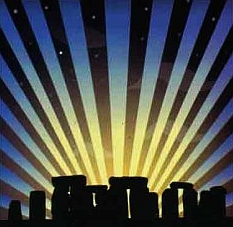 There can be no doubt that is Stonehenge. As Bob at Stonehenge Collectables says, “Had the graphics artist who produced the artwork for box and label created some stones graphically and not used an identifiable view of Stonehenge taken from the south, looking north, any commercial connection to Stonehenge could be disavowed.” True except, as we said, for the trilithons, which you won’t find in any other ancient stone circle we know of.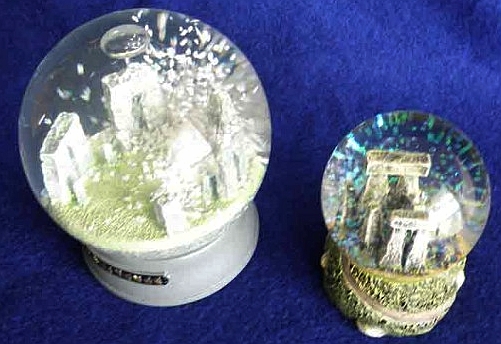

 photos by Jim of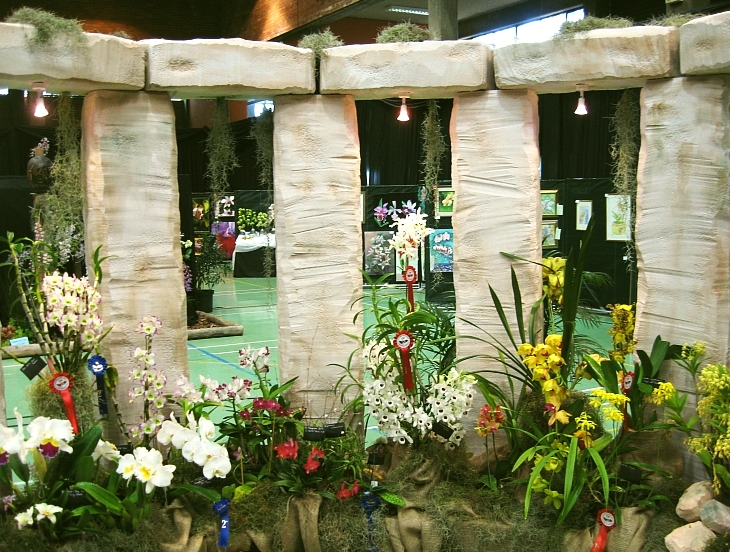

 photos and henge by
  My wife is an Archaeomythologist, so she ensured that we had our henge oriented with 2 “gates” facing the Winter Solstice Sunrise & Sunset, and the Summer Solstice Sunrise & Sunset. I partially buried a wooden spindle and affixed an old satellite dish (painted in hammered copper) in the center of the spindle as our “altar” tray, doubling as a bird bath. Sorry no sacrifices, unless you count flowers, fruit, and wine. It took us 2 solid weekends to actually build it, and it was well worth the muscle aches, bruises, and blisters!”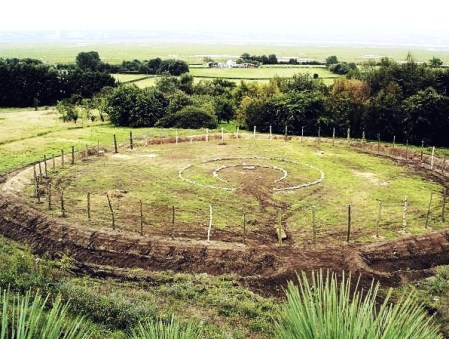







 CLONEHENGE

