Let Me Tell You About My Stonehenge (Model Kit)

Our own photo

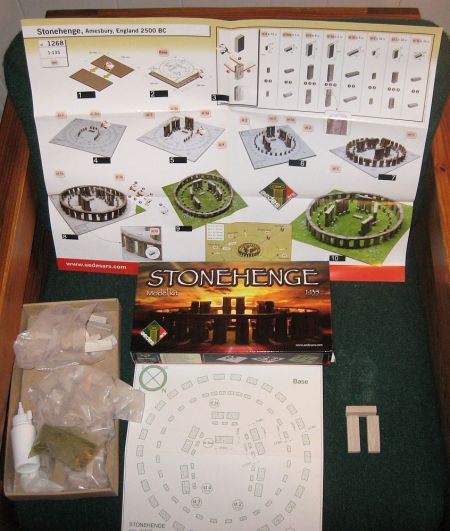
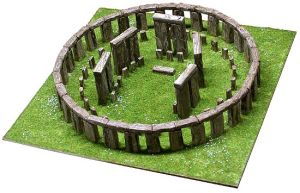
Recently we were pleased to receive our very own Stonehenge model kit from the Spanish company Aedis Ars. Apparently the post took its good old time getting it here, as it had been sent as much as two months ago, but all’s well that ends well, as they say, and here it is at the Clonehenge offices.

The set is quite impressive. It comes with a nice little history of the building of Stonehenge  and a large poster with pictures and diagrams showing how to assemble the kit. This is not a ready-made kit that requires only that you set the stones upright, but a kit for a serious hobbyist, preferably someone with a shed and extra work table where the set can remain while the modeler works at refining and constructing it over time. It seems perfect for the sort of British hobbyist who spends much of his time at the allotment or in a shed in the back garden, taking pains to perfect the finest detail in anything he fiddles with.

In other words, the end result would completely depend on how much time and finesse one wants to put into it. So far, I am sorry to say, ours remains in the box. Still, it looks like a fine model kit, with key details included.
For example, although the base provided is only big enough to include the main circle at Stonehenge, the construction poster shows an expanded view including the positions of the Slaughter Stone, the Heel Stone, Station Stones, and the Z, Y, and Aubrey Holes with distances and dimensions given, so that if said eccentric enthusiast wants to make his own expanded base in order to include more of the landscape, the information and extra stones he would need are there. We like to think that Clonehenge had something to do with that bit. If you know otherwise, please allow us our modest delusions of grandeur.

We can’t score this kit as we do complete replicas, but if we replace our usual druid scoring, as a set we would give it as many as 8½ anoraks. If we ever get our model made, we’ll post a picture. But don’t hold your breath. The new Stonehenge visitor center will probably be built first!

Many thanks to Aedis Ars for our complimentary kit. Nice to get a little loot for all of our thankless labour over the keyboard! When blogging about Stonehenge replicas becomes a lucrative business (any minute now), we’ll have an employee built the model (and we’ll expand those offices). Until then, gentle readers, happy henging!
The “Better Than Stonehenge” Henge: Esperance’s Replica Rises at Last!

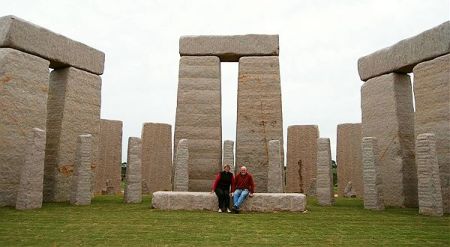
photo from The Esperance Express, showing Kim and Jillian Beale at the henge

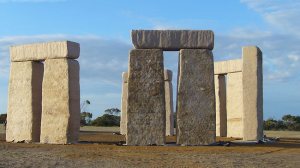
Was ever an erection so eagerly awaited? Well, yes, probably, but still we have been watching these stones since almost before they were cut, so it is delightful to see them standing at last! This is the Stonehenge replica in Esperance Australia, made from the stones cut for the much ballyhooed Ross Smith replica that died, so to speak, in utero with the stones still in the quarry because of money problems.

Then we got news that some enterprising individuals in Esperance, a town in southwestern Australia famous for beautiful beaches and for things like birds and bits of Skylab falling out of the sky, were going to buy the stones from the nearby quarry and build their very own tourist mecca/modern monument. They got a discount–there isn’t a huge market for unused life-sized Stonehenge pieces. The names Kim and Jillan Beale started to float into view. (Yes, the Jillian Beale in that racy Rotary calendar, but that’s another story.)

Our last update came in February, assuring all that plans were going forward. Then apparently we missed an article in March, in which, well, here is a quotation from it: “Mrs Beale was confident StoneHengeEsperance would be more visually striking than the mysterious English prehistoric monument. “It will beat it hands down,” she said. “We hope it will become a major attraction for Esperance and WA. It will be absolutely fantastic.”

We could do a whole post just on that, discussing the merits of the spelling of StoneHengeEsperance, whether this is in fact “the world’s first full-size stone replica of Stonehenge” and just how likely it is that the new structure is more beautiful than and will beat the real Stonehenge “hands down”, but time and news have moved on and so must we. We trust that our readers are of the sort who can make up their own witty remarks in a pinch.

Today we are celebrating the long awaited construction of the monument and discussing instead the more recent article which begins promisingly with this sentence, “JILLIAN and Kim Beale’s construction of what is thought to be the world’s only life-size replica of the ancient Stonehenge Druid ruins on their 1,066 acre Merivale Road property has taken another step forward with the addition of a new outer circle.

Let’s start with a discussion of whether this is the world’s only life-sized replica. No*. Then we go on to the phrase “ancient Stonehenge Druid ruins”. And when we are done LOLing we ask where did they do their research–on a forum for people who always dress in Renaissance Faire clothing? Someone needs to send a strikeforce into that sentence to take out the word Druid. Regular readers know, but we repeat: druids could not have built Stonehenge. They didn’t even arrive (or develop)  in England until 1000 years after it was completed. And, for the conspiracy theorists, is there any hidden meaning in that 1066 number??

We have tried to read the rest of the article but can only conclude that the reporter misinterpreted her own notes when she wrote it. There is talk of “horseshoe stones” and “an outer circle of 19 trilithon stones, surrounded by a circle of 30 sarsen stones”.  The right words are there but it doesn’t sound as if they are in the correct order.

All in all, what we see in the top picture looks very good, although the lack of lintels on what we can see of the outside circle naturally concerns us. Despite the strange reporting it is getting, we think the replica (we can’t bring ourselves to call it StoneHengeEsperance) will be awarded quite a few druids (our tongue-in-cheek scoring units) once we get a complete account and view of it. We’ll try to keep you posted, but if you see something about it before we do, please let us know. Meanwhile it is time we add it to the list of large permanent replicas.

Our thanks for alerting us again go to the lovely and talented @salisbury_matt , aka Matt Penny, who is still slogging away at SalisburyandStonehenge.net. Poor lad. And thanks to you if you have read all this way, or even just skipped down here from the beginning. Until next time, happy henging!

* Life-sized replicas other than the Montana replica linked above include the cement replica in Washington State, the Circle of Life in Connecticut (of  granite as this one is), and the BBC’s Foamhenge, which, alas, no longer stands.

Cakehenges and Word Fields: the Plight of the Carbon-Conscious Blogger

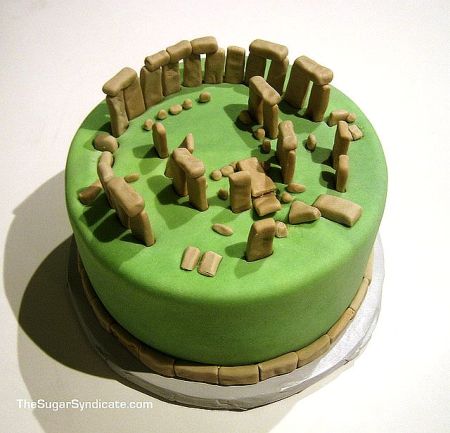
photo from TheSugarSyndicate.com’s Flickr account
Believe it or not, we are swamped with new Stonehenge replicas of all sorts and you might think, if you were not in possession of all the facts, that we should be posting here at least a couple of times per week, if not every day. You could be forgiven for assuming we are just lazy.

But nothing could be further from the truth! What people don’t realise is that unlike other bloggers, who just use mass-produced letters and words, often imported from countries where they have been grown with pesticides by people who are paid sub-subsistence wages and who have no access to health care despite their crippling work, here at Clonehenge we personally grow every letter and every word ourselves, nurturing them with great care and at much expense.

This labour of love gives us precious little time for the fun of producing these posts for our adoring public, but because we know you are waiting breathlessly we tear ourselves away from the Palabra beanfields to craft these posts like drystone walls, turning and fitting each word and each letter until somehow they fit and balance to make the august edifice that is Clonehenge.

Today our topic is Stonehenge cakes, or cakehenges. The example above, beautifully done, was the 2007 creation of a Chicago-based bakery, The Sugar Syndicate, which is, alas, no longer a going concern. It is an outstanding example of the cakehenge genre, second only to our favourite, the mom-made cakehenge from New Zealand’s Vanda Symon.

photo by Siobhan Jess Sarrel

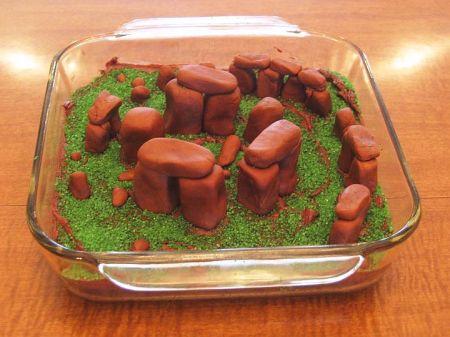
The confection in the pan above was posted on the Clonehenge Facebook page by reader Siobhan Jess Sarrel, about whom we know nothing, especially not how to pronounce her first name. She baked gluten-free brownies, used fondant to fashion the Stonehenge on top, and took it to a friend’s solstice party. (We do not know if Ms. Sarrel is in the northern or southern hemisphere, so we don’t know if it was a summer or winter solstice party.)

These henges have many things right with them. First, they are our preferred type–replicas of Stonehenge as it stands today. In both cases the builders looked at pictures of Stonehenge to guide their modeling. Both show the trilithon horseshoe and the three remaining adjacent lintels. Both show fallen stones.

The top cake is more accurate in scale and placement and also includes the bluestones. It is impeccable and professional looking. The brownies, on the other hand, are gluten-free.

This may not mean much to the average reader, but for us this is a huge factor. Not only are we at Clonehenge among those who are required for health reasons to eat gluten-free foods only, but it is a little-known fact that the original Stonehenge on Salisbury Plain IS IN FACT GLUTEN-FREE!!! Well caught, Lady S. J. Sarrel!

Scores? We give the Syndicate henge 7 ½ druids and Ms. Sarrel’s brownie henge a solid 7. We figure we don’t want to run afoul of any syndicate out of Chicago!

Well, it looks like we’ve just about run out of words that are developed enough to pick. We’ll have to let the fields grow a bit before we can post again. Here’s hoping the aliens don’t come by and ruin things with crop circles!

If you’re still hungry for cakehenges, find more here. And until next time, happy henging!

P.S.: What the hell is fondant, anyway? Yes, we know we could google it but the truth is we’re far too lazy. Oops.

The Guerilla Henging Craze (and the Land of the Frozen Maple Leaf )

photo from this article

Happy solstice to our reader(s)!

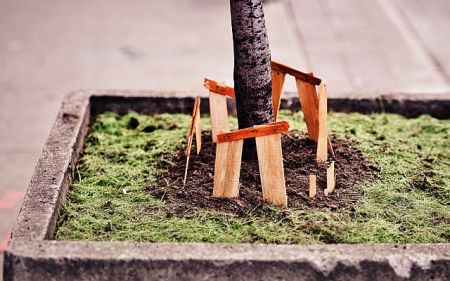
Listen. We need to have a talk about, yes, guerilla henging. Everybody’s used to guerilla theatre and, more recently, guerilla crochet. But for years a hidden epidemic of Stonehenge building or henging has been going on without fanfare and without triggering any alarm in the unsuspecting public. Wake up, people!

It took this throw-away article on street art involving city-abandoned planters in (not surprisingly) Toronto (Ontario again!) to stir our thinking. It involves only one guerilla henge, but we know this is just the tip of the iceberg! [Note to Canadians–we used that as a common figure of speech. It is not, we repeat, NOT a cheap Canada/snow and ice joke.] This is not just a few flaky hengers, drifting along at glacial speeds, but a blizzard of henge creation that is crystallising now and is unlikely to melt at any time in the foreseeable future. *wink wink* [blah, blah, blah, Mounties, white bears, ice floes…]

Anyway, after a lengthy hiatus, we have been doing a little searching around the internet for new henges and the results are startling. Everyone is building Stonehenge replicas! We don’t mean stone circles, as we have explained before. That is a completely different category of creation. We’re talking about structures with lintels, meant to mimic Stonehenge itself. They are appearing in unprecedented numbers, from pre-made kits and models to instructions for junior hengers, to the usual alcohol-inspired henges and foodhenges, plus the mysterious henges that appear on lawns and in public places like mushrooms springing into existence overnight.

What is going on with people? The human race has gone into a frenzy of Stonehenge reproduction–those little worms that entered their minds upon seeing pictures of Stonehenge, or the real thing, taking over their wills as if they were wombs, and forcing them to give birth to Stonehenge’s children! There should be a task force on this or something.

But for now there is only Clonehenge. We are the voice crying in the wilderness, warning everyone of the danger of Stonehenge replicas eventually taking over every vacant square inch on the earth’s surface. Alas! We cry out but no one hears us. Our valient warnings fall on deaf ears. Et cetera, et cetera.

What we’re actually saying here, for those who are incapable of reading subtext, is–Day-um, ma peeps, git your asses out there and put henges in all the oddest and most surprising places. This is our time! Flash mobs are going out and guerilla henging is IN! Clonehenge wants YOU.

So once again we wish you happy henging! But please, some of you, be careful on the ice! You know who you are, eh?

P.S.: We forgot that we meant to use the word frightening in this post. Feel free to insert it where you will.

Why No Posts?

photo by Jo Wallace

Four words: “Disk failure is imminent.” All of the henges we had lined up (and we DID actually have some!) are currently unavailable and (possibly) awaiting rescue. Our apologies. Meanwhile keep those links, photos, and suggestions coming. If you sent us one and you haven’t seen it, please send it again.

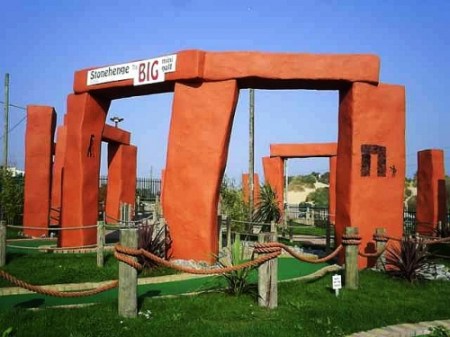
We’ve posted the picture above before in our post on the Stonehenge/golf connection, but here is a link to someone’s blog post on this replica, sent us by ever-alert reader and contributer Bob Bradlee aka @StonehengeGuy . We’ve seen pictures of a minigolf course in Thailand, a couple in England, maybe one or two more, but surely we don’t have them all. You can help in this vitally important research! If you’re traveling this summer, keep your eyes peeled for Stonehenge golf courses, large or small. Clonehenge fame awaits you!

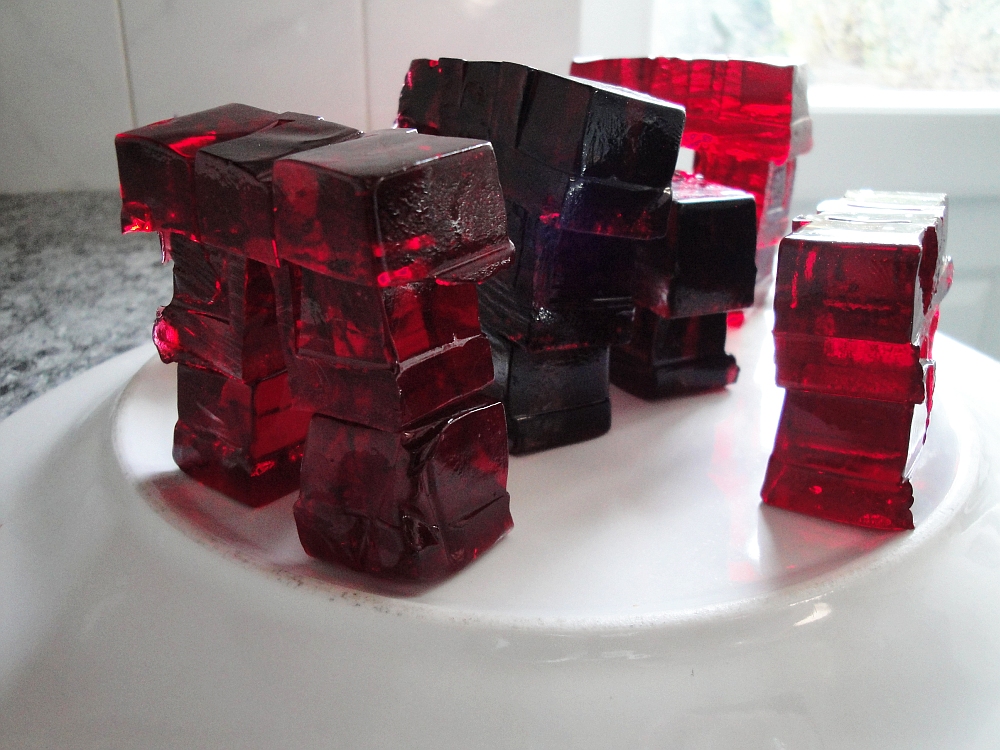
Jellyhenge: Why Shouldn’t Stonehenge Be Red, Transparent, and Edible?!

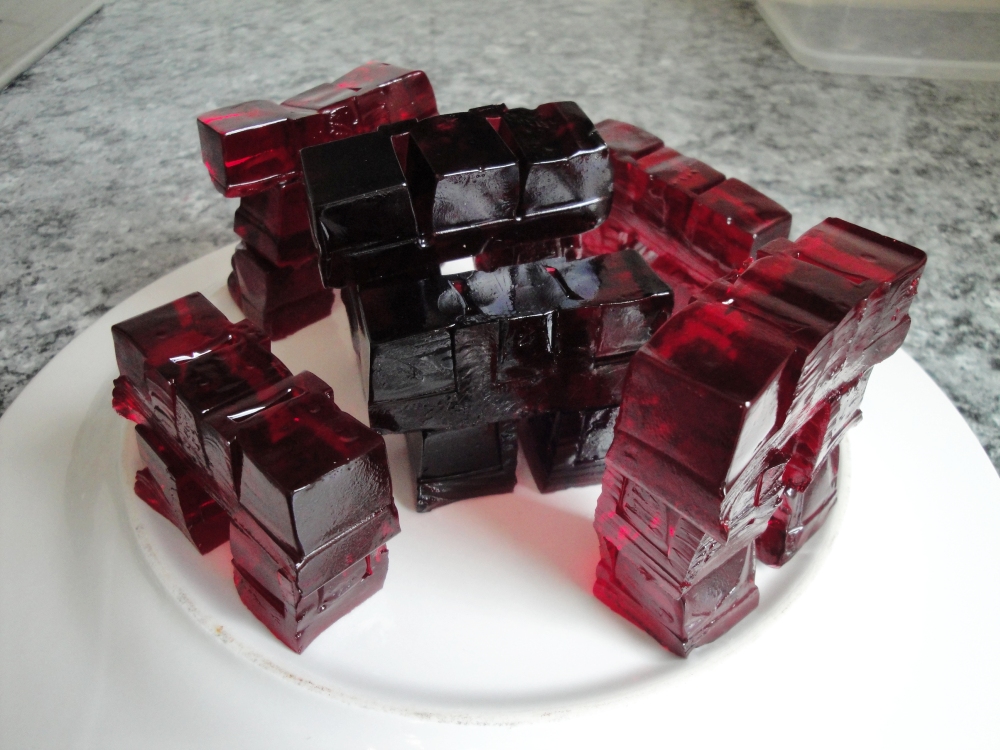
photo by Dan French, used with permission (at least until he reads this)

This henge was presented to us by Dan French. We assume he or someone he knows created it, but who knows? The man does not seem to be trustworthy. For one thing, he gives his name as Dan French, but–get this–he IS NOT ACTUALLY FRENCH!!!1!! Like we wouldn’t notice that!

Also, he is a Bruce Springsteen fan. From Baldock, Hertfordshire. Does that seem right to you? Baldock, we happen to know (because we just read it on Wikipedia) was founded by THE KNIGHTS TEMPLAR!!!!1!(one)! and was the site of a leper colony in medieval times. How are lepers and the Knights Templar connected with Bruce Springsteen? And jelly? (We will again take up the topic of Baldock in a future post!)

Whew! There. Two solid informational paragraphs–and at first we were afraid we wouldn’t be able to write anything thoughtful about this henge. Pshaw. This is why we are the best Stonehenge replica blog going!

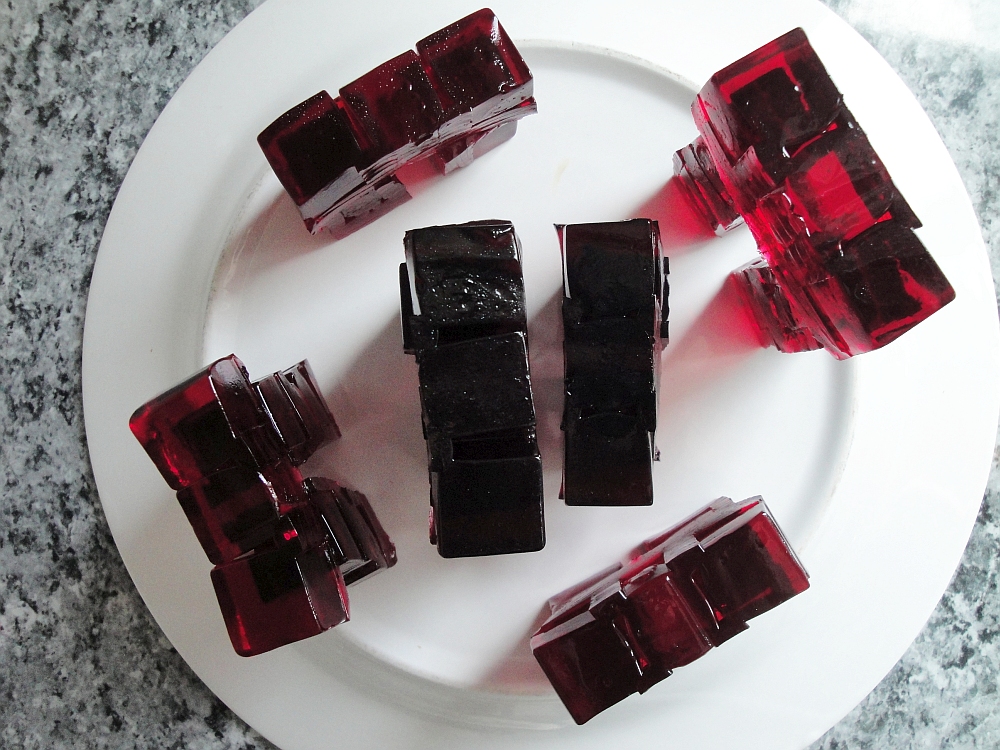
Which reminds us, what about the Stonehenge replica? We do love our Gentle Readers but they constantly work to get us off topic, as if we were an eccentric secondary school physics teacher. What we have here, Class, appears to be four outer trilithons and two inner trilithons. A little short of the real thing, but we have to take into account the superior materials. This is the henge the ancients wanted to build, but they didn’t have the advantage of modern gelatin technology.

Mr. “French” (Lestat?) claims the outer trilithons are raspberry and the inner are blueberry, cleverly giving a nod to the bluestones. But we all know how dependable he is. This could well be the ultimate blood sacrifice henge, with the blood incorporated directly into the megaliths!!

Not to get off the subject (heh), but have you seen this srsly awesome slow motion video of jelly (or Jello or Jell-O) cubes being dropped onto a hard surface? We do not use or advocate drugs, but if you are already smoked up or tripping, you will have a distinct advantage in enjoying this. And for the jelly-shot types, did you know that if you make them with Bacardi 151, they are so strong that they can kill you, but they can also be lit on fire?! DO NOT try this at home, especially if you have a couple of them first, even though that IS when you’re likely to be tempted!

What’s that you say? Henge? Oh, right. Let us address the score. The stone shapes are not right. There is no continuous linteling on the outer circle. The inner trilithons are not higher than the outer and there aren’t enough of them. No outliers or altar stone, no Aubrey holes… The list goes on and on.  But–it IS clear and wobbly. Think of the sunrise shining through this one, people! Think of the rare lichens. (?) We have carelessly given decent scores to much worse replicas than this.

Score: 6 druids! Congratulations, Mr. “Dan French”, but we’re still onto you. Millions of people would do anything to penetrate the prestigious world of Stonehenge replicas, including assuming false identities. Our nanotechnological insects are seeking you out as we speak. This isn’t our last post concerning you, sir!

To all of the rest of our Gentle Readers, know the chapter on vectors by Thursday. And until then, happy henging!

It’s Got Character, Charm, and a Slab in the Middle–Celebrating Our 300th Post!

Brought to our attention by the ever-vigilant Wiltshire citizen and elegant shutterbug, Mr. Pete Glastonbury, this bit of video is part of The Complete and Utter History of Britain, a project done by Terry Jones and Michael Palin in their pre-Monty Python days.

In it, a realtor is showing Stonehenge to a young couple as a potential home (despite its being a bit drafty). The monument in question appears to be a circle of six trilithons, as seen at second 15 of the video. A Stonehenge replica from 1969–excellent!

Score: 6 druids. Wish we could give them more, but Palin (that’s Michael, not Sarah) had yet to perfect his tourism schtick. Our thanks to all of our readers–even those who stumbled on the blog while searching “nudity mandatory“! Keep sending us those links and pictures and keep building those linteled stone circles. The future needs them, for some reason we have yet to divine.

Until next time, happy henging!

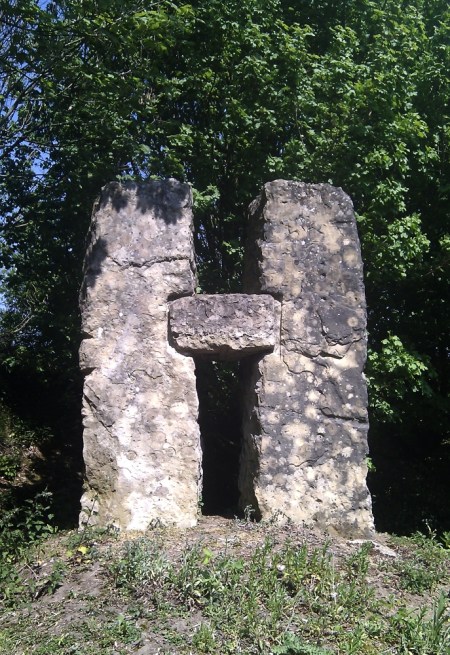
H is For Henge: The Salisbury Hospital Trilithon

photo by Matt Penny, aka @Salisbury_Matt (but heartlessly cropped and altered by evil Clonehenge elves)

When we receive an email with the subject line, “Does this count?” it appeals to our considerable megalomaniacal tendencies. That is correct, minions! It is completely up to us. We alone decide what is henge-sufficient and what is not. Ha. And this time friend of the blog Mr. Matt Penny, knowing our weakness for flattery, played on it in order to be given the prestigious name of Discoverer of a Large Permanent Replica. Well  done, sir!

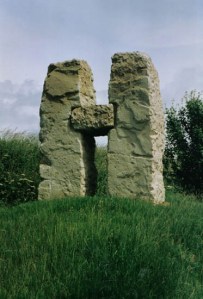
What and where is it, you ask? Mr. Penny (yes, alert reader, that same young Mr. Penny we have mentioned before as the creator and sovereign of the website Salisbury and Stonehenge.net) says it is “a tri-lithon style ‘H’ which stands at the entrance to Salisbury District Hospital (usually known as Odstock)”  He goes on to say, “My feeling is that this is at least possibly a clonehenge rather than a simple stone ‘H‘ because of its elevation on a vaguely tumulus or tor shaped mound, and because of it’s relative proximity to the stones themselves (or clonehenge v0.1, as I’m starting to think of them).”

Although we prefer to think of ourselves as the only truly clever people,  we grudgingly admit that it was perceptive of Mr. Penny to look at this sculpture and realise that it is indeed a reference to that great grey heap of stones out on Salisbury plain. Proof that his hunch was correct can be seen on the sculptor’s website where it tells us the piece was “Commissioned by Salisbury Health Authority : H FOR HOSPITAL, a 6 tonne trilithon of Chilmark stone to mark the entrance to a new hospital. Click HERE to view.” [H IS FOR HOSPITAL–nice title but I think all of us here know what H is actually for!]

That word trilithon is the clincher. Put the word trilithon into Google along with the name Salisbury and one topic dominates the results–Stonehenge. Therefore this stone H fits solidly into the category of Stonehenge sculptures. In an odd twist, the notch method of inserting the third stone actually makes the sculpture more like the famous Tongan stone trilithon than like any of the trilithons at Stonehenge. But we are not ones to nit-pick (Much. Heh.).

More from Salisbury Matt, because he says it so well (or is it because we’re too lazy to write it ourselves? Surely not.): “The other quite nice aspect is that it’s made of Chilmark stone, which I *think* is the the stone that was used to build the Cathedral (I’ve never really been much into ley-lines etc, but Salisbury Cathedral and Stonehenge kind of go together – somebody like Dr Johnson said something like they are the ‘first essay and the last perfection of architecture’).

Wikipedia notes that Chilmark stone appears to have been used to pack around the base of at least one of the uprights at Stonehenge. This sculpture certainly ties in nicely. Curiously, when a hospital near to Clonehenge headquarters, far from Wilts, tried to call a huge H on their premises a sculpture, authorities judged it to be a commercial sign, denying them privileges or tax breaks. Maybe they should have made it of crude stone and called it a Stonehenge replica. Psh! And people say that our topic has no practical applications!

As for a score, we’re charmed by the connection of the Wiltshire Chilmark stone, the placement of it on a mound, and even the connection to healing, rumoured to be one of the functions of Stonehenge itself. We give it 5½ druids, not a bad score for a mere trilithon. And we give to Matt Penny that most coveted of titles–official Clonehenge Finder of a large permanent replica. Please, Monsieur Penny , we don’t want to hear about all the free drinks and action (wink, wink) you get as a result. Meanwhile don’t forget, other readers, if you want that kind of glory, make or find a Stonehenge replica and send us pictures! Your life will change in ways you can only imagine!

And to everyone, happy henging!

Stonehenge Film Clip: How the Stones Were Rearranged (with model)

STONEHENGE: STONES REARRANGED SHOCK: (Clip 1).

We present this link via the ever alert and helpful Pete Glastonbury–a film clip about Stonehenge, showing how the stones were moved with heavy machinery in the 20th century.  We post it primarily for the Stonehenge model, glimpsed briefly shortly before half way through. The stones look accurately proportioned and shaped, what we can see of them. This could have gotten a tidy bunch of druids (The Tidy Druids–great name for a band!)  if we could see the whole thing.

Where is it now? Did anyone keep it? How many of these things are there, anyway??? And, most important–are we the only ones counting? Happy henging and enjoy the springtime (or autumn if you live in upside-down world!)!

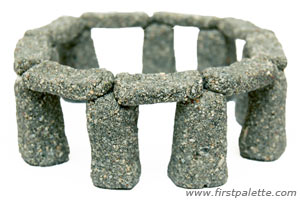
Fostering Childhood Henge Addiction and Practicing the Craft(s)…

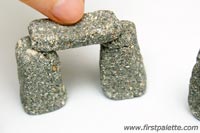
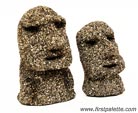
photos from firstpalette.com

As we know, not everyone is content to have Stonehenge an ocean or even a few miles away. The many ways of supplying your Stonehenge fix include virtual Stonehenges, large private Stonehenges, large public Stonehenges, pre-made fabricated mini-Stonehenges and then there are the homemade mini-Stonehenges. Where there is so great a need, teachers are bound to spring up. This one caters especially to the younger set of henge addicts, setting them up for a lifetime of henging!

These instructions do several things right, enough so that we forgive them for calling it, “The Stonehenge.” First, they go into the whole lith, monolith, trilithon complex of words, thus reducing embarrassing spelling errors for those children who may grow up to the noble profession of Stonehenge replica blogging. We went for many posts before a friend pulled us aside and reminded us that it isn’t spelled trilothon. (Bright red-faced smiley and lawks!)

They also explain the lintels and there’s this nice little moment when their colouring the salt clay where they simply say, “Color your clay or dough by adding a bit of black acrylic paint or poster paint. Add a tinge of blue if you like.” (Our emphasis) They don’t mention bluestones, but that they throw that in, even though it’s for the sarsens, is nice. They also discuss the trilithon horseshoe at the bottom of the page, for the advanced neophyte henger. Not bad!

So we’re going along, showering them with adoring approval when what do we see? Say it ain’t so!! Yes, they are moai! Groan. Now many of our multitude of readers may have joined us too recently to remember, but the association of Stonehenge and moai is kind of a pet peeve of ours. True, in this case they are at least on separate pages, but this has opened old psychological wounds and we are now curled up in the fetal position dictating this to the cat!

Score: 6 druids! We like that it’s instructions for kids. Everyone should know several ways to create a Stonehenge in a pinch!

That’s it for now, so until next time, happy henging! AND SEND TUNA!!!!