photos from Digital History Wiki page, by Creative Commons license
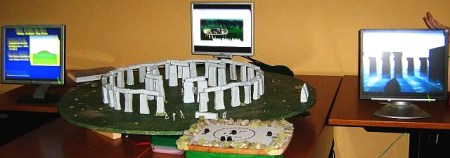
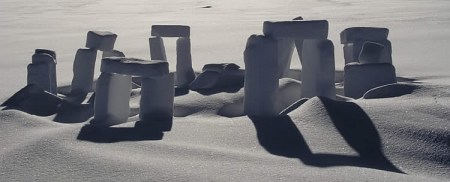
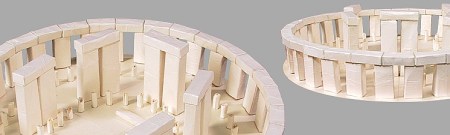
This small replica was part of a project aimed at better understanding how people interact with presentations of historical subjects, one of a group of projects done under the tutelage of William J. Turkel of the University of Western Ontario. Note the computer monitors also showing Stonehenge.
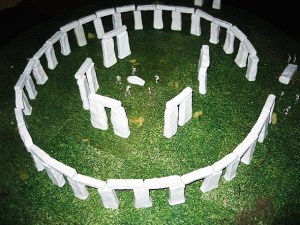 This made us think it would be great to set up computer monitors in a circle with a nice Stonehenge model in the middle, and have them all showing Stonehenge, constantly rotating. But back to the study, the conclusion arrived at here was that people are impatient and easily distracted, and, extrapolating, it’s difficult to teach us anything. Duh!
This is a nice little model, though, and we award it 6 druids. We want to add a couple of links to photos of small models we can’t get permissions for. Here is an early model, from the late 1800’s or early 1900’s (scroll down on that page, and note the other model in the background). And here is a very clean well-done model from the Salisbury and South Wiltshire Museum, photo taken in 1964.
Clearly people have gone to great lengths to make these models accurate to their idea of what Stonehenge is or was. What is this hold it has on us? We’re four months into Clonehenge now, and we still don’t have an answer for that!

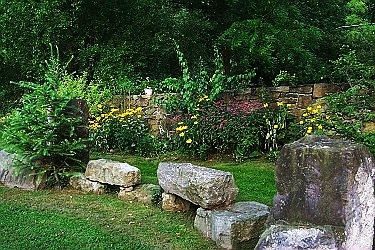
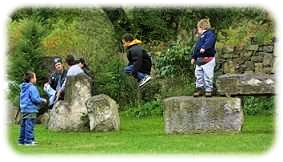 The site says: “The mission of Stonehedge Gardens is to provide a healing, sacred, inclusive environment for the cultivation of personal and community transformation and wellness through the gardens and nature, the arts and holistic education.” The gardens are said to be beautiful, but why Stonehedge? Perhaps to meld the spiritual implications of Stonehenge with the garden word hedge. We do think they spelled it that way on purpose, unlike some. (See the 3rd comment below for the real explanation.)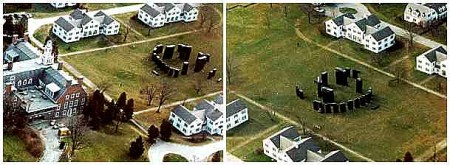
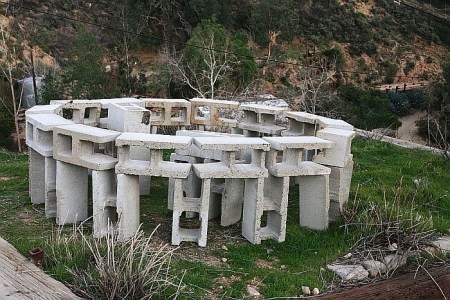
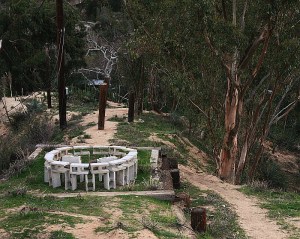
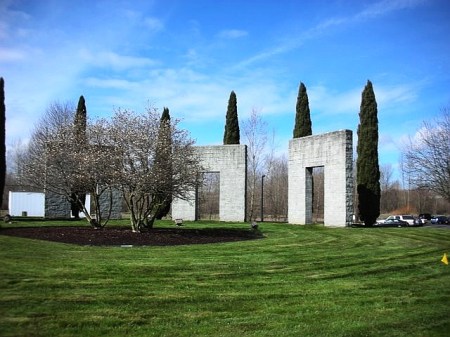
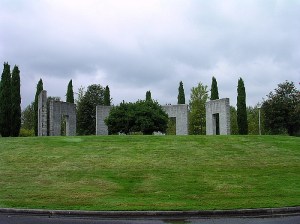
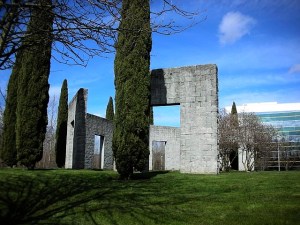 What else do we know? Almost nothing. It’s an odd one, an arc of trilithons made up of what appear to be cement blocks. Judging by the architecture of the building (nicknamed the Ziplock building–well, look at it!) in the lower photo, also by Zullig, we would guess that it’s been there a few decades. But who built it, how and why, are unknown to us. It’s Washington State, we’re tempted to say, so of course there’s a Stonehenge!
 CLONEHENGE