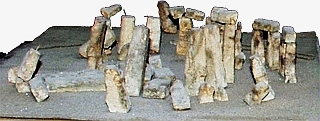
photos from the website of the Ashmolean Museum in Oxford, U.K.
Society often mocks those who are obsessed, but time and time again they are the ones who accomplish much and who see the need for action in their field long before others do. Such a man was Henry Browne, who lived from 1769 to 1839 and devoted his later years entirely to the study, chronicling and protection of Stonehenge.
The story of how he made his first cork Stonehenge replica is told in a footnote to page 77 of the book Stonehenge and its Barrows, by William Long. He brought his tools and materials to the site and did all he could to imitate every aspect of the monument as it stood then, in the year 1824. He also made models of his idea of how Stonehenge looked originally.
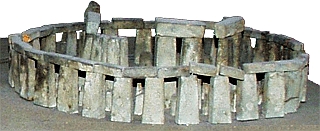
Browne may have been the first to notice that the lintels were kept in place with notches and grooves and the first to suppose that lintels originally went all the way around the outside circle. He was among the first to see that Stonehenge needed to be conserved and protected from tourists as well as local residents who broke up stones for building.
A photo of a Browne model in the Haslemere Museum, taken by the distinguished gentleman from Surrey, Mr. Andy Burnham, originator and Grand Poobah of the highly esteemed Megalithic Portal, may be seen here. This humble blog is to the Megalithic Portal as a child’s wooden block Stonehenge replica is to Stonehenge itself and we are greatly in Mr. Burnham’s debt for providing such a resource!
As to score, well, this man did it right. 9½ druids for Mr. Browne’s models. They are now, as Mr. Burnham says, precious artefacts themselves.
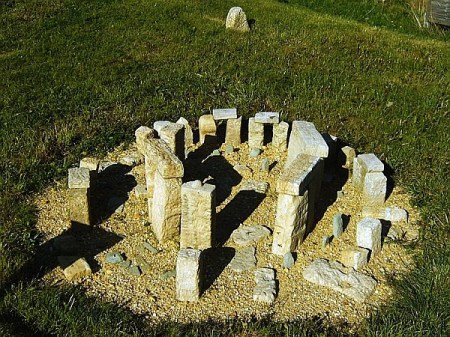
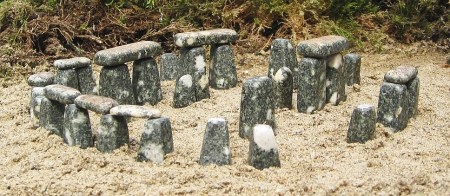
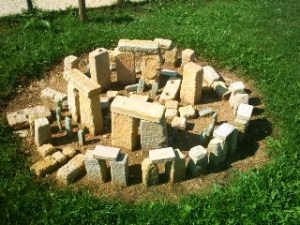 What do you think? Are these worked stones or molded cement? Tough to say. [Later note: we have it from the photographer that they are indeed stone.] The proportions are certainly better than the Brisbane model and we like it a little better than Babbacombe’s, too. Legoland Windsor still wins when it comes to shape and proportions of the stone, I’m afraid.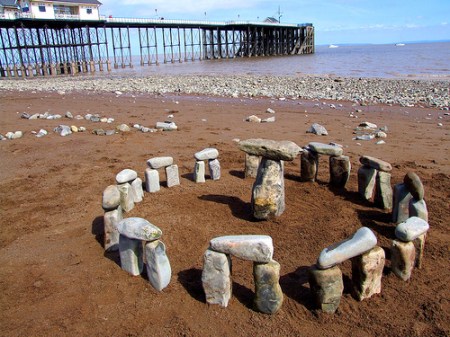

 CLONEHENGE