Rolla Stonehenge, Missouri

photo by Andy Lahr, used with permission

photo by Andy Lahr, used with permission

On the campus of the Missouri University of Science and Technology in Rolla, Missouri, stands a half-scale partial reconstruction of Stonehenge, built of granite that was cut with high pressure water jets. The monument was suggested by Dr. Joseph Marchello, who had helped to found the Center for Archaeo-Astronomy at the University of Maryland before he moved to the Missouri school.

It was built with the help of a civil engineer and astronomer as well as a high pressure waterjet group (who knew there were such things?), so, fittingly for a science and technology campus, it is a demonstration of the science aspect of Stonehenge rather than a work of art. Impressively, the website [link] says, “The Rolla replica of Stonehenge incorporates many of the features of the original and includes two capabilities that the original did not possess.” Click on the links to the right of the page to read the explanations.

Score: 6½ druids. Some great functions here and we’re impressed by them, but it doesn’t capture whatever it is that made Stonehenge an icon.

You can see it on Google Street View here.
Cardboard Stonehenge, the blog

nightime

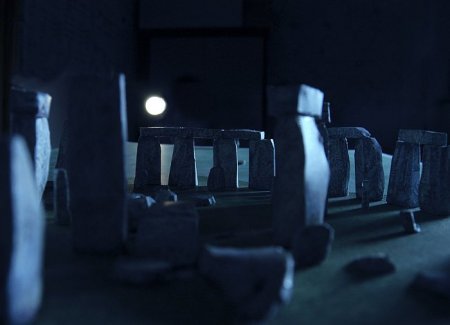
photos from Cardboard Stonehenge, taken by Soo Martin

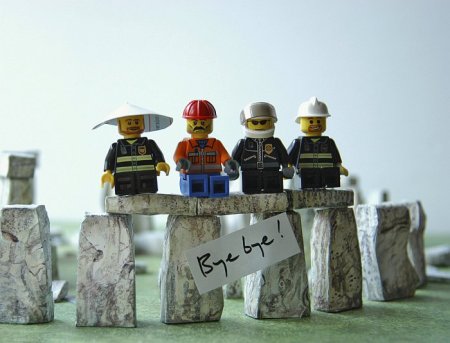
It’s a whole world we never dreamed existed, the world of the cardmodel kit. Moduni.com offers a great many of them, along with other kinds of models for building. Two people, Alan A. and Soo Martin, who work for a British archives service bought a Stonehenge cardmodel kit, decided to build it during their lunch breaks, and, to our good fortune, chose to blog about it for over 3 months as they did. The results are remarkable, as shown by the pictures above and below.

goodbye

(Is that the bunch from Fathers 4 Justice? Love the hat on the left!)

It’s not easy to make this post short, even more than with some other subjects we’ve tackled. We urge anyone with an informed interest in megaliths and Stonehenge to read the blog. It’s short. Many interesting points are made and musings noted, all in a mood of bemused fascination. Take, for example, their Meditations on Underground Access. These are people who have spent too much time thinking about sacred sites. Unlike us. Heh heh.

Anyway, scoring this one is difficult. This blog, with its interim models of glaciers moving  bluestones and of the Stonehenge underpass, with the taping off of the center stones by the Lego constabulary for solstice, with office leylines drawn, and photoshopped lines showing the forms said to be visible in the stones, etc., has completely bowled us over and it’s all we can do to keep from looking sappy by giving it a 9 ¾. It’s a manufactured model, for Sol ‘s sake! After a very cold shower, we give it eight Lego druids . . . maybe 8 ¾! Okay, someone click on Publish, quick!

Maryhill Stonehenge: the first major American replica, Washington state

maryhill-stonehenge-war-memorial

photo from this site

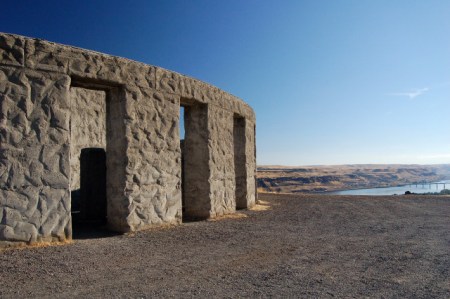
The subject of this post, the Maryhill, Washington State Stonehenge replica, has a longer and less whimsical history than other Stonehenge replicas. Building of the monument began in 1918 and was completed in 1929. The builder, renowned Quaker Sam Hill meant it to commemorate local men who died in World War I and to remind people throughout the ages of the sacrifices of war. An excellent account is given at this link, and you can see an aerial perspective here.

We included the Youtube video both to add a little levity (the superior Stonehenge? sacrificial virgins?) and because it gives a sense of the hush that seems to come upon people inside the circle. This replica more than any other can leave visitors with a sense of awe and of the uncanny when they enter the arc of its concrete uprights. Maybe the spectacular siting and the sincere intent of the builder created the right environment for a gathering of the spirits that once lay beneath the land.

For perhaps the only time, we award the coveted 9 druids score to this haunted henge.

Note: We thought this was the earliest of the large henges, but we received this information from an alert and friendly reader:

I’m afraid the Washington replica is 200 years after the first known
example, at Wilton House, erected for the Earl of Pembroke.

The historic importance of the Washington replica is though in my
opinion, that it was the first to be erected after actual stones were
raised (‘restored’) at Stonehenge (1901) and at Avebury in the
K.Avenue (1911).

Thank you! Our apologies. Perhaps we’ll post that older replica once we find out more about it.

Share

Tamponhenge (apologies in advance!)

tampon

As we say in our “Why?” page, Stonehenge replicas are often made of the most unlikely materials. We saw our first tamponhenge on the web some years ago, but its web address now goes to a 404 page not found page on the University of Nottingham website. Fortunately (?) another tamponhenge has been posted on a Czech website [now sadly no longer with us, and anyway, we’ve since been told it was the same one.]. Translated, the site title, Slunecní hodiny (add a carat above the c), means something like sun clock or sundial.

tampon-2

What sets the site for this homemade henge above the rest are several photos that are visual portrayals of how the ancients achieved the movement and erection of the tampon “stones.” Above, for example, we see two oxen pulling a megalith across the landscape. We don’t know the significance of the mysterious face on the paper plate above the scene in some shots. Perhaps it represents the sun?

If you know us at all by now, you may guess that the megalithic-moving dioramas are likely to translate into some big druids for this henge. And you are right. Score: 8 druids and some big applause, which requires no translation!

[An interview with the maker of tamponhenge can be found here.]

Foamhenge, the U.K. version

foamhenge

Foamed polystyrene, often known by one of its brand names, Styrofoam, makes an attractive material for Stonehenge replicas. It is light and can be formed into any shape. Lintels no doubt help to keep the light uprights in place.

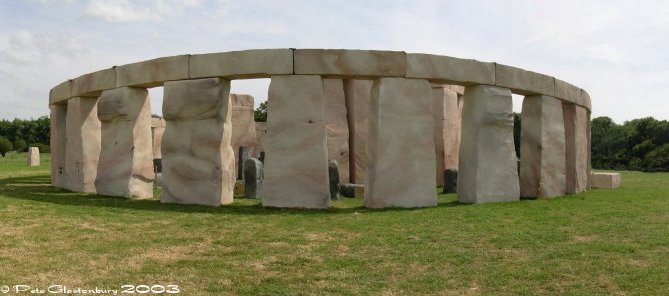
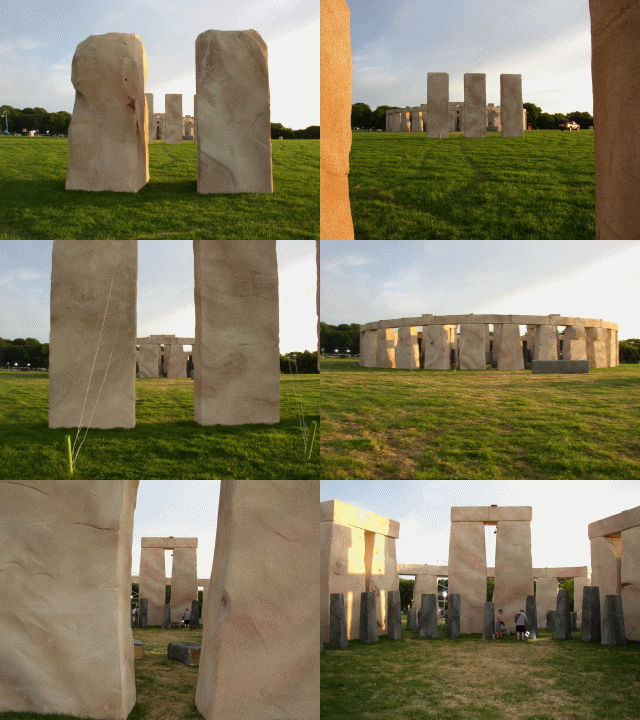
We know of two Foamhenges. One is in Virginia in the States (to be covered later), and one was a temporary construction, built on the Wiltshire Downs by Channel 5 TV in the U.K., and then sold on Ebay. This was a full-sized careful reconstruction of the monument at its height, rather better-looking than many because the real shapes and irregularities of the stones were taken into account. Is the odd pink cast meant to be the colour of the megaliths when they were first cut?  We welcome any information that would shed light on the mystery of the flesh-coloured stones!

foamhenge

Many thanks to brilliant photographer Pete Glastonbury for permission to use his pictures. Permission to use them elsewhere must be given by him. Our original score for this henge replica was a solid (well, as solid as they can be, made of carpet tubes and polystyrene) 8 druids, but recent conversation has caused us to reconsider and this entry’s score has been increased to 9, with a future possibility. Very nice!

Just found this: a Youtube video [link] showing the research done at this Foamhenge. Brilliant! Stonehenge has always represented midwinter to us, and this bears that intuition out.

Virtual Henges, Part One

reconstructed

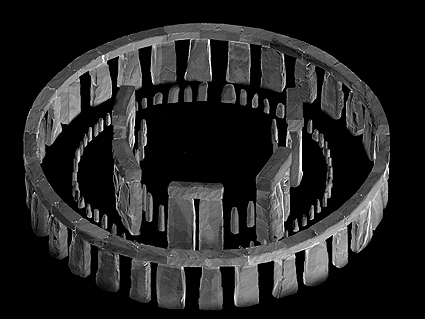
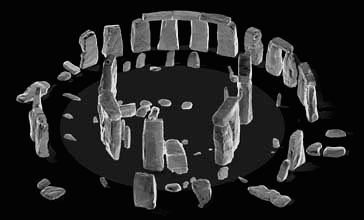
Okay, so right off we admit, these henge replicas don’t exist out in the real world. They are figments of the base 2 realm. Even so, they merit a look as more evidence of the Stonehenge-building imperative. There are a number of them out there, and at first we were inclined to post them all as one. But there is enough  on the site posted by reader sarsen56 for us to make a whole post just from that.

sarsen56

At the top is a reconstruction of how Stonehenge’s stones may once have stood. The lower image is a reproduction of the stones as they are today. The page the second picture comes from has many more images of interest to Stonehenge fans and we recommend a look. We hesitated at first to post what is after all just a few runs of zeros and ones, but in a way, wasn’t the original Stonehenge a sort of grid, a way of reducing the landscape or at least the horizon to a series of zeros and ones in order to bring order to the information it contained?

How to score this? Difficult to say. We like the second image very much, and the first one also has its charms. Still, they don’t exist, do they? No biscuits or cheese puffs to eat at the end of the day, no tourist revenue, no waiting for sunrise or misty weather in order to catch the perfect photo. Score: 6½ virtual druids.

The Hengiest Biscuit

custardhenge

Grainy photo taken in the heat of battle

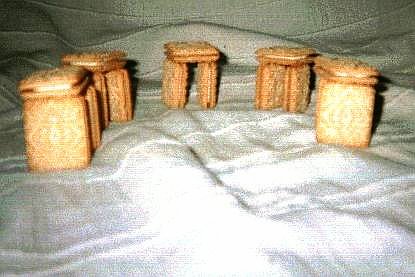
The web page title screams, “Biscuithenge–the ultimate world record showdown,” and with that the contest for the world biscuit* henginess championship unfolds (with, in the author’s words, ‘the use of a very bad camera and a bottle of high quality booze,’ not hard to believe). It’s a short fun read, with Stonehenge itself quickly eliminated. “Stonehenge – The traditional favourite in the pagan pops was swiftly dismissed by the panel who described it as passe, inedible and overrun with tourists.”

To learn what manner of biscuit took the title by “embracing contemporary values and looking positively to the future, whilst upholding the majestic greatlitude and history befitting the henge tradition” take a look at the site. Four kinds of biscuits compete, each with its own henge picture, and with an unexpected victor. This had everything we look for in a henge page except, well, adequate photography.  Score: 8½ druids for the web page, awarded for keeping the right attitude in the henge wars!

*biscuit translates as ‘cookie’ in American

Bamboo henge, Rotterdam

rotterdam-henge-2

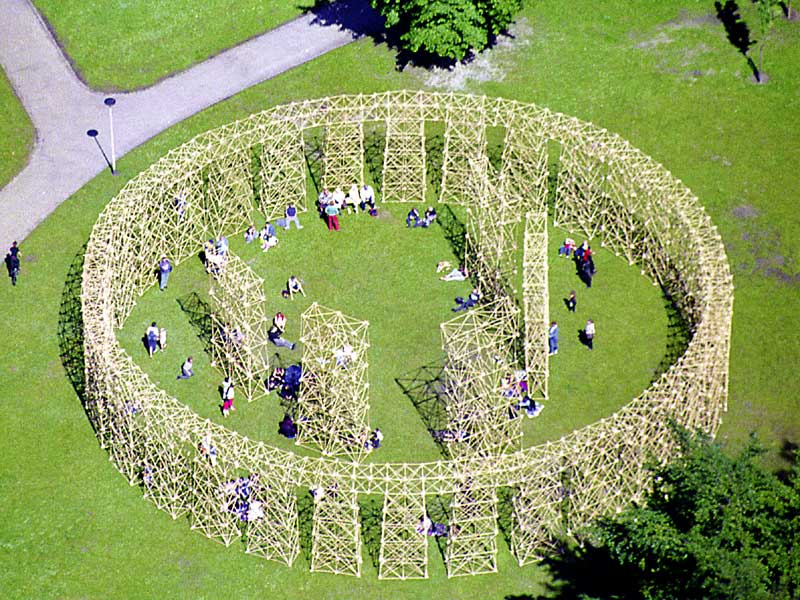
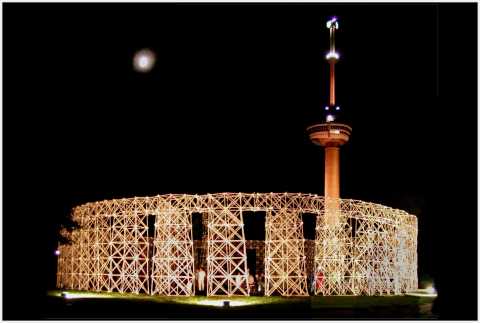
Bamboo Stonehenge replica built in Rotterdam for an arts festival. What a great cooperative effort! We couldn’t find much text about it in English, but there are several videos, including this one, and some sites with photos, here and here. Look at it lit up in the night:

rotterdam-henge

Along with the Doorhenge video, this makes the idea of cooperative building of large henge replicas look very appealing.  What it lacks in likeness to the original Stonehenge it makes up by bringing in the group dynamic that must have been involved in the building of the original, in a way we have seen with no other replica. Score: 8 druids!

Straw Echo Henge

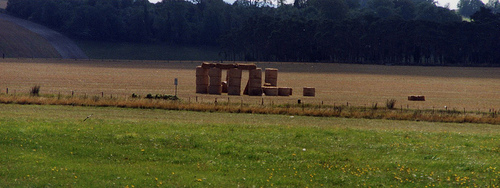
Rare item: a henge replica at Stonehenge! This lucky person, Leon Reed, saw this 12 years ago and fortunately for us saw the meta-henge possibilities. We have found no other pictures so far in which a henge replica stands close enough to Stonehenge to appear in the same picture. Thank you, Mr. Reed!

Have to give this one a good bunch of druids, for the situation and a game attempt at reproducing the current state of the monument. 7½ druids for this straw henge, partly for the haiku-like visual juxtaposition of megalithic timelessness and the fleeting seasons of the field.

The henge watch

stonehenge-lyt_11

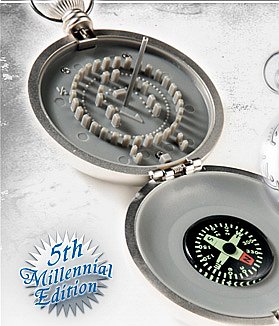
Christmas, I mean Yule, shopping? Here’s something for the megarak* on your list. “A great leap backwards in time telling!” Or as Yahoo News said, “Is that a megalithic monument in your pocket or are you just happy to see me?”

Yes, you get a tiny henge monument and a compass to help you use it to figure the time. “Every astronomical function that was intended by the original builders of Stonehenge can be accomplished with the watch.” Or so the makers claim. In case you’re not good at telling time with shadows, the outside of the watch has an analog watch face marked with Roman numerals.

There’s no denying this is a nifty thing. But how many druids does it score? Feeling generous after a big meal and an afternoon with family, we will award it 8 mini-druids. And it will fit in a stocking hung on your mantlepiece!

*megarak: portmanteau word formed from megalith and anorak, meaning one who is very interested in (possibly even obsessed by) megaliths, standing stones, stone circles, etc.