Circle of Life, Connecticut’s Stonehenge

circle-of-life-sean-kernan

photo by Sean Kernan, reprinted from the NY Times.

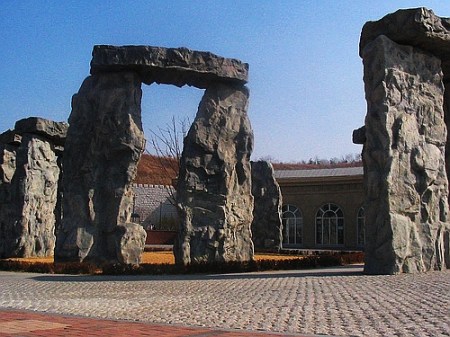
Here’s one of the more famous Stonehenge replicas, named The Circle of Life. It even has its own website and a description of its creation process by the man hired to oversee the process.  Conceived by and on the property of Jonathan Rothberg, who hired Darrell Petit to get it done, it is made up of 700 tons of Blue Pearl Fjord granite from Norway and stands in Sachem Head, Connecticut.

The story is that the idea for this Stonehenge replica was born when plans for an astronomical observatory were rejected by the local zoning board. They say this wasn’t revenge exactly . . . *grin* Anyway, it was built very carefully, astronomically correct (costing, of course, a bundle of $$!), and ultimately the fascination with the project itself overtook the  original impulse.

It’s a classic and leaves us in awe, as much at what money and modern technology make possible as of the structure itself. Score: 7½ druids for this one, maybe 8, although there is no inner ring, no great trilithons, no ditch and bank. What really inspires awe in us is the undying impulse to rebuild Stonehenge and the myriad ways it is manifested by the hands of men!
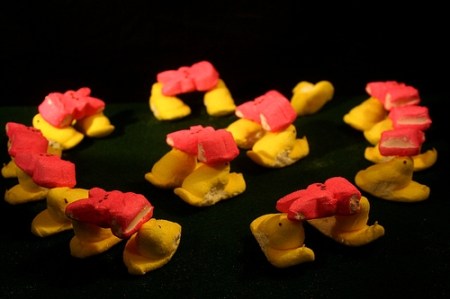
Peephenge–and PeepHenge

peephenge

photo and henge by deadeyebart a.k.a. Brett, with permission

When we started, we didn’t think there were enough Stonehenge replicas to last us more than a month, certainly not to go on until 2009. But here we are, well into January, with new henges cropping up all the time. People are wackier than we thought! Which is a good thing. Mostly.

But few are wackier than our friend the Mad Henger, deadeyebart. This peephenge is part of his henging oeuvre. We say “this peephenge” because, well, ta-da! [link] (Please to take note of what’s going on in the last picture on that page. Shocking! And they remembered the bluestones!) Mr. bart is not alone in his peephenginess. Those people at Lord of the Peeps are giving him a run for his marshmallow.

Still, there’s something about the simple structure above, with the bright colours on black. These peeps have an ancient weathered look, as if they have been marinating in light and time for millennia until now they are hiding the secrets of the ages. Yet they would probably still get hot and gooey after a few seconds in the microwave. What a treat!

All peeps are made at a factory a few miles from Clonehenge Headquarters (more peep truthiness here), but we don’t let that bias our sombre decisions. Score: 6 druids for being wacky and for reminding us of spring!

Bluestone Henge: Transported magically from Wales to you!

bluestone-henge

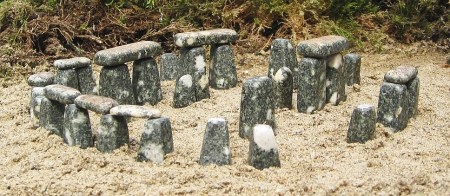
photo and henge by the good people at Lost Stones, with permission

We had a post on the controversies concerning  bluestones at Stonehenge almost written when the electric went out and Blam, it was gone. We’ll take that as an omen and cut to the chase!

Stonehenge’s bluestones are small with no lintels, forming an inner circle and an inner horseshoe. They were brought by glaciers or Merlin or winter sleds or water and log rollers from the Preseli Hills in Wales to the Salisbury Plain, over 400 km (250 miles). Why? Heh. We know but we’re not telling! 😉 Maybe they were thought magical, or healing. Maybe it was just how when cut they show star-like white spots as you see above.

No builders we know of, even those who claim they have the “most exact replica in the world!” (I know, right? And yet there are several.), bothered to match the stone types used at Stonehenge. This goes part way. These real bluestones come from the legal source in the Preseli Hills that supplies Lost Stones. This picture isn’t on that site, but ask. And check out their trilithons, baby!

We have plenty more to say here, but it’s time to go. Scoring: 6½ druids for taking geology into account. We like it!

*By the way, a friendly wave and hello to any readers blown our way by search-engine winds while navigating for more about the newly dicovered bluestone circle near Stonehenge. We invite you to have a look around the blog. We’ve posted photos or links to well over 200 Stonehenge replicas and there are more to come. We suggest a look at our interview and the list of Large Permanent Replicas for a start!

Kansas presents Stonehenge, Jr.: Wichita’s Stonehenge?

wichita-stonehenge

photo by Ingrid Stamatson, with permission [her sweeps site]

Back to the question, What makes a Stonehenge replica? Stonehenge is like the elephant of the old story. One man sees an architectural structure, one sees an ancient temple, one sees megalithic culture, one sees a solar / astronomical calendar, another just sees an emblem of fair England, and each makes his replica according to what he sees, so that one Stonehenge replica may not even resemble another or its parent to outside eyes.

As with Mystical Horizons and the Arctic Henge, this ‘henge’ doesn’t look like Stonehenge: no lintels, no horseshoe, no ditch and bank. Yet, since it has picked up on one aspect of Stonehenge in an original and engaging way and it’s often referred to as Stonehenge, Jr., we think it’s worth a post. Quote from the Roadside America page on it: “On the Equinoxes the rising sun shoots through a large metal eye perched atop one of the stones and illuminates a colored glass stone embedded in the ground.” We understand the solstices are similarly marked. More pix here.

Scoring? Well, we find the complex utterly charming and we would love to have it in our local park. What a great teaching device for children, magical enough to inspire future megaraks*! Still, we can’t ignore its dissimilarities to the real thing. Score: only 5½ druids–but we want one!

* Megarak. A combination of the words megalith and anorak. One who is very interested in megaliths, standing stones, prehistoric stone circles etc.

Kennewick Man–Washington State Strikes Again

543-at-stonehengereplica-hot-zone

photo by Bethany Lee, reposted from Atomictown.com / Tri-City Herald

We’ve always  been amused by things that show penguins and polar bears together. They’re from opposite ends of the world, right? How would they be together? Turns out there’s a similar trend with Stonehenge replicas: people will sometimes add, not a model of Silbury Hill or a barrow or a stone-lined avenue such as you might find near Stonehenge in Wiltshire but–moai such as you might find halfway around the world on Easter Island.

What’s that about? We can think of three examples* including this one. Unlike Washington’s Maryhill Stonehenge, today’s replica is small and privately owned, built by Ed Mays of Kennewick, Washington to replace the old rose garden in front of his home. Quoting from the article: “After forming some pillar bases for the replica, Mays estimates he went through about 75 sacks of cement, which he mixed all on his own. . . . In addition to the circular henge, he placed a giant rock with a carved out face in the center to portray another large rock design, Easter Island.

Far be it from us to do anything but encourage henge building as a retirement activity! If we get a laugh out of this garden megalith complex (complete with a spotlight on the ersatz moai!), it is meant in the same good humour displayed by Mr. Mays’ admirable creation. Score: 5 druids for a game try by this solo pensioner!

* Stonehenge II in Texas and Harry Rossett’s Stonehenge come to mind.

Shunt Henge, or Haha! Eat this, Smithsonian Channel!

shunt-henge

Photo by linux-works, with permission

A henge made mostly of jumper shunts–who would guess they would make such a striking picture? linux-works, the builder and photographer, did an outstanding job catching a clean image of this excellent henge.

When Smithsonian was cruising Flickr looking for images for their henge video, they saw the image here, and approached the artist who declined to release it for commercial TV without being paid. (Tch, tch, sucks to be them! *Clonehenge shakes head and grins*)  We, however, being about as uncommercial as one can get, was given linux-works’ generous okey-dokey and here is shunt henge for you to see. Thank you, sir!

We’re told there is a back story, too, and we’ll add it if we get it, but for now we will score without. As you may have noticed, we kind of equate electronics with druidry, an advantage for this one. We award 6½ druids to this minimalist henge, which seems almost to hang in mid-air.

Paju City Stonehenge: England in South Korea!

korean-stonehenge1

Photo by Sonja Jean, with permission

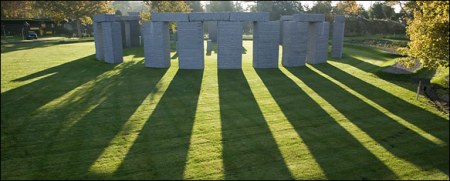
If English speaking is vital for success in South Korea, how can less affluent children get an experience of immersion? One way is to create an English village in Korea. And what is more likely to be part of an English village than–you guessed it–Stonehenge?!

It’s a nice big one, too, possibly bigger than the original, although the pictures hint that it is not complete. There are few sites about it in English. Here is a report about the village from a radio show in the States.

Some replicas demonstrate astronomy or represent ancient observatories, some are to show creativity with stone, others to be cool, some make a political point or serve as a monument to the dead, plus some we suspect are, well, compensation, but this was just built to make it seem like England. So many reasons to build a Stonehenge replica!

How to give druids when we can’t get a look at the whole thing? We’ll say 7 druids for size and whimsy (whose idea was it, we wonder?) and for being so far from its ancient home. A side note: there are real ancient megaliths near Paju City as well.

Share

Stonehenge in Poland

poland-stonehenge

photo from the Kurier newspaper

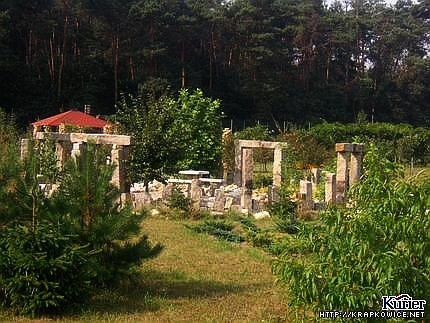
We don’t know much about this one, but we suspect there are hidden Stonehenge replicas like this scattered about in surprising places around the world. People get the bug or the thought, “I could build a Stonehenge in my garden!” We aren’t able to find them all, but let this stand for all the ones we’ve missed. We know there are hengers out there building or planning as we type this!

Here is all we can glean about where this henge is: “It is hard to find, hidden in the stands Krzakach, in one of podzdzieszowickich gardens.” We can’t help you with the pronunciation or meaning of that nice long word there. It gives us the strange feeling that the whole thing was written by WOL.

Clonehenge may go on hiatus for the weekend, so best wishes to all. Druids for this one, you ask? Oh, let’s say piec or szesc. These things need to be encouraged!

Bookhenge, or Henging with the OED in the Maritimes

oed-henge

Photo by John  “the Bookmonger” Doull, with permission

Sorry for the late post! We are crying in our utterly un-beerlike beverage this evening after being turned down–representatives of an artist who created a vaguely Stonehenge-like sculpture not only denied us photo permissions but asked that we never reference the sculpture on our blog as the artist had no intention of referencing Stonehenge. *sob!* So if and when we ever end this blog, there will always be at least one structure out there that people will think we missed! Still, we do respect artists, so that’s that.

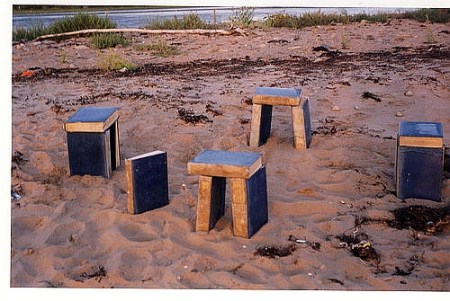
Anyway, on to the matter at hand and that matter is–The Oxford English Dictionary. We assumed when we started this that there would be a lot more bookhenges than there are, books being squarish things and, in many homes at least, always at hand. So we’ve kept our eyes peeled for a bookhenge worth posting and along came this bit of poetry with a lovely late (or is it early? Wait, book lover, right? Late it is, then!) Nova Scotia light giving the books and the sand a rosy glow.

The sand and the implication of leisure time begin to set up a scene of peace and relaxation until we remember to imagine someone lugging a bunch of old dictionaries out there and building a henge when they could have been taking a romantic sunset walk. Hmmm, what manner of people are these? Perhaps a bit too much like us.

And what do they get for it? How many druids can we give for such a rudimentary construction? These are hardy northern souls and they can take the bitter disappointment of getting no more than 4 druids for their bit of OED play. Now, who can help us get the verb “to henge” into the next edition?!