Does This Even Qualify? Philly Flower Show Henge!

photo by Michael L. Lahr

A quick news post. This was spotted in the Visit Ireland exhibit at the prestigious Philadelphia Flower Show, this trilithon is probably meant to be a dolmen rather than a Stonehenge replica, but we’re especially entertained by megalithic replicas at flower shows. We’ve posted some before, here (South African orchid show) and here (Salisbury Community Show).

This one is nicely done, with fake stones that pretty much look like stone, and moss drapes gracefully like a sort of full-body toupee. No score because if it’s in the Ireland exhibit, it can’t be Stonehenge. Just wanted to give it a mention. You people just can’t help yourselves, can you?

Happy henging!

Henge-Podge: Odds and Ends That Have Come Across Our Desk, Part One

photo by Kerry McKenna

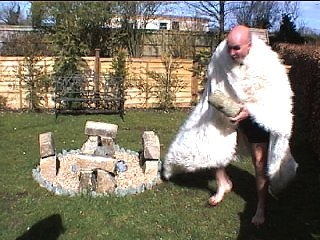
We have been accumulating odds and bits related to Clonehenge, none of them quite right for an entire post, but each a curiosity worth a look. Take the example above, a typical Englishman in tradition dress out for his stolid and dignified constitutional. Barely worth a second look if it weren’t for the henge-ish thing there: four trilithons in a circle surrounded by bluestones. We thank friend of the blog Feet, oops, we mean Pete, Glastonbury for drawing our attention to this. (That’s not him.) We also thank the shadows and the robe for being so helpfully strategic! Oo-er! We were going to make a comment about “stones” but, really, we’re better than that.

Also from Mr. Glastonbury, photo taken by him, is the curious grouping of stones at the left. He says, “I spotted this in the garden of Teachers Cottage in Avebury High St. It is a representation of the Obelisk and the inner stones of the southern circle in Avebury. An Avebury Model in Avebury!” Just the sort of obscure and odd thing we like, but it makes us wonder–do people build little pyramids next to the Pyramids? Or is it a thing that only henges do to the mind?

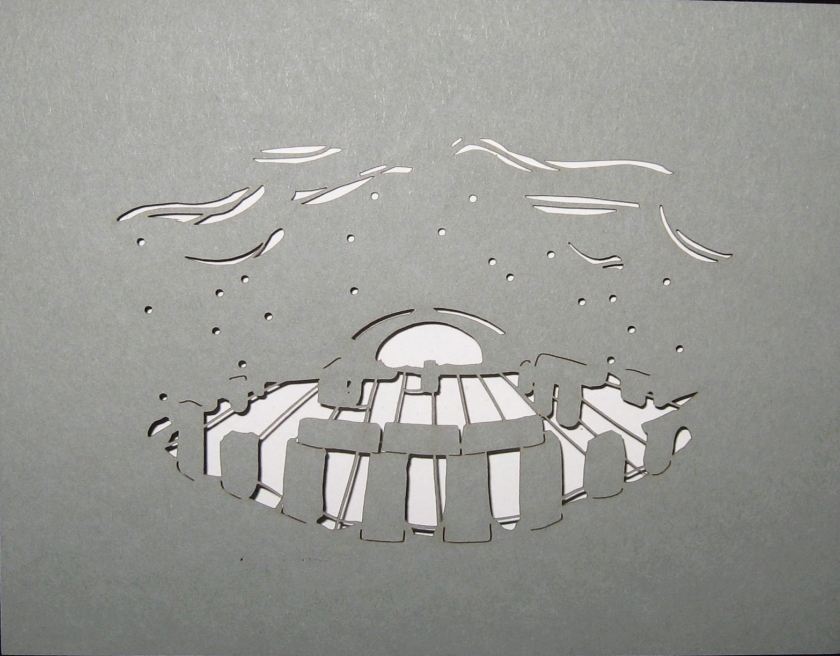
And last for this post, for we find, now we’ve started, that we have more of these bits than we thought, is this card we received for winter solstice (and related holidays) from Mr. @jwisser, aka Jonas Wisser, who is, in the interest of full disclosure, the progeny of the Clonehenge perpetrator(s). He had these cards made by [name to be inserted here later because we once again did not do our homework] especially for him. The sun is rather large, but we do believe in poetic license in such cases, and we think it is a cleverly fashioned thing, all in all. Quite observant, putting the remaining three connected lintels front and center.

We will save the rest of our hengy bits for another post. That way those of you who subscribe to our feed get the thrill of yet another of our delightful posts showing up in your inbox just when you need a lift! And we get to go do something else now. Keep sending in your Clonehenge-related news! Frankly we are surprised at the lack of snowhenges this year and suspect some people have been lax about bringing them to our attention. Ahem.

And until next time, happy henging!

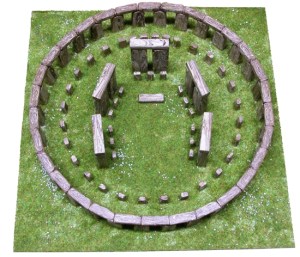
Aedes Ars, New Stonehenge Model for Sale, Made in Spain!

photo from the aedes ars website, used with permission.

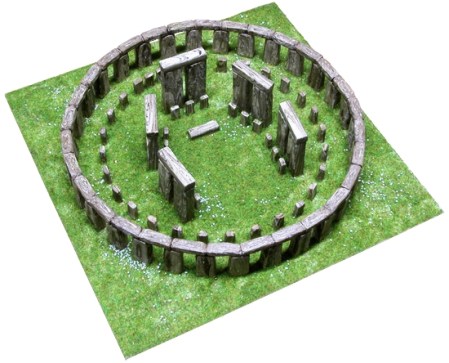
We should have held out for a bribe! For the first time in our two-plus years of folly, a company contacted us in advance to announce the release of a new Stonehenge model. Did we maximise? Did we monetise? No. We’re just doing another post for free, losers that we are.

The kit’s dimensions are listed as 280 x 280 x 70 mm., about 11 inches square, for those who think in old units. Pretty small. All of the 121 pieces are fine quality ceramic fired at 800° C.

We’re told by the people at Spanish manufacturer aedes ars, “The main work with this kit (different of the rest of our products) is to scrape the surface of the pieces to make them irregular and to let the clay colour mix appear in the surface.” So they’re going to some trouble to make the stones look suitably old and stony, always a good sign. They haven’t quite got their English right, but we don’t score on that. Our Spanish isn’t that great, either, a decir la verdad.

What we don’t know yet is how much it’s going to cost, but the company seems very proud of this Stonehenge model, as it is pictured on the cover of their latest catalogue. So, how shall we evaluate it? Our only other commercial clay Stonehenges, the models by Hawkes Nest in North Olmstead, Ohio, got 7 druids, but this one is a little finer, with better-shaped stones and a more professional look. Still, the Hawkes Nest models had a nice wood base…

We like sets you assemble yourself, though. Makes it easier to use for history class dioramas, etc. While the set is of the Stonehenge-as-it-is-imagined-to-have-looked-at-first variety, you could make a good stab at setting it up as it is now. That’s a plus! We like the current, disheveled look of the grey monster of Salisbury Plain better, all in all.

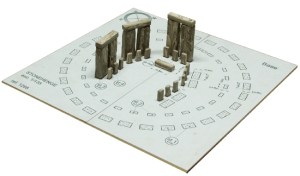
Score? We give it 8 druids. Nice set. Things that future model-makers can do better: 1) shape stones individually to match each real stone at Stonehenge, as they did in the exquisite cardboard Stonehenge, 2) include a larger baseboard with room for Aubrey holes and a heelstone, and more space so it doesn’t look so cramped, and 3) draw stone positions for the current state of the monument on the reverse side of the base material.

Now, for those thinking of contacting us with commercially available Stonehenges in like manner in the future: we figure we should get about €2000 per druid scored!  Or, you could just ask us politely like they did and we’ll probably do it for free. This is our mission: to demonstrate to the world the incredible rate at which Stonehenge is reproducing itself like a virus, using human minds as cells to incubate and create its young and thus to take over the world!!!1!

We don’t have to be paid to sing our siren of warning into the vastnesses of cyberspace. We just hope for a monument to be built to us after mankind realises the fate we’ve saved it from. We’re thinking of a nice linteled stone monument, about 33 meters across, surrounded by a circular earthwork…

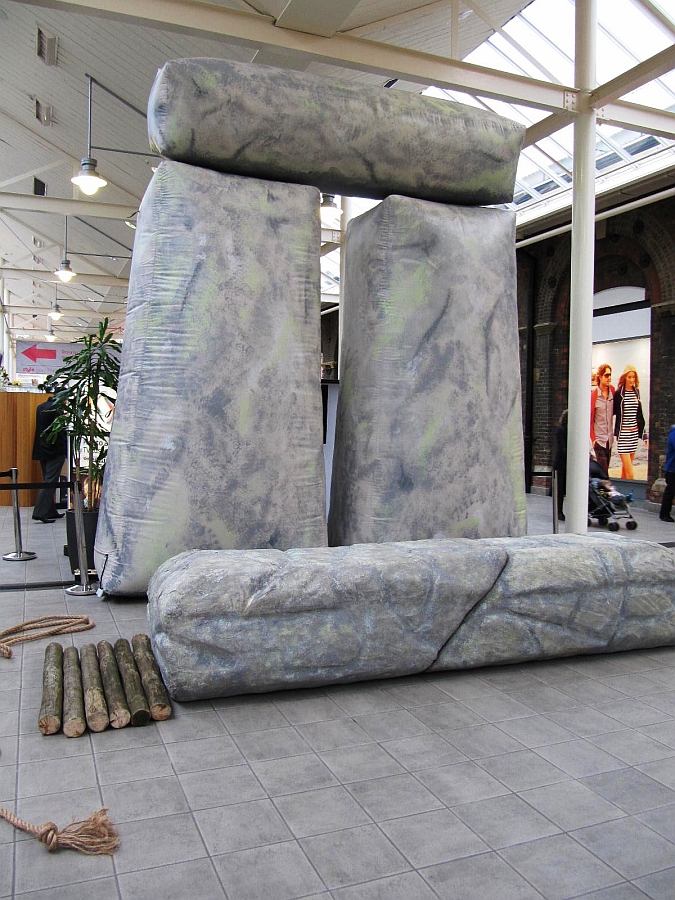
The BBC Inflatable Trilithon–Bring on the Helium!

photo by Thelma June Jackson, used with permission.

Is it just us, or has there been a surge of Stonehenge-related news (ish?) lately? Of course when it comes to this obscure topic, it IS just us: Stonehenge-Replicas-R-Us! (Which it happens is the name of our new retail outlet, still in development… Okay, then, very early stages of development… Oh, all right, we just then made it up. Happy? Now stop interrupting!)

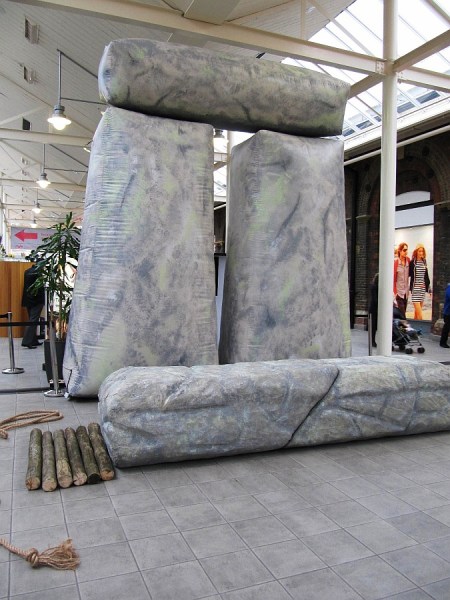
Anyway, this is the first, and the most earthshaking, of a few posts for which we have been forced to come out of retirement, which, we find, is much less restful than one might think anyway. We present to you, Gentle Readers, the fabled inflatable Stonehenge! It’s only a trilithon, but with the way Stonehenge has been reproducing around the world, a full Stonehenge is only a matter of time. Just lock this trilithon in a room with one of Spinal Tap’s inflatable touring trilithons and in no time there will be little inflatable Stonehenges hopping about the fields and meadows, looking adorable while American and Japanese tourists snap away on their cameras! Exciting.

Until then, this remarkable construction is being hauled around Great Britain–well, minus Scotland and Cornwall–as part of the BBC’s Hands on History tour, The Secrets of Stonehenge, for half term break.  Brilliantly, people have been kind enough to take pictures the same way they might for someone who had a legitimate worthwhile blog, but for us instead!
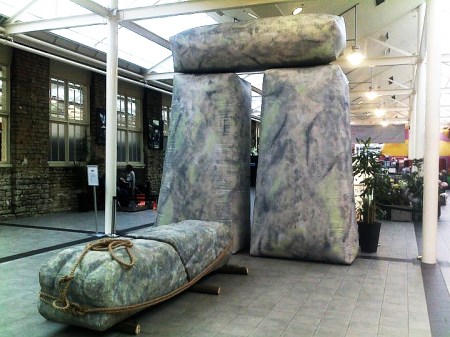
photo by the Wiltshire Heritage Museum, used with permission

Note how the “logs” in the top picture are being used to roll the fourth “stone” in the second picture. Children and presumably some adults* are permitted to try their hands at moving an inflatable megalith. Fun!

Of course, the real stones at Stonehenge are not light weight inflatables, but are huge, enormously heavy rocks. We don’t actually know that they aren’t hollowed out, though. Some, in fact, suggest that they’re filled with a very advanced sort of clockwork for which the Antikythera mechanism was just a mock-up, and that on December 21, 2012, a huge stone clown’s head will leap out of the ground in the center of the circle while the stones play, “Pop goes the weasel!” Frankly, it’s no loonier than much of what we hear said about Stonehenge, so who knows?

After all that blithering nonsense we come to the score. The thing these inflatables have going for them is that they are close to full size. Adds a full point. Some trouble has been taken to make them look rough and uneven. They are educational and can be touched by children… We award these trilithons 6½ druids! That is possibly the highest score we have ever given t0 a mere trilithon!(Meaning we can’t be arsed to check.)

The illusive inflatable Stonehenge finally appears on Clonehenge. We’ll post one again when it’s listed in next year’s Ann Summers catalogue. Finally inflatables will make it possible to live two great fantasies at once. Humph. And people say the future isn’t bright!

*Those who, unlike one adult we won’t name (but who rhymes with Feet Crastonbury), could be trusted to approach the inflatables without attempting to pop them.

NEWSFLASH!! As of April 19, 2012, the inflatable Stonehenge dream has been even more fully realised! Click here for our post on Jeremy Deller’s inflatable bouncy Stonehenge. Humbling to see mankind reach its highest purpose in our lifetimes, is it not?

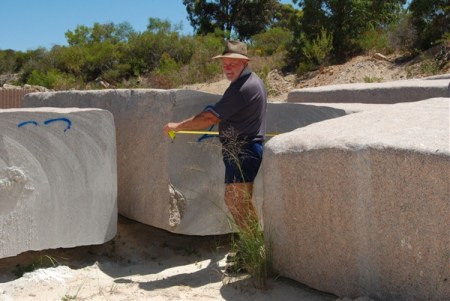
Update on Esperance–Australia’s Pink Stonehenge Going Forward!

Photo from the Esperance Express.

This is an update to our post (Stonehenge Recycled, Australia Tries Again) on the proposed Stonehenge replica in Esperance, a town on the south coast of Australia. (Claim to fame? When pieces of Skylab fell there in 1979, the town of Esperance charged the United States for littering.) Our thanks to friend of the blog Matt Penny, aka @salisbury_matt,  once again, for sending us the link to this article.

It doesn’t sound as if any stones have yet been erected, but the article does say, “According to Mr Beale the site has been soil-tested and initial works have begun in working out where the stones will go. It is hoped the project will be finished late March to early April.” So plans to erect the stones must be in place. Right? We hope.

Of course there appear to be worries about pagans worshiping there (Oh, no, Trev, someone is honouring the earth again! Can’t have that, Nige!), as if pagans will only worship in your area if you build a Stonehenge for them. But the couple doing the building reassures the locals that Stonehenge may not have been a pagan place of worship at all (Whew!), so all is well.

For us, the good news is simply that the project seems to be going forward. Esperance will soon be home to “the world’s only life-size granite replica of Stonehenge.” (Apparently they don’t consider Rothberg’s Circle of Life in Connecticut a true Stonehenge replica, which is kind of true.) We are eager to welcome number 67 to our list of large permanent replicas! Just hopethey don’t charge the U.K. for littering!

Post script: Esperance, Australia is also famous among “a-flock-alypse” followers as the site of at least two mass bird deaths a few years ago. Many people believe the deaths had to do with high lead levels, while others insist the cause is still not known.

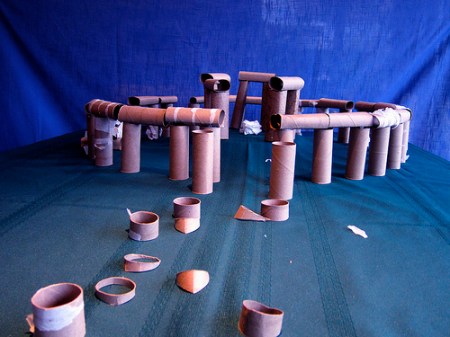
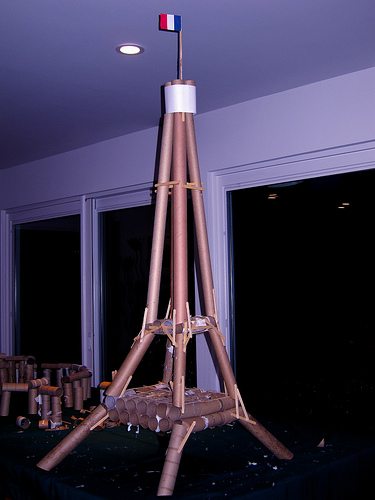
Bog Roll Tube Henge, aka Toilet Paper Tube Henge

Photos provided by Simon Burrow, henger and hengeophile extraordinaire.

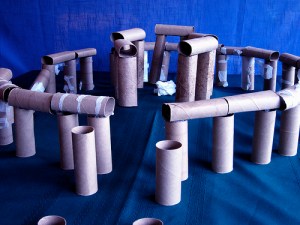
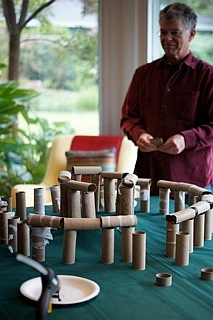
The key to henging fame is not necessarily to do something first, but to do it better than those who came before. Simon Burrow has taken the second route to henging greatness with Toilet Paper Tube Henge 2010. He writes (in his blog, here): “Kimberly Clark’s announcement that the toilet paper tube was an endangered species inspired this tribute.”

That’s right–the paper products company is pioneering the tubeless paper roll. So if you want to build your own bog or toilet paper roll henge, you’d best do it soon! We doubt, however, that you will surpass this thoughtful and detailed construction. Mr. Burrows has been doing henges for a long time and has hit just the right balance between thoughtful and silly.

Note the higher inner trilithons and the scattered loose “stones” in what we assume is the direction of the rising sun. We admire the rough look attained by leaving bits of paper that adhered to some of the tubes. There are inaccuracies but we assume the master artist left them in so as not to be too literal. Score? We award it 6½ druids!

And then there is the matter of the item he has labeled the “Awful Tower.” Hmmm . . . there must be a blog for those, too. How will mankind go on when these versatile materials are no longer available? What will happen to our souls when they are no longer enlivened by creations like this???!!!! But alas! That day hastes toward us like a flock of dead birds hastes toward the pavements of Arkansas.

For similar henges, see the slide show on the MySpace page of Captain Henge, the Bog Roll Mania blog, and . . . dang! we can’t remember where we saw the third, so until we remember, how about a nice soap henge?

We end with a tribute to Mr. Burrow, who has dedicated himself as few have to the continuation and perfection of the henging art. Thank you, sir, for your contributions to the field. We look forward with great eagerness to your next creation!

What will it be, you ask? Here is the last part of the missive containing the announcement of this tube henge:

“Next year Knit Henge! Stay tuned.  Simon”

Joyous Yule!

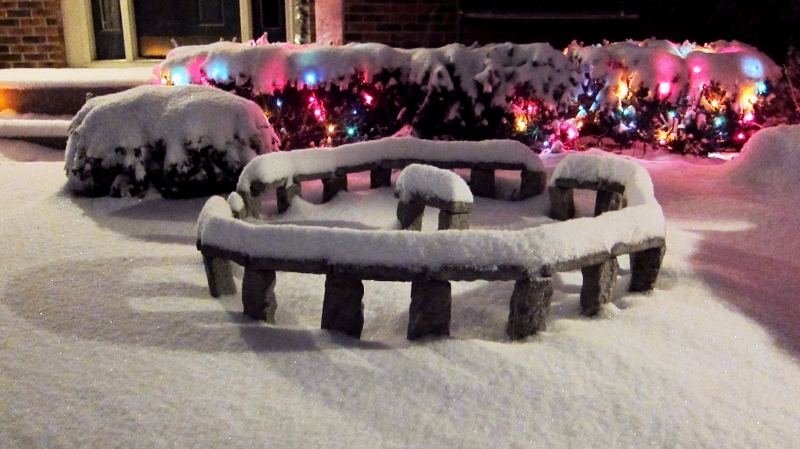
Photo by Jill Warvel.

Season’s greetings. The blog has been inactive for a while, but we still exist floating somewhere out in the blogosphere, and we want to say hello and best wishes for a lovely solstice or holiday of your choice, and happiest of New Years to all who wander here!

We have featured this garden Stonehenge replica once or twice before on Clonehenge, but we recently received this photo in an email from lovely Friend of the Blog Jill Warvel and it was too good to pass up! Thank you, Jill and thank you to all of our lovely readers. Enjoy the rest of December and all of 2011. And think of us when you here of, create, or wake up naked next to a Stonehenge replica. Pictures are always welcome–of the replica we mean, of course!

Remember, you don’t have to be at Stonehenge to notice the path of the rays of the rising solstice sun. Mark your desk, mark your wall, mark your garden or trees. Honour the play of the sun with the land! Something real that enters all our virtual lives.

For All You Druids In Tulsa Oklahoma, a Hidden Henge

photo from article in News on 6

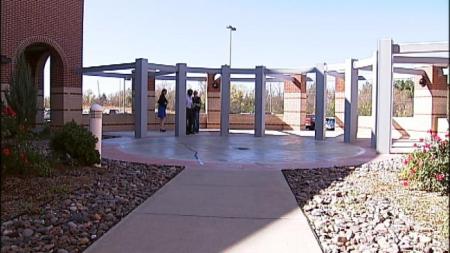
Hey, we’re baaaack! Albeit just briefly. Could not ignore this nifty news item sent in by alert and helpful reader Matt Penny, aka @salisbury_matt , still a friend of the blog, Salisbury and Stonehenge enthusiast, and still, as far as we know, perpetrator of the Salisbury and Stonehenge website.

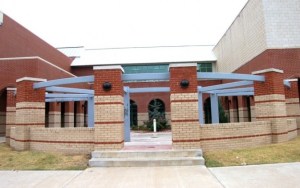
Faculty members at Tulsa Community College’s West Campus have discovered a functioning henge, hidden (as is the method of secret societies like the Illuminati!!1!1!) in plain sight. Henge detector extraordinaire, Earl Goodman, Jr., noticed the suspicious array of posts (see above) and began to plot shadow positions over time. Lo and behold, Voila!, Aha!, and other exclamatory interjections–Mr. Goodman was able to mark out the tracks, or analemmas, showing how the sun’s position moves over the course of the year. Read it here. And here. Although the second link lacks the crucial video–more on that later.

Okay, admittedly we’re being silly here, frankly, in a desperate and pathetic effort to be entertaining, but if we may be serious for a moment, well, we need to put a cape on this guy and a brilliant logo incorporating the letters HD , and send him around the world with the mission of detecting hidden henges everywhere!!! We’re not saying that being stuck in Tulsa for a lifetime is a tragic waste of human life (Why bother? We’re sure others have and will say it.), but let’s face it, someone with this man’s talent could be rooting out henges everywhere, causing education and knowledge to smite people with the suddenness and power of a million lightning bolts!

*Wipes foam from mouth* Ahem. Aaaanyway, we’re pleased to see that so far no one is clamouring to have the whole structure ripped out to save students from pagan influence, as they are at Arlington Texas’s Caelum Moor. The professors are right that this is an excellent learning opportunity and we applaud them.

And now to the extra geeky joy of all this, a special moment in that video at the first link. At around 5 seconds into that video, a henge appears on the screen behind the newsperson. Wait! What is that?! Pause and look . . . that ain’t Stonehenge, people! We used to pride ourselves on being able to name any Stonehenge replica just by looking at a thumbnail, but we’re a little rusty these days. Still, our best guess is that we’re looking at the UK’s Foamhenge, a temporary henge built for a BBC project. It’s possible it’s the Texas Hill Country’s Stonehenge II, but the proportions look wrong. At any rate, we were excited to see another Stonehenge replica involved in the story, even if it’s by mistake.

This is not, as the faithful readers we fantasize about would know, Oklahoma’s first permanent Stonehenge replica. That title goes to the replica at Stonehenge Realty in Stillwater, Oklahoma. These south central states certainly have their hidden corners. Oklahoma and Texas together now have 6 entries on our list of large permanent replicas. Hey, what’s really going on down there?!

Many thanks to Mr. Penny. Keep those cards and letters coming in, friends. We’ll add ’em as fast as you send ’em. Well, almost.

Glasshenge, Fashioned by a Cloud Maker

artwork by David Brinnen, posted with permission

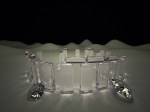
We mentioned a glasshenge before, some time ago–this one, in fact–but we’ve never done a post. Please take note: the henge above is entirely created of pixels. No physical model of it exists, which eliminates the question nagging at the back of your naturally physics-calculating mind, “How did they get those bits to stay up?”

People often forget that Stonehenge’s stones aren’t just balanced so carefully that they’ve been able to stand on Salisbury Plain for millennia, but that they remain standing because they are much longer than we see and extend many feet into the ground. You’re all nodding sagely now and thinking, “Of course,” but if we hadn’t mentioned it, plenty of you would never have thought of it. It’s okay *wink wink* we’ll all pretend you were one of the ones who knew it all along.

One of the beauties of virtual Stonehenges is not having to worry about all that. Instead you’re worrying about the angles, quality, and colour of light, plus in this case, the peculiarities of glass and transparency. We don’t usually allow anything resembling product promotion on Clonehenge (only because no one has ever offered us money for it!) but the artist’s explanation of this piece, edited to add links, does contain brand names.

The image was made using DAZ3D Stonehenge and Ruins* to demonstrate a new feature in the flagship 3D landscaping software Bryce 6.1. The feature is (HDRI/IBL) high dynamic range image based lighting. The lightprobe for the scene was made by this fellow, Horo (Bryce Demi-god) and all round hdr expert. DAZ3D have just launched a new version of Bryce, Bryce 7 pro, featured here.

And he adds–and here we are completely charmed– “For Bryce 7 pro – I make clouds…” And gives this link. David Brinnen makes clouds. How cool is that?

Faithful readers know that we wish all virtual Stonehenges could be based on laser scans of the stones, but for one that isn’t, this one is pretty good. We like this glass Stonehenge and its lighting. Score: 7 druids. Should have been lower, we know. But it’s pretty.

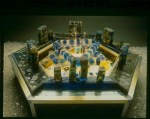
Below you can see another virtual Glasshenge on the left and a real one, an original artwork complete with colours, to its right:

(Click on either to go to a page where you can see it larger.)

They may not be as astronomically useful, but for sheer visual effect even the ancients might have considered using glass. If they could see their way clear . . .

*A product of which we strongly approve!

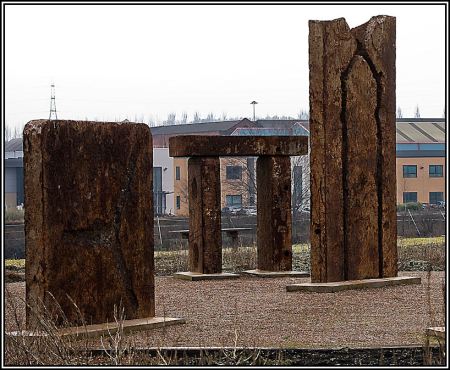
Steel Henge in South Yorkshire, Centenary Riverside Nature Reserve

photo by Kevin Clarke, used with permission

Another one for our list of large permanent replicas! When we reached 30, we thought that had to be the end of the line. Now it’s 65, and we know there are more.

Rotherham in South Yorkshire had a flooding problem. When a flood plain was created to protect the downtown from flooding, nothing could be built there, so it was perfect for use as a nature reserve. In order to commemorate the former industrial use of the site, people took some of the iron ingots that remained on the site and built a memorial circle in imitation of ancient stone circles around Great Britain, and although it was made of iron, they named it Steel Henge.

Yes, we’re pretty sure about that spelling. Most sites writing about it are calling it Steel Henge rather than the more intuitive Steelhenge. (The BBC at the above link even spells Stonehenge as Stone Henge. When the Beeb does something, does that make it right? Or even official?)

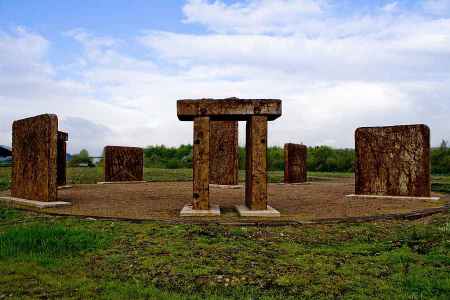
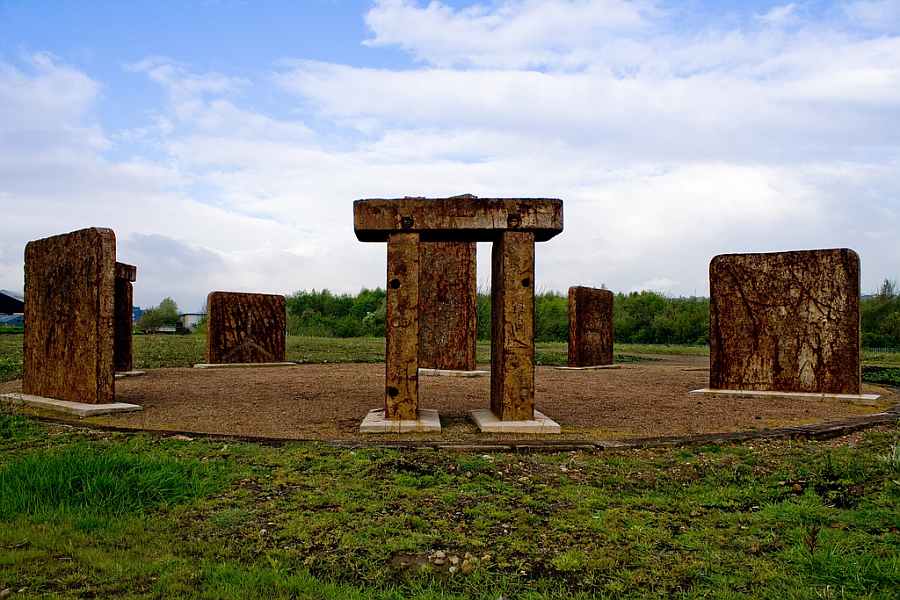
photo by Martin Gannon, used with permission

Aaaat any rate . . . we’re posting this only because they included three trilithons in the circle, moving it from outside our jurisdiction to inside. And, yes, they did take time to line some part of it up with the solstice. It’s not entirely clear what part or for that matter which solstice, but that’s okay. Its presence is what matters.

There is a certain grace to this, having the riverside (the River Don) nature preserve and its birds and wildflowers punctuated by a monument to the city’s former industries, a monument that uses some of the gritty remains of the industry to build a form that suggests the timelessness of the landscape. Man’s pursuits and efforts come and go, and the iron once in the furnace is now no doubt at times a perch for hunting birds of prey.

It suggests, instead of the pain we associate with the loss of industry, a move toward peace and balance with life. We chose these two pictures to illustrate the two sides: man on one side, and nature, including the sky and landscape on the other, linked by this structure in a state of rusting and returning to nature. Creative. Poetic, even.

Score: 6½ druids. Or should it be aging iron workers? This bears little resemblance to the real Stonehenge, but that wasn’t its goal, and we find it an interesting use of the henge idea.

What’s that you say? “Shut up! We just want to laugh about a henge!”? Ha, caught us out. Not much funny in this post. But doesn’t Yorkshire take enough of a ribbing? And it’s Yorkshire Day in a few days, a good time to show it’s not all flat caps, whippets, accents and men taking their clothes off to “You can leave your hat on.”

That is, as far as we know. We do, however, object to the manufactured word in this Sheffield headline about Steel Henge: “Stone h-engineering on old steelworks site”. We have to draw the line somewhere!

For pictures of the nature part of the preserve, see a few more photos by Mr. Clarke here. If you think of anything funny to add, feel free to avail yourselves of the comment function. Otherwise, until next time, faithful readers, happy henging!