
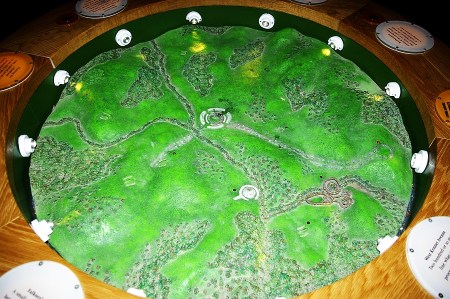
 photo by Pete Glastonbury, with permission
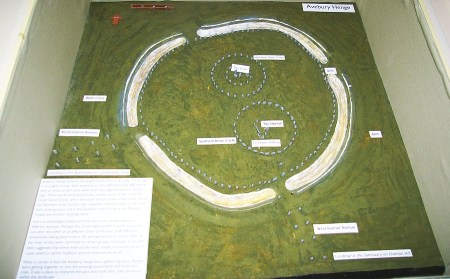
Perhaps this is the ultimate Avebury replica. Housed in the National Trust’s Barn Gallery, associated with the Alexander Keiller Museum which we mentioned once before, this Avebury replica has all the bells and whistles–or at least all the buttons and LEDs. Buttons by the information plaques around the edge turn on the lights by the features they describe.
And what an array of features! Pete Glastonbury tells us, “The model has a complete Avebury, Silbury and Windmill Hill.It includes the following Longbarrows: Shelving stones, Horslip, Longstones, South Street and West Kennet. It even includes the wooden Palisade Enclosure and Falkners stone circle near the West Kennet Avenue..” At long last, the Avebury replica with everything our greedy hearts could desire!
Avebury is that obvious circle in the middle of the model above, and Silbury Hill is the white bump. The long barrows are the odd green hot-dog-in-roll things scattered about. Windmill Hill is in the upper left and the palisaded enclosures are in the lower right. This truly gives a sense of the Avebury landscape. All of the ancient stone circles and henges are better understood in their landscape context.
This is, as photographer Pete Glastonbury says, The Big One. Score: 9 druids. We can’t even think of anything funny to say!
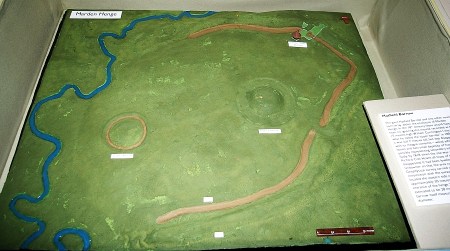
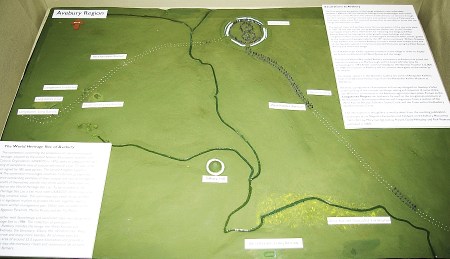 And then there’s this one, depicting, as it might have been at its height, the entire Avebury region, or nearly so, as it excludes Windmill Hill and, of course, all the ancient crop circles. It includes various barrows, the serpentine avenues (which we discussed
 photos by
  Stukeley proposed that the avenues of standing stones, now called Beckhampton and West Kennet Avenues, originally combined with the Avebury circle to form a glyph of a serpent passing through a ring, a traditional alchemical symbol. The head was formed by a circle now called
  photos by
  The replica at the top of this post, seen in glass on top of the cabinet, is one of the cork models by Henry Browne,
 CLONEHENGE
