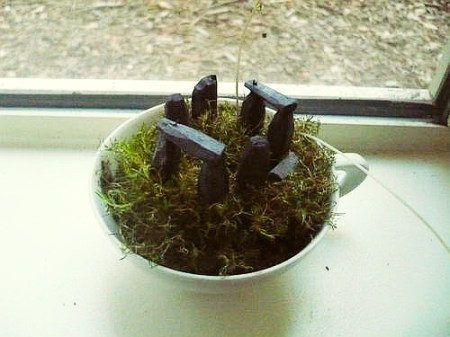
Stonehenge in a Teacup, England in a Nutshell!

photo and henging by Caitlan Vandewalle, used with permission

My boyfriend went to Scotland for a month and saw the Pictish stones, and I did a reproduction of these amazing ancient stones for him. While I was at it I made myself a stonehenge in a teacup.” That’s how Caitlan explains her venture into the rarified world of megalithic mini-gardening, or pseudo-megalithic mini-gardening, or maybe minilithic teacup gardening?
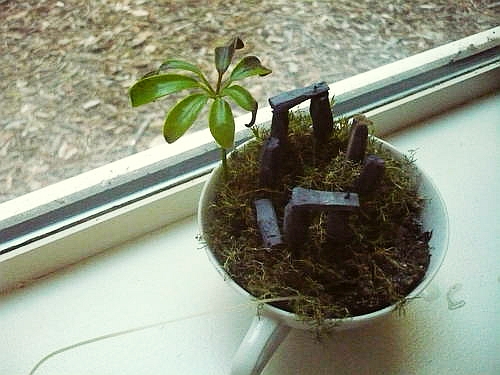
But we like this: “These actually are balsa wood. Sorry. They’re in a teacup to add a glaring element of Britishness, or as my boyfriend put it “you can’t reduce an entire culture to tea and Stonehenge!” to which I replied, ‘well I just did, so… maybe you can’t.’

Well done! What are the English besides Stonehenge and tea? Although as one commenter suggested, it would work best if there is a picture of the Queen on the teacup!

We were tickled to see that the whole thing was inspired by the Stonehenge mini-garden built (planted?) by the inimitable Janit Calvo of Two Green Thumbs Miniature Gardens, a friend of the blog. One Stonehenge replica inspires another. Stonehenge has perfected a unique and successful reproductive strategy seen nowhere else in nature, that of mind infection, and we see it at work here.

It seems by the comments that most Brits were not offended, but actually liked the visual shorthand here proposed for their culture. Still, just in case, Caitlan offers a salve: “(I know that’s not all there is to the UK!!! Feel free to make a washington monument obelisk in a mcdonald’s fries carton, it would serve me right.)” It just wouldn’t look as nice on the windowsill, though, would it? Making it even more accurate as a representation . . .

Score for the teacup henge: 6 druids. It’s only two trilithons and a few stones thrown in, but it has charm and, of course, moss. We liked it the moment we saw it. Maybe we’ll make one ourselves and save the plane fare. It’s exactly like being there!
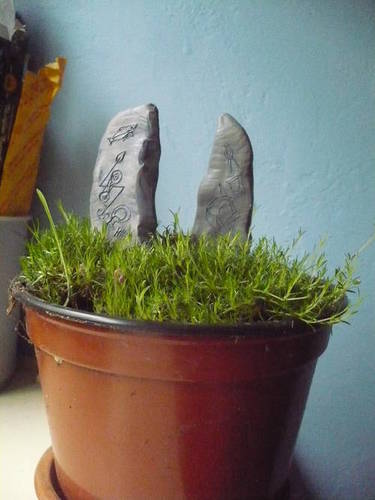
The Pictish stones garden made for the boyfriend, also nicely done!

Pastels, Peeps, Bunnies, and Violent Death–It Has to Be Spring!

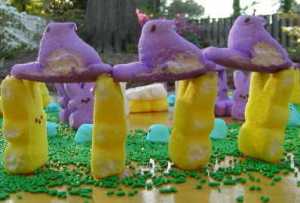
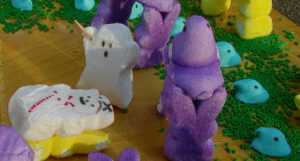
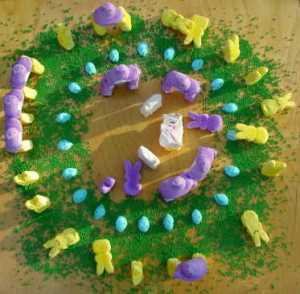
photos from the PeepHenge page of Lord of the Peeps

In the northern hemisphere it is Spring. And where there are those who celebrate, this Sunday is Easter. In our opinion, this is the ultimate Spring and Easter or Eostre, or Spring Festivus henge! Look, it even has bluestones!

And amazingly even that 3 lintel section that still stands today at the real Stonehenge, with the trilithon horseshoe oriented toward it . These people looked at Stonehenge before they built their, well, madcap? zany? crazy-ass? henge. And druids are included, of course. Ish.

But the best thing is the sacrificial slaying, of course. A ghost/druid is posed in the act of ritually slaying a marshmallow snowman (symbolising Winter?) on a yellow bunny altar stone. Violent death never tasted so good! (We would see to it that the victim and perpetrator ended up on a funeral pyre–just until they were toasty brown and a little runny!).  Oh, murder most foul!

We haven’t said much about Lord of the Peeps. This is because you wouldn’t believe us if we told you that someone has done Lord of the Rings with marshmallow animals. Would you? No, we didn’t think so.

Score: 7½ druids. This is a great foodhenge! It has some accuracy, a sense of humour and some downright, almost worrying, craziness. That, folks, is what we like!

Happy Spring, Eostre, Easter, spring bird migration or whatever you celebrate this time of year! Enjoy it, but watch out for ghosts with toothpicks!

Happy henging!

Share

Ginger Henge, a Druid Hut, and Some Holiday Disorientation Disorder!

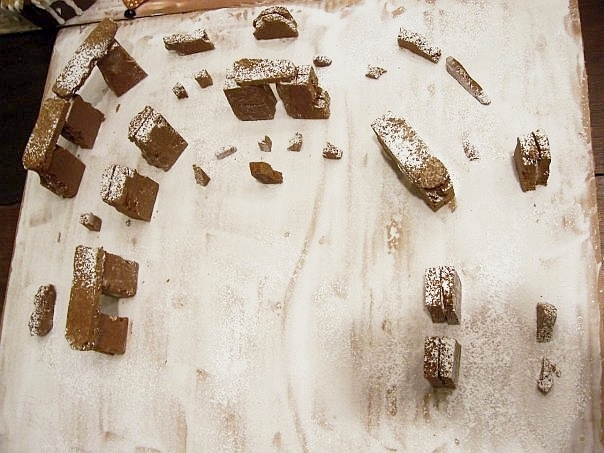
photo sent in by Emily Hunziker, used with permission

And here is the second in our two part Hunziker series of henges! Yes, we know it’s Spring Equinox-ish/Easter/Eostre, and we’ll address that in our next post, but for now let us cast our minds back to three months and a week ago . . .

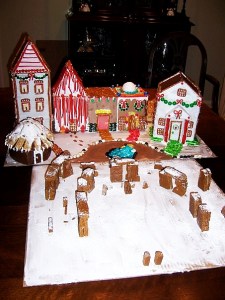
Ms. Hunziker writes: “The gingerbread henge came about this christmas time, when, for purposes of saving time, my family and our friend decided to combine our ginger bread house and winter solstice henge projects into one. We modeled our henge strictly off of stonehenge, making sure that there was even an alter stone and heel stone.

You can see care was taken and Stonehenge was the model. Look at those bluestones, so rarely included in an amateur henge!

Then, “We connected our christmasy gingerbread village with this henge by having the the Druids live in a hut right next door.” That hut is the little roundhouse in the picture on the left. Well done, we must say!
And she finishes with, “Our friends and neighbors who come by appreciate the time and creativity we put into our projects but as we explain to them the ideas behind them (such as dolls made specifically to preform a “virgin sacrifice” that goes along with a henge made out of fish sticks or gingerbread) they smile, nod their heads, and back away slowly making no sudden movements.

Well, that’s just a wise way to behave around hengers. Don’t trigger their chase response!

Score: 7 druids! They even have a place to live. We like this little set-up even if it is oddly horseshoe shaped over all. Having it open toward the viewer gives it a welcoming feel, not quite what the original Stonehenge builders were going for, but charming in its own right.

And at the end of the email she says, “lol. What can we say, we love it. Happy Henging!” We couldn’t have put it better ourselves.

Our thanks to Emily, Lauren, Russ and Eliza Hunziker and Lois Sisco for making this henge! Keep ’em coming!

Fish Finger/Tater Tot Henge

photo from Emily Hunzicker, used with permission
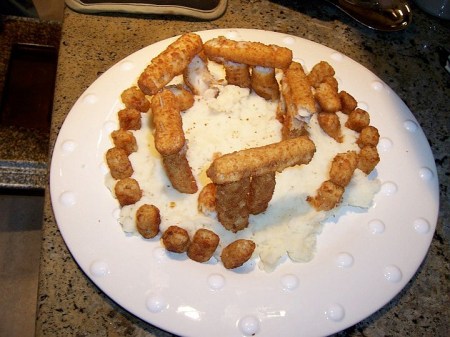
Yes, a foodhenge. We tweet foodhenge links on most Fridays, but haven’t been posting many here on the blog lately. We are about to remedy that, as we have at least three foodhenges lined up to post in the near future. First we’ll go for the greasy fried version, with sarsens of fish fingers (or fish sticks Stateside), and bluestones represented by tater tots (Is there a British term for these? Oven crunchies?). This foodhenge isn’t actually for eating, is it?

Emily Hunziker tells us the story of its origins:

Well, My family (Russ and Elisa Hunziker) and our friend (Lois Sisco) were thinking of some way to celebrate the summer solstice last year, and what better way to do so than with a henge! We figured fish sticks and tater tots were an appropriate size and shape to replicate a henge which we could eat for dinner afterwards. The sticks and tots are bedded in mash potatoes for support and not pictured was the Salisbury ‘plain’ Steaks which were the main course.

Regular readers will have guessed it–it is those Salisbury “Plain” steaks that truly won us over. Bad punz–we likes dem! And knowing that Stonehenge is on Salisbury Plain is a plus–after all, the people mentioned are in L.A.

We realise that an inner circle of four trilithons isn’t exactly right and it is odd to include the blue stones inside the outer circle and not those in the inner horseshoe. We’d have loved it if the mashed potatoes had been dyed green. But let’s have a look at a subtler good point–those Aubrey holes (-ish!) built in to the plate. Nicely chosen!

Emily dutifully passes this on: “My mother, who is quite opposed to eating such ‘cafeteria like’ foods, wanted me to mention the fact that, although they make excellent henge replicating material, tater tots, fish sticks, mash potatoes and steak gave us all heart burn.” Duly noted, Emily’s mom!

But the truly worrying part comes next. “Following dinner, there was a virgin (doll) sacrifice, in which a chocolate heart was cut from her chest and eaten to appease the gods.” Hmmm . . . sounds very Aztec to us, especially if the chocolate heart was still beating!

Yes, we know there is no proof that human sacrifice took place at Stonehenge. But we allow for a certain amount of playful poetic license on that matter, as with the PeepHenge we have linked to before (and which may soon have a post of its own because we love it so much!).

Score for this henge: 5½ druids! But this is not the end of Emily’s contributions. We shall hear from her again. The Hunzikers of Los Angeles seem to have a penchant for playing with their food–and we certainly approve!

So to all, we hope you had a lovely equinox celebration. Enjoy the long awaited Spring, and happy henging!

Share

Stonehenge Adventure Garden in Austria

photos from the Landgasthof Feichthub website

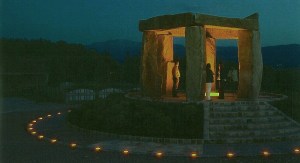
It has been a while since we found something to add to our list of large permanent replicas. Not only have we found one this evening but we’re delighted to add a new nation to the list. This Stonehenge garden is on the grounds of Landgasthof Feichthub country guest house in Austria.

A Stonehenge in the garden of a country inn may not sound interesting, but the designers and builders on this one have gone above and beyond the call of duty. They’ve placed a glass sun (we regret to say we have no picture of it!) 149 cm (almost60 inches) in diameter in the Stonehenge replica and surrounded it with minerals representing earth, air, fire and water, repeated 3 times so they represent the signs of the zodiac.

But that’s not all! A path around the Stonehenge with a diameter of 16 meters (about 52 feet) is used to represent the sun in a model of the solar system, with stone balls proportionally sized to represent the planets scattered about the garden. Of course it isn’t possible to make the distances proportional, but still we think this is a delightful bit of whimsy, used at no other replica we know of.

The Stonehenge itself appears to be built of sandstone of a similar colour to the Tasmanian replica and the one in Orem, Utah. It’s just a linteled circle with five or six uprights, but that’s better than a circle of trilithons, and this comes close to having Aubrey holes and a bank, sort of.

Score: 7 druids! That’s not for the structure alone but includes the educational and aesthetically-pleasing additions that provide several ways to contemplate the sun in its relationship to Stonehenge and its effects on our lives. The innkeepers seem justifiably proud of their Stonehenge, which was built by the stone design firm of Alfred Schnellnberger. (No, that is not misspelled–it’s just Austrian!) The inn may be his baby, too.

For a few more shots of the Stonehenge, check out this Youtube video, in German, of course, about stone building and design.

That’s how it is, folks. We thought (hoped?!) we’d run out of Stonehenges to post and then we run across this. We know there have to be more out there. Help us find them! Or just give us money and let us tour the world looking for them. Either one is fine with us!

Happy henging!

Share

Columcille–Megaliths and Dreams

our own photos

Okay, so we’re low on Stonehenge replicas right now, except those we’ve been tweeting about (we may just do a post on that remarkable cheesehenge from last week, whether or not we hear back from the one who posted it.), so here’s a place we’ve kept back for just such an occasion: Columcille Megalith Park on the side of the mountain outside Bangor, Pennsylvania.

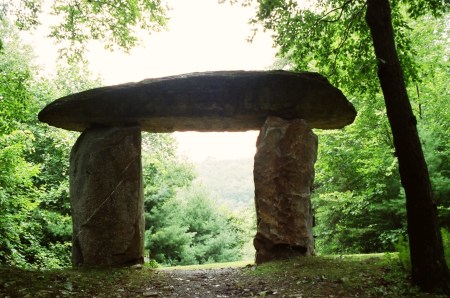
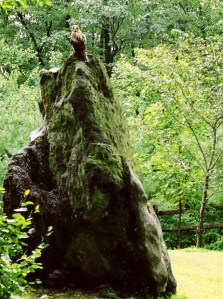
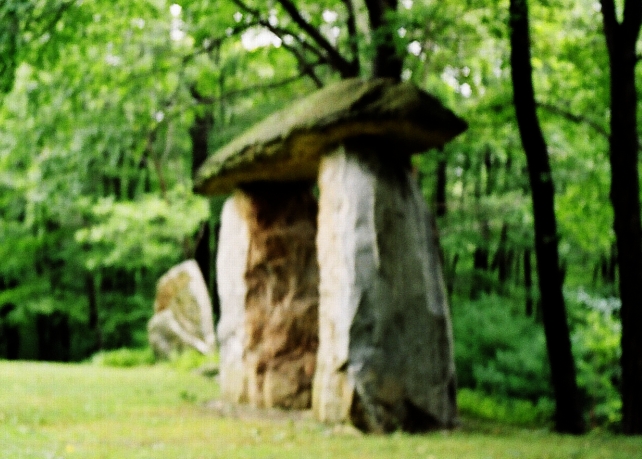
There is no Stonehenge replica there, but there is at least one trilithon, stone circles and an imitation long barrow. You could describe it as a replica of a sacred landscape (a funny term–as if all landscape isn’t sacred!) There’s also a dolmen, many standing stones (note the young red tail hawk on the stone in the picture on the left), some of them quite large, and a chapel.

We have studiedly avoided posting the many modern megaliths in Great Britain,  across the States, and around the world because our focus is Stonehenge replicas only, but there is something special about this one: it is near enough to us for us to visit.

It’s a funny thing, this modern megalith phenomenon. It seems to be all tied up with something in the common psyche, and it has to do with spiritual things, nature, poetry, dreams and, of course, druids and Celtic peoples. You can tell people that the Celts were over a millennium too late to have erected any of the standing stones in Great Britain and they don’t want to hear it, even though all it means is that someone else , probably equally connected to the earth, the landscape and the magic and mystery of it all. put up the stones they admire so much.

It’s true, visiting a modern megalithic site like this is a little like going to a Renaissance Fair, but it also reminds us of something modern people tend to forget. There is magic in the earth, in the stones, in the landscape. We arose from it, we still depend on it and one day we’ll be part of it again.

So we recommend finding your local modern megalithic site and visiting it this spring if there’s one near you. Walk around, allow yourself some reverie and dreaming. Maybe the heart of the place will touch your heart somehow. It doesn’t have to be in England, you know. Every inch of the earth is as old as Stonehenge–in fact much, much older!

Let yourself be awed by that once in a while.

Wayland’s Smithy, Forged of Wood

from a photo by Les Williams, used with permission
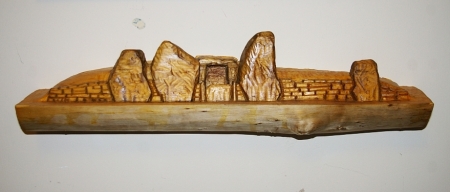
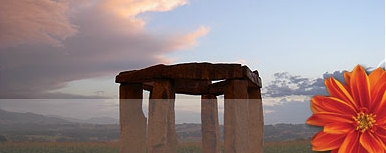
There are times here at Clonehenge when the cupboard is bare of Stonehenge replicas. At these times, readers who send in odd things that normally might not be posted here can find they’re in luck. Such is the fate of one Les Williams, possibly of Wales*. He sent us photos of a wooden replica of the long barrow at Wayland Smithy, hand-carved by himself, and here it is although it is not a Stonehenge replica at all!

Wayland, often called Wayland’s Smithy is a megalithic site–a long barrow much like the West Kennet Long Barrow near Avebury stone circle and Silbury Hill, which has, in fact all of which have been mentioned in Clonehenge posts before. But while we have until now limited ourselves to posting replicas of sites in Wiltshire, Wayland Smithy is over the boundary in neighboring Oxfordshire, near the Uffington White Horse and a full 64 kilometers from Stonehenge.

The smithy bit has to do with a Germanic smith god, and the name was applied several millennia after the building of the barrow, although it’s possible it was connected somehow with the idea of smithing before the name came along. At any rate, the legend was that you could leave your horse there and have him magically reshod. As far as we know it did not translate into having flat tires magically replaced.

From Mr. Williams we have this account in answer to our questions: “The wood is Linden and I found it as a leftover from tree clearance on a riverbank in the Rhondda Valley’s. I thought I would have a go at a henge, over the last few years my wife and I have visited many of the Henges and Barrows in Southern Britain and Wales. The most atmospheric, imho, is not Stonehenge but West Kennet Long Barrow and that was my main inspiration.

However, I thought it was more than I could handle so I chose Wayland’s Smithy in Oxfordshire (never been there!) as my subject. The result that you see took about 50 or 60 hours to carve, all done from photographs found on the net.

Oh, yes, the net. We’ve heard of it, and if it affords this kind of result perhaps we should look into it. We find this replica to be quite impressive in several ways. One is the fact that it was hand-carved from wood. Another that it was done completely from photographs yet was beautifully done. And one is the aspect we always love, i.e., WHAT MAKES full grown, seemingly sane people DO THESE THINGS?

Whatever motivates them, we like it. When people do odd and quirky things, they’re expressing that unique bit of them inside that makes life interesting. We thank Les Williams for sending us his remarkable creation, and hope he will send us photos of his carved West Kennet Long Barrow when he has finished it.

No score, of course, since it is not a Stonehenge replica. Just a bravo and a virtual druid to keep on his desk!

And to all of you, happy henging!

*Here is how you can tell a good blogger from a poor one. The good blogger would not write this post without first ascertaining Mr. Williams’ home village, or in a pinch would have avoided the topic of where he lives, while we, the poor bloggers, just go dithering on and even draw attention to their laziness in an unnecessary footnote in hopes that you will mistake it to be entertaining rather than pathetic.

Sad, really! We wouldn’t blame you if you resort to that other blog on Stonehenge replicas. What’s that? There IS no other blog on Stonehenge replicas? Well, then you’ll just have to live with our faults, won’t you? Tsk!

Later note: Les Williams’ West Kennet Long Barrow model can be seen in a later post, here.

European Vacation: Toppling Stonehenge, American Style!

photos are stills from this Youtube video of the Stonehenge scene in European Vacation

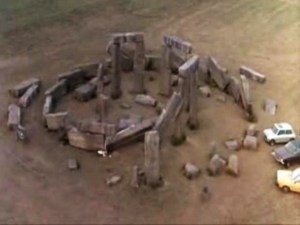
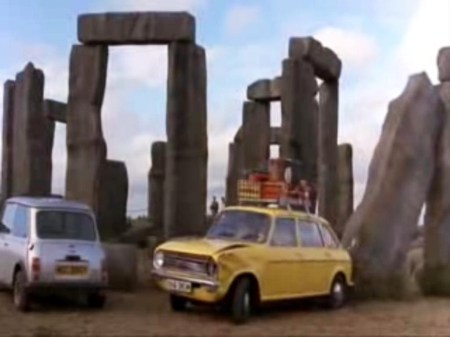
We know we’ve mentioned it before, but this one seems like it should have its own post, possibly the last in our film series for a while. The movie’s title is European Vacation, but everyone knows it as National Lampoon’s European Vacation, one of a series of movies in which the Griswold/Griswald family, led by parents Clark (Chevy Chase) and Ellen (Beverly D’Angelo) go on disastrous holidays.

Of course they hit the big European tourist spots, and Stonehenge is not left out. As they leave, Clark Griswald makes a speech about it having stood the test of time, “a thing of glory for a million generations to see.” He then gets into the car, backs into one of the stones, and knocks the entire circle (set up almost like a spiral) down. (See video of the Stonehenge scene here.)

Okay, haha, no denying it’s funny in a broad slapstick way. But our job is to look at the replica or replicas involved. It is a peculiar one, a circle of tall thin trilithons, no attempt at making it a linteled circle like the real one, with a circle rather than a horseshoe of taller trilithons inside.

No bluestones, understandably. They would just complicate the scene and most people don’t know they’re there (or else think the sarsens are bluestones). No ditch and bank visible, but the landscape in the background looks enough like Salisbury Plain to pass.

All in all, although its peculiar proportions put us in mind of the mini-Stonehenge in the gardens at Cockington Green in Australia near Canberra, it’s not a bad replica when compared to many others. We do not know for certain whether only one replica was used to make the movie or if a miniature model was used for some shots of the monument falling down.

Score: 7½ druids for this movie replica, made to fall. A note to British and European Stonehenge fans: next time you object to the barriers that keep tourists from walking among and touching the stones at Stonehenge, remember the Griswalds and think whether it may not be better that English Heritage is keeping the Americans out! Who knows how many shocking offenses have been averted.

Of course there are even British people who take it as a challenge to somehow topple the monument, and those who claim Stonehenge as it stands was an invention of the English tourist industry of the early 1900’s and not worth knocking down. This is the internet age. People will say and do anything. There’s even a blog about Stonehenge replicas. We kid you not!

Share

Building Stonehenge at Stonehenge, A Trilithon Model

photos are stills from Pete Glastonbury’s Youtube clip, used with permission

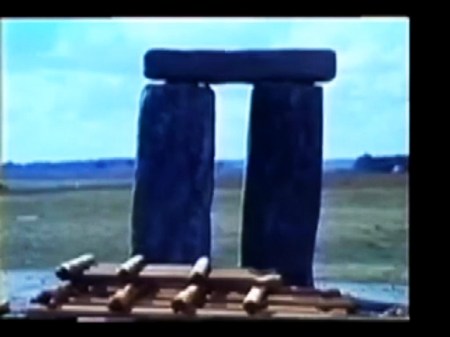
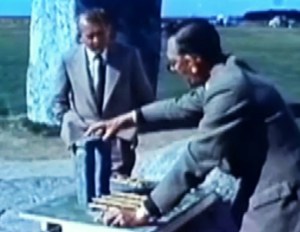
Here is one for the record books. Only once before, during the first month Clonehenge existed, did we post a replica that was actually at Stonehenge (Straw echo henge–wow,our posts were short back then!) Here is another one, this time, in keeping with our film and movie theme of late, from a CBS TV special made in 1964 called (like so many other things) The Mystery of Stonehenge.

It happens that a contributor to that TV special, Gerald Hawkins, author of the well-known book Stonehenge Decoded (one of those books that has been on our shelves for so long that we couldn’t say when we bought it!), was an acquaintance of our friend and frequent contributor Mr. Pete Glastonbury. Mr. Glastonbury uncovered a copy of the film in Mr. Hawkins’ archives and sent us the link to this delightful bit at Stonehenge in which Professor Richard Atkinson explains to a CBS reporter how he thinks the monument was built, putting a trilithon replica together in the process. (In the smaller photo here you can see a real sarsen upright in the background.)

What can we say? For the Stonehenge replica nerd, this is about as good as it gets–a renowned Stonehenge scholar putting together a Stonehenge replica at Stonehenge–on film. Score: 7½ druids! It’s great, true, but that’s as high as we can go for what is only a miniature trilithon.

This probably won’t be the last of these old-ish films. We’ve read that Hawkins was filmed explaining his theories using a plastic Stonehenge model and some lighting to simulate the sun shining into the monument at different times of year. If we can find it, we’ll post that, too.

Meanwhile, if all this academia is making you homesick for good old Spinal Tap, here is our post on that. We don’t want to stay too serious about Stonehenge replicas, dudes and dudettes. They are inherently silly things.

Happy henging!

Note added later: Oddly, completely by coincidence, Stonehenge Collectables’ latest addition to their site is a press release and TV Guide listing about a rerun of this CBS special in 1973. You can see it here.

Share

Stonehenge Apocalypse: And We’re Back to Hollywood

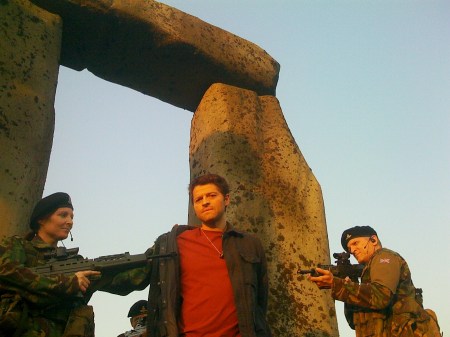
photo totally nicked from Misha Collins’ Twitpics, which we’re pretty sure are meant as promotional pics

The movies–the good, the bad, the indifferent, and in this case, the never-yet-aired. This movie is Stonehenge Apocalypse. The plot on IMDB reads like this: “When a group of archaeologists dig up a human skeleton near the historical monument of STONEHENGE, an ancient piece of machinery hidden beneath the bedrock is discovered. Not knowing what it could be the workers accidentally trigger the mechanism and start a chain of events that may very well end the world as we know it.

The world as we know it? Man, it is long gone at this point. Who says that anymore? But we’re not the ad copy police. (They won’t let us carry handcuffs!) So let’s look at this Stonehenge replica. We think it’s a pretty good trilithon. You can see other shots of it here and here. Score: 7½ druids. Good lichens, but it is just a trilithon.

So you may ask, why does Doctor Who get to film at the real Stonehenge while this film didn’t? Well, people, that’s why they call him The Doctor, innit? It helps to be a beloved national institution!

Meanwhile, here’s a synopsis of Stonehenge Apocalypse from the New York Times: “Stonehenge mystically begins rearranging itself causing massive unexplained natural destruction around the world.” No one seems to know just when it will air, but when it does we doubt it will reach Doctor Who audience levels. But we would love it if it surprised us. Any movie with a Stonehenge replica is one we’d watch!

Happy henging!

Share