
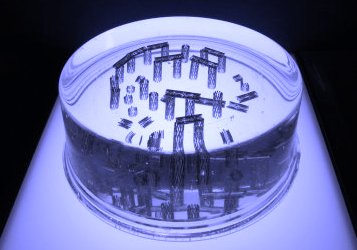
photo from ADAMANT, used w/o permissions–permission pending
Happy New Year, Gentle Readers! The first henge of the year is one that will be hard to top. It’s made of stents of the sort used to prop open coronary arteries. The copy accompanying it reads:
“A reader reports one of his dearly departed co-workers spent a great deal of time creating a scale model in stents of Stone Henge. Stent Henge was created with pieces of scrap Nitinol self expanding vascular stents embedded in cured Sylgard 184 elastomer. It is a nearly perfect reproduction of the layout of the famous stone circle in England in a compact package just about the perfect size for a paper weight. It took nearly a year of work during slow periods. ” [links added by us]
We wonder, how do you even do something like this over a year? Do you add the clear silicone slowly, layer by layer? We don’t know, but the outcome is impressive and accurate. See the section that has retained its lintels? And the inner trilithon horseshoe?
Whoever made this used a photo of Stonehenge as it stands today as a guide. Perhaps he kept it in his chamber–or maybe he knew it by heart! I suppose we shouldn’t go on in that vein. (Don’t beat us!) Heh. Our New Year’s resolution is to actually be funny. Wish us luck!
Score: 7½druids. It’s made of unusual materials, and someone has taken pains to make it accurate. That’s what we like here in Clonehenge country. Posthumous kudos to the builder of this eccentric beauty!

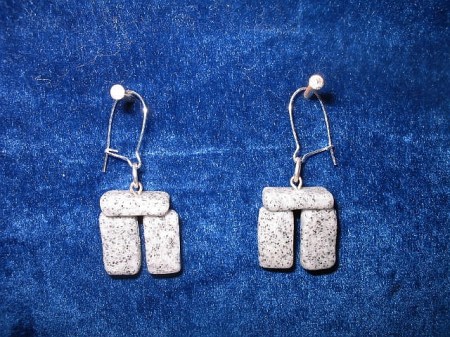
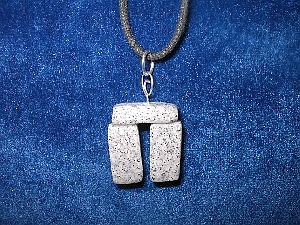
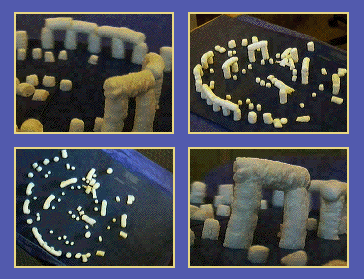

 photo by Thelma June Jackson, with permission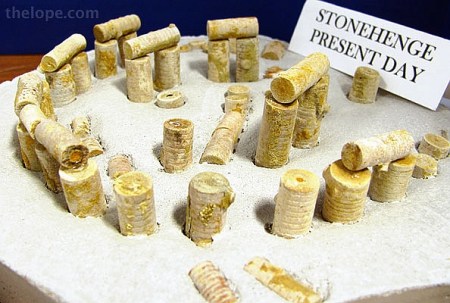
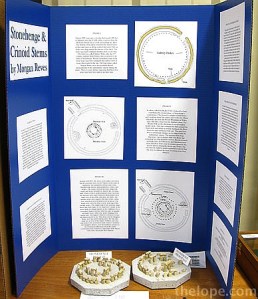 As you can see on the left, diagrams and explanations of Stonehenge, and possibly of fossil crinoid stems, accompanied the models. Was this a science fair project or some other kind of display? We can only speculate, but we’re glad it was there to add to the weird materials list for Stonehenge replicas!
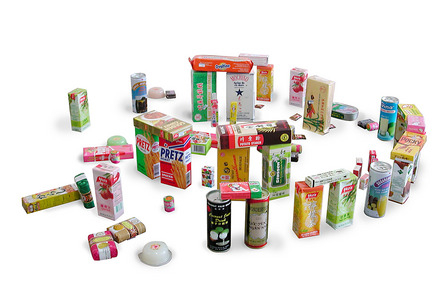
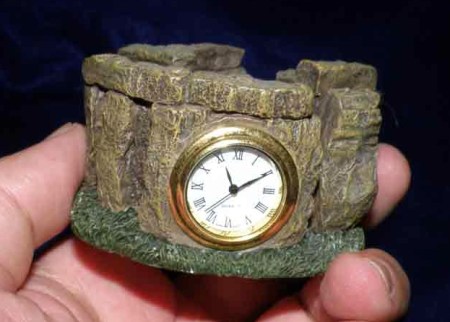 photo by Stonehenge Guy, Bob Bradlee of
  CLONEHENGE
