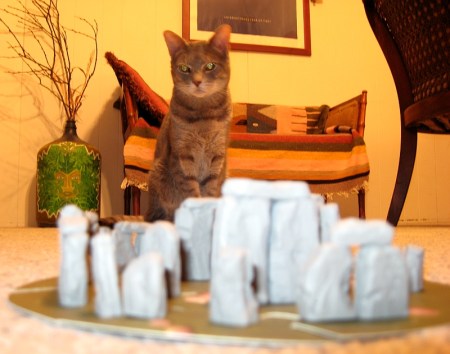
We post this simply in defiance of the 9/9/09 cat ban.
 Also see
 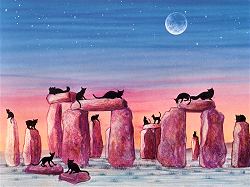 And we found this as free wallpaper somewhere. To be honest, this blog has been a little dog-heavy. Today we make it right, for 9/9/09 in honour of their 9 lives! 😉

We post this simply in defiance of the 9/9/09 cat ban.
And we found this as free wallpaper somewhere. To be honest, this blog has been a little dog-heavy. Today we make it right, for 9/9/09 in honour of their 9 lives! 😉
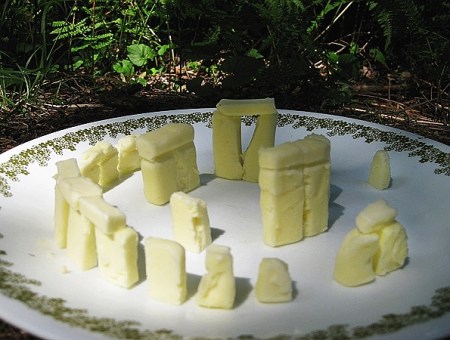 photo and henge by Dave and Janet Burt, with permission
Finally the sculpted butterhenge we’d hoped for! To use a quip from a comment on the last butterhenge we posted, I can’t believe it’s not Stonehenge! We were interested to learn that Dave and Janet Burt, its creators, were not inspired by our request for a sculpted butterhenge, but were forced to sculpture by a lack of enough sticks, not even aware of the pioneering butterhengers before them.
But in henging as in real life sometimes difficulty breeds excellence. It is not perfect, but unlike many replica makers these two actually took time to look at a picture or model of Stonehenge. Some of those sarsen shapes do look familiar!
One of the hengers writes “I think the plate makes a nice outer ring, and placing it in the ferns gives it a magical kind of look (although not reminiscent of the stark English countryside). Seems to match most of your criteria, although am hoping size doesn’t matter in this instance.” So they have given thought to the ring and ditch and even to the plain itself, if only to note that it is not accurately represented. *nod of approval* In all things, folks, attention is key. And does size matter? We leave that question to greater minds than our own. There is room for every size in the world of Stonehenge replicas.
Score for this bovine-sourced replica: 7 druids. Maybe even 7½. And Dave and Janet say they’re already put their thinking caps on for the next henge project. If this one’s any indicator, we’re sure it will be the cream of the crop!
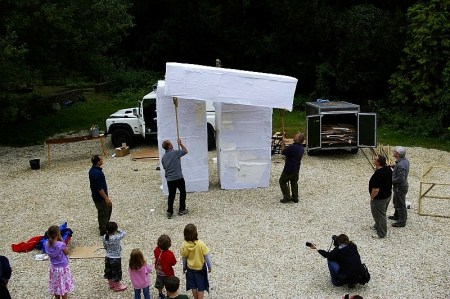 photos by Pete Glastonbury, with permission
On Sunday (30 August, 2009 for those of you who are reading this from the future), Wiltshire Heritage Museum and Julian Richards held an event for families in which visitors could help build a partial Stonehenge replica. You may remember our announcement here. By all accounts, including this one, it was a success and a good time was had by all.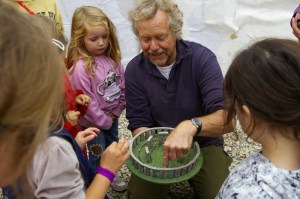
We love the picture on the right. The excessively cute future archaeologist in pink is putting everything on hold in order to take in what Mr. Richards is teaching them about Stonehenge.
The lesson we want to leave you with today: It’s never too early to introduce Stonehenge replica building to your children! And community Stonehenge building is bound to be the way it was originally done, no matter how Wally Wallington tries to convince people otherwise. Score: 6½ druids. Because while it’s only a trilithon, involving people in the project spreads the word. And, hey, it’s in Wiltshire–automatically more authentic! May this kind of event spread to archaeological museums everywhere.
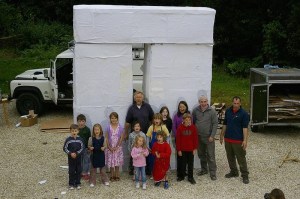
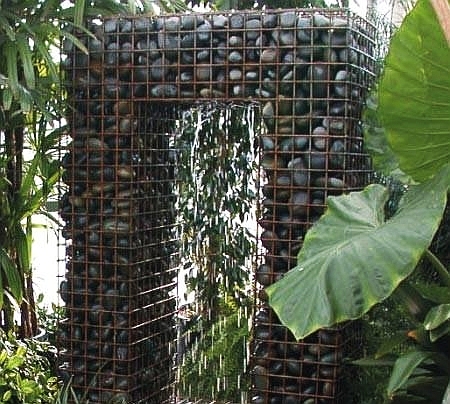
photo from Opulent Items website
It’s not for every garden. But look: you do not need to erect huge stones in order to have “this aquatic Stonehenge replica” in your garden. Just assemble the metal encasement and fill it with the Mexican pebbles. Voila! Just like a Stonehenge trilithon but even better because there’s a pump cycling water through it to create a constant waterfall. Heh.
So what if it looks like a standing gabion? [Admit it–you learned a new word just then!] The website says: “The serene sights and sounds of the flowing waterfall is a gift to any patio setting. . . . Ideal if seeking very unique outdoor decor ideas.” It is very unique, and its sights and sounds is a gift.
This isn’t our first Stonehenge water feature. Remember this? After seeing this one, we almost feel we should have given that one another druid or two. In fact, if this weren’t called “Waterfall Stonehenge” we probably wouldn’t even be looking at it. But it’s good to have a post about something like this once in a while, isn’t it? Pointing out lameness can be fun if done in moderation.
Score: 3½ druids, and that’s generous. Not, we hasten to say, that it might not be just the special feature one needs for that certain garden (after all , it is only $5,500), and a miniature version might even be a charming touch for some of those miniature gardeners out there. You know who you are!
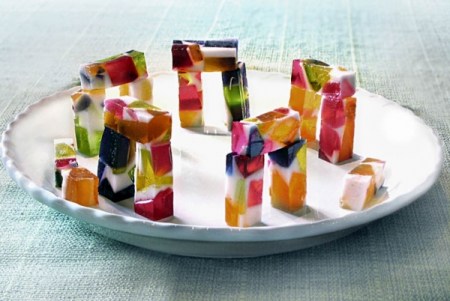 photo by Paula of The Cookie Shop, with permission
Doesn’t this look like a party? Today we celebrate our 200th post on Clonehenge and our biggest month ever, stat-wise, with this colourful and yummy-looking Stonehenge all the way from Brazil. If we could we would send out a dessert like this to everyone who has supported us, contributed to the blog, or just read it over the last 9 months. Many thanks to all!
We’re not sure what possessed Paula to rebuild Stonehenge with the leftovers of her candy, but she created a neat little beginner’s henge, a circle of trilithons with a couple of fallen uprights. Nothing in the form that we haven’t seen before, but it just goes to show that the mysterious force that makes people build Stonehenge replicas hasn’t waned since this blog began. We encourage playing with your food!
And, yes, we’re back in South America. This is our first Portuguese-speaking henge. Doesn’t it seem like people are more colourful in Brazil? It must be that yerba maté they drink. Score: 6½ druids. Thank you for helping us celebrate! Many happy returns to us all.
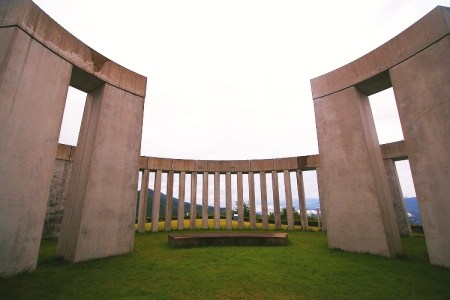 photo by Hatsuki NISHIO, with permission
Imagine our chagrin upon visiting The Megalithic Portal to find a replica we’d never heard of gracing its news page! We’d always suspected that Japan must have at least one large permanent replica, but searching in Japanese presented a problem. Well, now we have a Stonehenge from the Land of the Rising Sun, and Mr. Hatsuki Nishio tells us it is not the only one! (How we longed use the title Samurai Stonehenge! Doesn’t it have a ring to it?)
Gunma Observatory (A Google Translate version of their website can be seen here. We’re thinking the word lithograph in the second part there should be megalith.) appears to be a real observatory with a teaching and a tourist function. It is located near the village of Nakayama in Honshu, Japan.
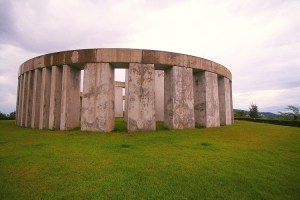 The replica itself is interesting, as astronomy-oriented ones often are. The bluestones are missing, and the uprights around the outside vary greatly in width, being very narrow and close together in some sections of the circle, as you can see above, while others are more similar in proportion to those in the original. The curve of the lintels in the inner trilithons is also noteworthy.
Still, we like this replica and its placement at the top of a hill with a view. It doesn’t have the mystical atmosphere thing going for it, but it does say interesting things. As we’ve said before, each replica tells you something about whoever built it–what they see and what they deem worthy of reproducing from the original. Astronomers tend to see a clean, balanced construction meant only to be an observatory when they see Stonehenge.
Score: 8 druids. In this business, size matters. For a look at a different style of Japanese replica, made to be part of a cemetery, scroll down this page. Not sure when we’ll have the photos we need to do a post on it, but when we do, you’ll be the first to know. Until then, 今はさようなら。 !
Clonehengers, awake! We urge any of you within travel distance of Devizes to be at the Wiltshire Heritage Museum on Sunday (August 30, 2009) at 11:00 a.m., to help Mr. Julian Richards build a replica of Stonehenge with cardboard and wallpaper as materials. Julian Richards, as you may know, is a radio and television presenter best known for his work on the programme Meet the Ancestors, and is a Stonehenge expert.
The Museum notice is here and you can see an online article here. To quote the article, “Ali Rushent, education officer at Wiltshire Heritage Museum, said: ‘Julian hopes as many people as possible will turn up and give him a hand with this project.
‘The Stonehenge model could be quite a size. The tallest monolith is expected to be more than two metres high. The model is likely to fill the whole car park at the museum.’ ”
Need we say more? If we could manage it, we would fly over from the States in order to be there. We have heard a rumour that Mr. Pete Glastonbury himself may be there, so perhaps we will have photos. But don’t think that lets you off the hook! We want to see your photos, too.
So be there or be . . . sort of circular with a horse shoe shape inside. Remember, if you mention Clonehenge you get in free! ;-D
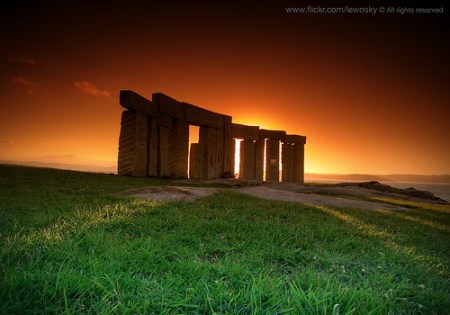 photo by Jacobo Fraga, aka Lewosky
This monument was made for a very serious purpose: to memorialise the victims of pro-Franco repression, particularly those who died in terrible incidents in the area. Outside the Galician city of A Coruna is an area called Campo de la Rata, or Field of the Rat, where this and another modern megalithic monument* are located. This one was designed by the artist Isaac Díaz Pardo.
Galicia is the Celtic province of Spain, and that may explain the tendency toward megaliths in these memorials, the myth of the Celtic culture being the megalith builders being very persistent. An inscription says, roughly, “Martyred in these fields before the murky sea for loving just causes.” It seems to be playing on that same idea of sacrifice at Stonehenge as at the Maryhill, Washington State replica.
This photo seems to capture some of the tragic meaning and haunting memory of the monument. Nice work, Sr. Fraga!
How can we make a funny? Here we see the Stonehenge idea used well, to give gravitas to a piece of land that will forever commemorate the sad loss of life. Red paint, like blood, is streaked on some of the stones, and it almost as if those great stones represent the individuals who were tortured and put to death here.
Score: 7½ druids. No, it’s not a circle, and you can see here and here that the form is even more unusual than it looks above, but this sculpture, set on a spit of land that reaches out into the sea, captures a poignancy and a weight that brings it closer to the spirit of the original than one would expect. Beautiful!
*The other monument, Menhires por la Paz, a group of modern standing stones with a rectangular window in each one, can be seen here.
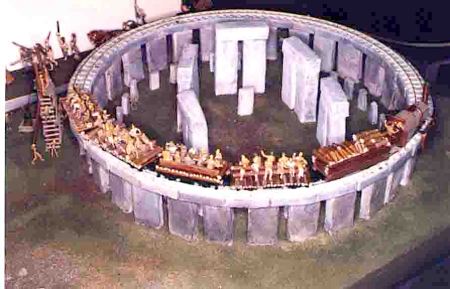 photo by Vin Callcut, with permission
All right thinking people should be deeply grateful to Mr. Vin Callcut for unearthing the hitherto unknown story of the pre-Roman Stonehenge narrow gauge railway! How this important construction of the past eluded all serious historians until now is difficult to understand, but leave it to Clonehenge to be one of the first to get out the word. Come to us for all late-breaking Stonehenge news!
This startling revelation requires us to re-evaluate all we thought we knew about ancient Britain. That a Greek physicist came to Britain with Phoenician traders and built this brilliant amusement ride for Bronze Age Brits on holiday puts the lie to all those claims of the hard lives of our ancestors. Look at them–Newsflash: they were having just as good a time as we do! Heh. For the full story, see the Stonehenge Railway page [link]. This may be the best thing since Tamponhenge!
Sadly, the Romans came and, offended by the idea of a non-standard gauge, destroyed the railway as thoroughly as they did Carthage, rendering its existence virtually undetectable. Now you can see a replica for the first time, thanks to Vin Callcut, who built this model in a suitcase for easy travel. The size limits of the suitcase made it impossible to include all outlying stones and holes, but notice that the bluestones, the altar stone and possibly the heelstone (see photos on the page linked above), still standing in this model, are included.
Score: We’re looking at an 8 druid replica here, people! Just amazing. There is just one sad note to be added. Mr. Callcut sold this model to someone who had a hobby shop in Austin, Texas and has heard nothing of it since. He (and we) would love to know if it is still on display. If there are any readers in or near Austin, could you look into this for us? Stonehenge Railway, phone home!
[Note for those of you who work for English Heritage: it’s not too late to rebuild Stonehenge and put that railway on top once more. Think of the tourist revenues. Americans would love it!]
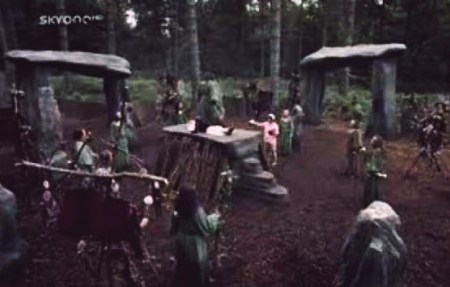 from Youtube
We have long thought that if there is a Heaven (and we could get into it), it must consist of new, unread Discworld books, and friendly people who like to discuss them as much as we do. Discworld author Terry Pratchett has given us many hours of happiness, and we were bowled over to find, upon renting the Discworld movie The Colo(u)r of Magic last week, that it includes a Stonehenge replica.
On the Discworld, stone circles are the computers and druids are the IT specialists and hardware consultants. (Yes, there is a Discworld and Pratchett Wiki. Get over it.) Here’s a druid line from The Light Fantastic: “They’re having trouble with the big circles up on the Vortex Plains. So they say, anyway; I wished I had a bronze torc for every user who didn’t read the manual.”
In the scene above, Twoflower, the Discworld’s first tourist, is intervening in a druid ritual, for although he appreciates its ethnic charm and primitive simplicity, he objects to the actual killing of the virgin . . . The druids aren’t thrilled to have him interfere, and the plot carries on from there.
Silly stuff, definitely, but as always Pratchett uses silly stuff to address serious issues sideways and to lampoon cliches and human foibles. Score for this replica: 6 druids. [Later correction by one P.G.: 7 Wizzards and an ArchChancellor] It’s just some trilithons, but one of those druids is awarded for the gentle jab at society’s romanticising of the henge builders and users. But without all that romanticising there wouldn’t be so many replicas, now, would there? And then where would we be?
 CLONEHENGE

