Bonsai Stonehenge–Yes, It’s Salisbury But It Isn’t Plain!

photo courtesy of Salisbury Newspapers www.journalphotos.co.uk

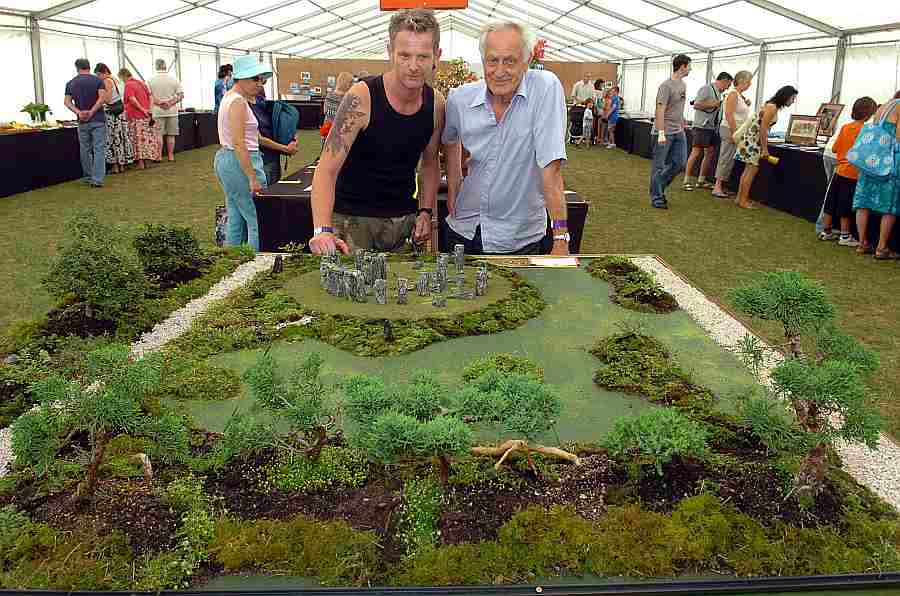
No one does a Stonehenge like the locals! Above we see bonsai hengers (wouldn’t Bonsai Hengers be a great name for a rock band?!) and gardener/artists Tony Oswin & Wilf Colston with their prize-winning creation at the Salisbury Community Show recently–a charming Stonehenge model landscaped with bonsai trees and a bit of whimsy.
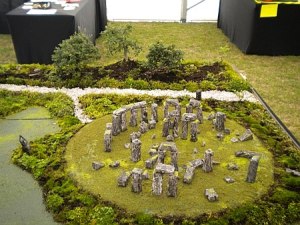
We have to say this is one of the finest and prettiest Stonehenge models we have seen! True, the landscape around it is not true-to-life, but we see no reason English Heritage shouldn’t run out and make it so. It would cost a great deal less than not putting in the tunnel and not putting in the new visitor centre has cost them so far!

The photo above, used courtesy of the Salisbury Bonsai Society, to which the gentlemen belong, shows the thought that must have been put into the Stonehenge section of the display. The stones themselves were cast in molds to make blocks all the same size and then hand carved with a knife and painted. No buying a little Stonehenge kit and quickly standing the plastic pieces in a circle for these fellows!* Care has been taken to make the assemblage resemble the original. We’re impressed!

Score: 8 druids! (New readers–no we do not believe druids built Stonehenge. Our scoring is a bit of a joke.) That’s very good for a small model. Mr. Oswin and Mr. Colson now have Clonehenge score bragging rights. That and £3 will get you a cup of coffee at Starbucks. Unless prices have gone up!

We want to thank Matt Penny, aka @salisbury_matt , friend of the blog, Salisbury and Stonehenge enthusiast, and perpetrator of the Salisbury and Stonehenge website for spotting this Stonehenge replica and sending us a link. We count on you, alert readers! Here’s a deal: you keep sending us Stonehenge replicas and we’ll keep wasting your time with our drivel! We promise.

We wish someone would start a serious site about Stonehenge replicas so that lovely ones like this would get their due from a thoughtful writer. But alas, it’s just us out here, I’m afraid, and we’re deficient in the genes that make one serious. They’re lucky we don’t live closer or we might have slipped in some mini-druids like those that mysteriously appeared at Babbacombe Model Village in 2005.

Our next post will bring our list of large permanent replicas to 65, and it’s another British one, so stay tuned! Until then, gentle readers, happy henging!

*You know we love you, Two Green Thumbs Gardens! 😉
Alton Towers, Through the Eyes of a Coaster Nerd

photos by renowned intertube sorcerer Clinton Montague (we think he implied permission?!)

Remember the Alton Towers post? Of course you don’t. It’s clear from how often people send us henges we’ve already posted that no one goes back and looks at old posts. So be it. We prefer to pretend we have a faithful following that has read every post since the beginning, and remembers each one and what we said about it–so play along, people!

For a slow, arguably too detailed, account of the development of the Alton Towers property from Iron Age Fort to hunting lodge to grand estate to public gardens to amusement park you can have a look at the Wikipedia entry here. Or not. The relevant phrase is “A building known as Stonehenge”. Well put. It doesn’t say anything like “a building that looks like Stonehenge”. There is a reason for that, as you can see.

But since you, faithful reader, remember our discussion of that from the first post, no need to go over it again. The interesting point here is that these photos are brought to you by Alton Towers’ unique (we think?) position as a mecca for roller coaster enthusiasts and those who seek out Stonehenge replicas (if such people exist. Surely they do–every other kind of person does!).

Mr. Clinton Montague a.k.a. @iblamefish kindly took these pictures for us, at our request, on what was actually a trip to sample and blog about Alton Towers’ rides. Very kind. We encourage readers to visit replicas we’ve posted and send pictures so we can do what we’ve done here and milk each one for a second or even third post!

By the way, we want to thank another reader and member of the Clonehenge Facebook group, Basha Cohen, for mentioning and linking to Clonehenge in her article Wild and Wacky Stonehenge Replicas at OpenJourney.com. She calls us “the complete listing”. We like that, but must demur–we know there are more out there yet to be found and posted.

Until then, though, we’re still your last best hope. As @Rafael_RNAm tweeted in April, in Portuguese, “Se vc ñ tem o q fazer, faça uma réplica de Stonehenge. Se tem menos coisa ainda, faça um blog sobre as réplicas.” Translation: “If you have time on your hands, make a Stonehenge replica. If you have way too much time on your hands, make a blog about them.

Happy henging!

West Kennet Long Barrow Carved from Silver Birch

photos by Les Williams, used with permission

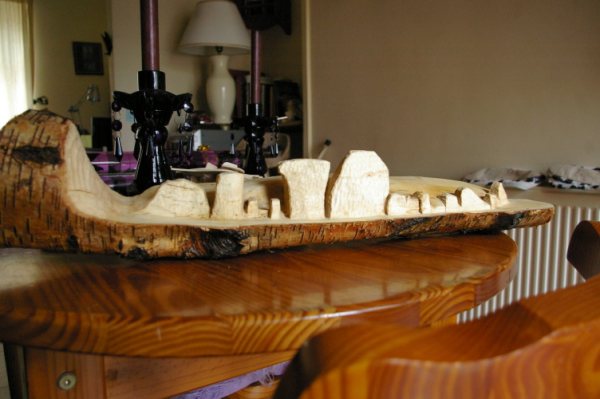
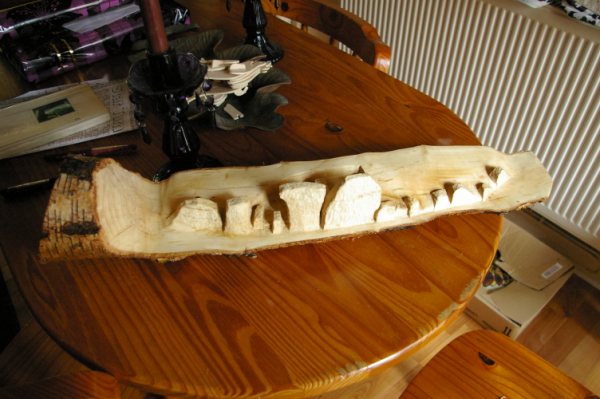
Way back in March we posted a wooden model of the long barrow at Wayland, often called Wayland or Wayland’s Smithy.  The artist, Les Williams, told us he planned to do West Kennet [sometimes spelled Kennett] Long Barrow, a site we’ve mentioned here many times,which is located in Wiltshire very close to Silbury Hill, not far from Avebury, and not too terribly far from Stonehenge. [See comments below for the answer to the Kennett/Kennet confusion.]

Now he has finished carving it and we are honoured to receive first-posting rights for his admirable accomplishment! Mr. Williams’ opinion is that West Kennet Long Barrow (WKLB) is the most atmospheric of the ancient henges and barrows of southern Britain and Wales, and he seems to have captured some of that in this careful rendition.

Curiously he has not chosen to put a finish on this one as he did on the first, perhaps to retain more of the rough-hewn look of the giant stones at the barrow itself.  Also, in order to make the stones large enough he has included only the front end of the long barrow, leaving the rest to the imagination.

But we don’t blame him. The choice he had to make was whether to A. make the stones tiny so he could include the whole barrow, B. use a huge piece of wood, most of which would be featureless barrow anyway, or C. what you see here. Good choice. We can tell you from personal experience that what is most riveting about WKLB is the row of megaliths at its entrance. Not that the interior isn’t  awesome. Amazing place!

And Silbury Hill is visible from there. They and Avebury’s henge and stones, plus several lesser known sites are all part of a mysterious, ancient, and probably sacred landscape. Stonehenge has a unique standing in people’s minds–a curious must-see for tourists who look at it for a bit and then go off to see other English things–but the truly wonderful and remarkable thing in Wiltshire is not that grey linteled circle, or any one of the many remnants of what was done to the landscape all those millennia ago. No, it is the constellation of all of them, the magnificent puzzle they create and the questions they pose, laid out on the hills and down for all to see.

What is that you say? Oh, right–Les Williams and his carving. Heh, I’m afraid we get carried away. Well done–the stones are the right shapes and in the right order. Is anyone else doing anything like this? It is a unique and remarkable creation, somehow holding more mystique than a Stonehenge replica would.

No druids will be awarded, since it is not a Stonehenge replica, just the appreciation of the megarak* nation, and the breathtaking fame and riches that result from being featured on Clonehenge. Don’t let it turn your head, Les!

Did we somehow miss slipping the word eccentric in there? Well, anyway, for those to whom it currently applies, keep cool and to everyone–happy henging!

*A combination of the words megalith and anorak. One who is very interested in megaliths, standing stones, prehistoric stone circles, etc.

Stonehenge of Notre Dame, Indiana

photo by Michael Bohn, aka digitalbohn, used with permission

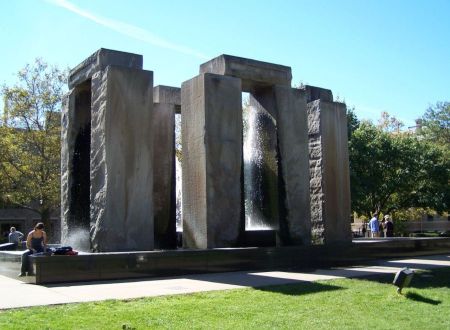
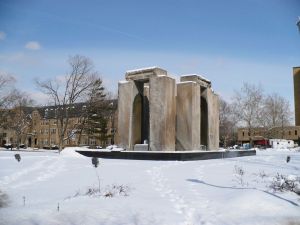
Okay, so how did this get by us for so long? Known variously as the Clarke Peace Memorial Fountain, Clarke Memorial Fountain, War Memorial Fountain and Notre Dame’s Stonehenge, this may be the only Stonehenge-referenced sculpture on the campus of a Roman Catholic university. It consists of four huge trilithons and five fountains, one for each trilithon and one rising from the sphere at the center of the monument. The taker of the photos toward the bottom of this post, a man we know only as John and by his Flickr name, Imazing, tells us, “This center fountain crashes down onto the sphere, creating a beautiful effect, especially during the night time when it is lit up.” You can see it here. Amazing photo!

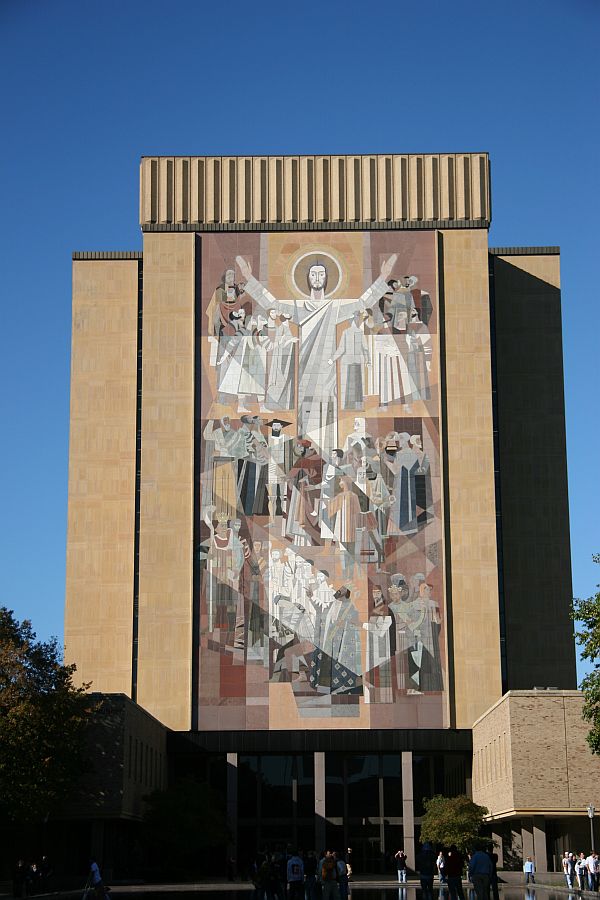
The proportions of the trilithons echo the architecture of the Theodore M. Hesburgh Library which stands behind it, as you can see in the same picture.  As an interesting aside, another side of the library , seen on the left, displays a huge mural that depicts Jesus, the central figure in Christianity, teaching. Around Notre Dame, a school known for its American football team, this mural is affectionately known as Touchdown Jesus because his arms are in the position used by referees to signal a successful goal, or “touchdown” in American football.

On this page we find this paragraph about the fountain, “A survey published in a recent edition of The Dome revealed that 68 percent of Notre Dame’s senior class had run through the waters of Clarke Memorial Fountain at least one time. Certainly an even larger percentage has gravitated here to study, socialize, and even dance in the shadow of this campus landmark. Perhaps the lure of the fountain lies in the hauntingly timeless appeal of its mammoth form, which noted New York architects Philip Johnson and John Burgee (Notre Dame class of 1956) purposely designed to mimic the mystical, monolithic monuments built in Britain during the Bronze Age. Not surprisingly, its nickname is Stonehenge.

Okay, yes, as you point out, you pedant, surely they mean megalithic rather than monolithic here. But it does show that the sculptors did have Stonehenge in mind, not the case, we’re told, about the campus sculpture commonly called Stonehenge at the University of California at San Diego. We must say it does have a nice looming effect. We like it much more than the Rolla Stonehenge at the Missouri University of Science and Technology in Rolla, Missouri. That one is more functional, though, while this is just, well, art. There’s something very robotic about that Rolla unit.

We found this Stonehenge, by the way, while browsing the Stonehenge page of a website on Peace Monuments Around the World. Thanks to them for that and for linking to us! There is more information and many more pictures of this monument on the Historical Marker Database.

The monument at night, photo used by permission

As for score: 6½ druids, which is what we gave to Rolla. We’re pleased to be adding another campus Stonehenge, another Stonehenge fountain and another to our list of Large Permanent Replicas, all at once! Who knows what further henging delights may be lurking out there?

Hope you’re enjoying the summer, or winter if you’re in the–heh–lower hemisphere! 😉  Happy henging!

Third photo by Imazing, used with permission. Touchdown Jesus photo is in the public domain.

Solstice on the Interwebs

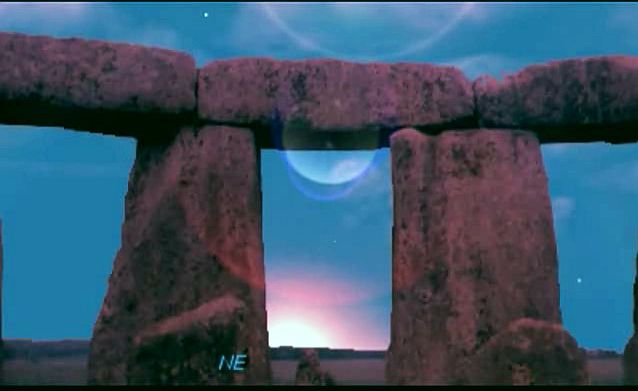
from video of Stonehenge Midsummer Sunrise Simulation

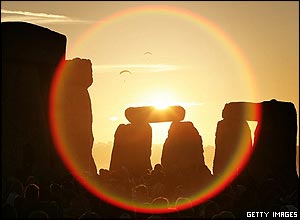
Well, it will be summer solstice on Monday and where do you plan to be to see it in? Oh, we know you would like to be at Stonehenge, just you and a few good friends, but what if you can’t get there or if you just don’t care to share it with the circus that takes place there every year? As with everything but dinner and the loo, the internet has the answer! Why not visit Stonehenge virtually or in a video?

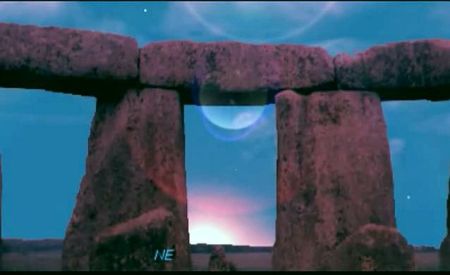
Surprisingly, we haven’t been able to find a virtual Stonehenge with a real-time summer sunrise simulation. Neither have we found a video showing the midsummer sun rising at Stonehenge itself, but that is less surprising. If the experience of those gathering there over the years is a guide, then perhaps Stonehenge was built to observe rain and cloud cover rather than the sun at all!

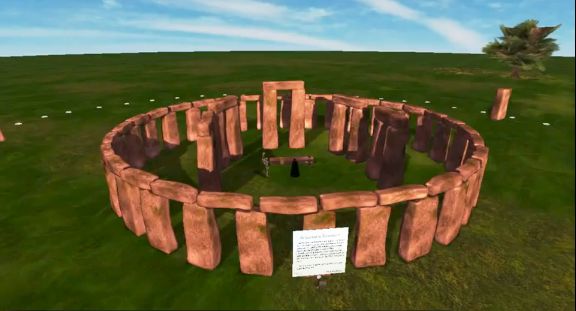
It burns us a little to have to admit that the best-known virtual Stonehenge we’ve found is that on the Heritage Key site. Clonehenge had an unpleasant run-in with them a while back and it left a bitter taste. Still, credit where it is due! You can see a video of their virtual Stonehenge here. (Sorry about that fellow’s accent. There should be a computer application that replaces the voice of anyone talking about Stonehenge with that of David Tenant in best Doctor form!) To access the real virtual Heritage Key Stonehenge, though, you have to sign up at the Heritage Key website.

When you do, Prad Patel, a pleasant member of the staff there tells us: “Stonehenge Virtual always has a summer solstice going on. Unfortunately we can’t make a sunrise happen in real time (yet!) but we’re planning to have a party [for summer solstice] regardless! Have a happy Solstice!” We wish we’d dealt with him the first time!

There is a Stonehenge midsummer sunrise simulation by someone else here.  And a brilliant flythrough of the Stonehenge landscape at this link. Still another video, here, takes us through the monument. There are any number of virtual Stonehenges, but no webcams, unless you count the notorious Dead Bunny Cam!

We hope that eventually virtual models will more faithfully reproduce the true shapes of the stones. Laser scans of some of the stones are already available. When completed they will allow virtual builders to get closer to simulating the true experience. Meanwhile, here’s a sample of what they have so far.

As long as we’re listing, here’s another view of Stonehenge from the inside, presented by BritishTours.com. You need to be running Quicktime, but we like being able to control it, moving up and down, fast and slow. Of course that one’s not virtual but camera-generated, but it’s still a good substitute for the arm chair, or more likely couch, solstice observer. Beat your drum or sacrifice your virgin in the privacy of your own home!

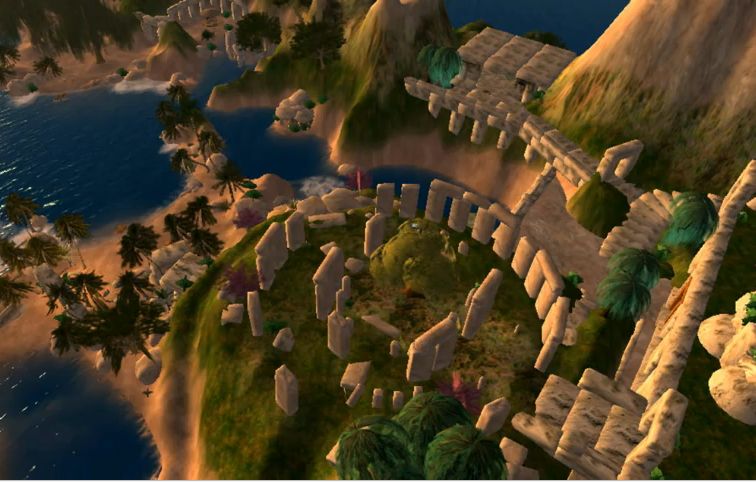
But wait, we hear you say, don’t end this post without showing us the worst Stonehenge video you found! It’s funny you should ask. We have just the thing! The title is Second Life–Spirit Stonehenge, and we can only guess that it is an amalgam of every even remotely Stonehenge-ish thing on SL. We won’t describe it in detail, just do try to hang in there to see Gollum and a dinosaur near the end. Wow!

There are more, plenty more, videos and simulations of Stonehenge out there. Stonehenge is the Lady Gaga, the Justin Bieber of megaliths. We’re almost certain that the famous Pete Glastonbury did a brilliant panorama from inside Stonehenge and we hope he will give us a link to it in the comments.*

But this post is way too long already and you have better things to do this midsummer than to sit here reading Clonehenge. So we part with a link to a lovely still of an anomalous midsummer sunrise, one in which the sun was visible from that old grey pile of rocks. Scroll down and there is a troupe of druids. They must have had some powerful bleach back there in prehistory!

We at Clonehenge wish you a wonderful solstice and a beautiful summer. Remember, if you want to be at Stonehenge, you can always make your own. Happy henging!

*Turns out that British Tours one is his.

Clonehenge Field Trip to—Cleveland?!

Our own photos

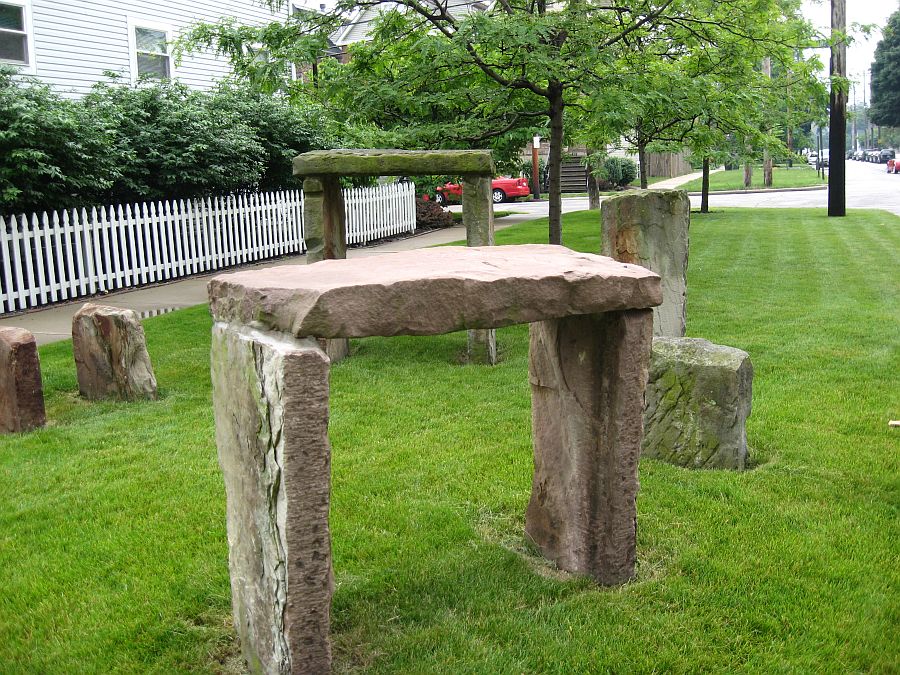
We took a holiday to Ohio to visit–ahem–a close relative, and while there we took a detour to the Tremont section of Cleveland to eat at the mildly famous Lucky’s Cafe. The youngest member of our party was carrying an iPhone and we asked him to bring up our post on Tremont Henge. He did, then found another photo of it, from which he was able to determine a nearby intersection, then in a moment we were looking at an aerial view on a map site. Technology is powerful. And maybe that cafe is lucky!

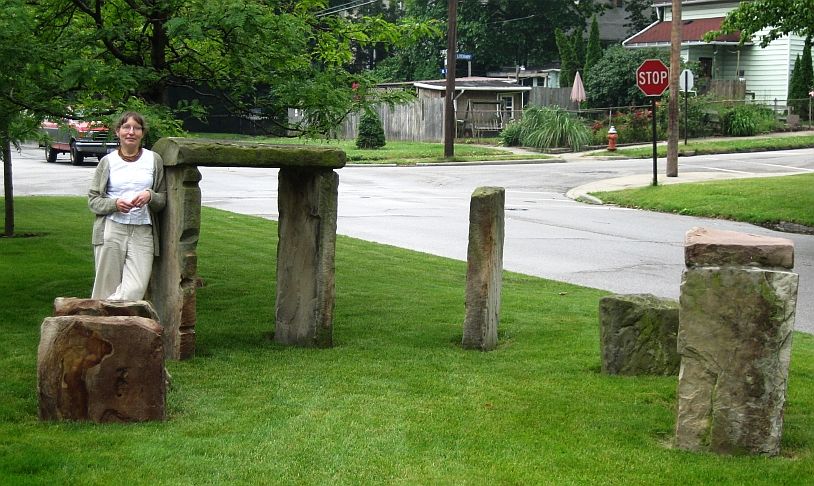
When we finished our meal, we walked the few blocks to the intersection, and there it was! Tremont Henge, just like in the pictures. Of course Yours Truly had to pose for a picture.

We were tempted to knock on the door to see if we could meet the hengers and learn their motivations, but hard as it may be to believe, Clonehenge is not yet a household word. We didn’t want to make them feel their henge was going to be a source of hassles and interruptions, and risk causing them to dismantle it. So we let them be.

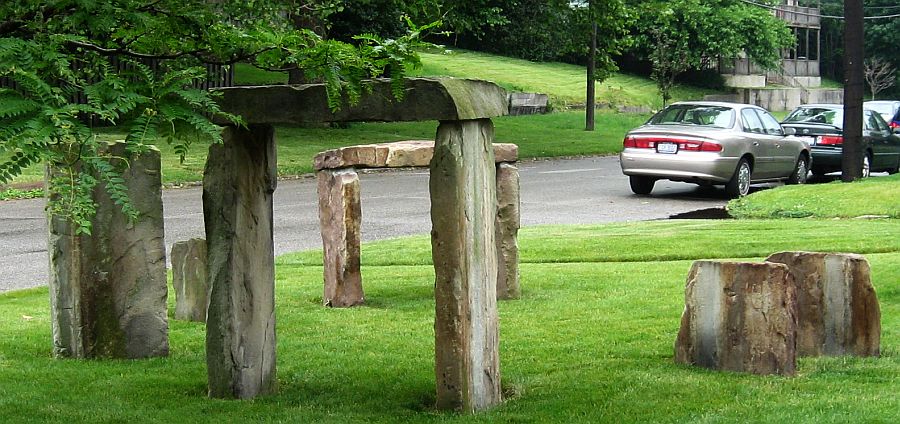
It’s a nice little hengy lawn piece. Despite its lack of heft, it has a solid megalithic feel. It’s an easy henge to like.

Readers, if you know of any other little henges like this, please send them in! Well, not the whole henge, of course, just pictures and as much information as you can get.  And Tremont hengers, if you’re out there, we would love to hear your story!

We walked around Tremont and were impressed with its funky, fun atmosphere. We could enjoy living there. Of course it could  use more henges! But that goes without saying. Parts of Cleveland clearly do rock!

Our thanks to @jwisser for his guidance to the site and to @hombredepan for taking my picture, chauffeur service and the meal!

Hmmm . . . what henge is next?

Note: You can also see Tremont Henge on Google Street View, here.

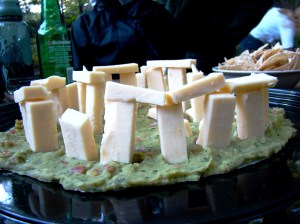
Cheesehenge, For the Sake of the Land!

photos from Laura Mousseau, used with permission

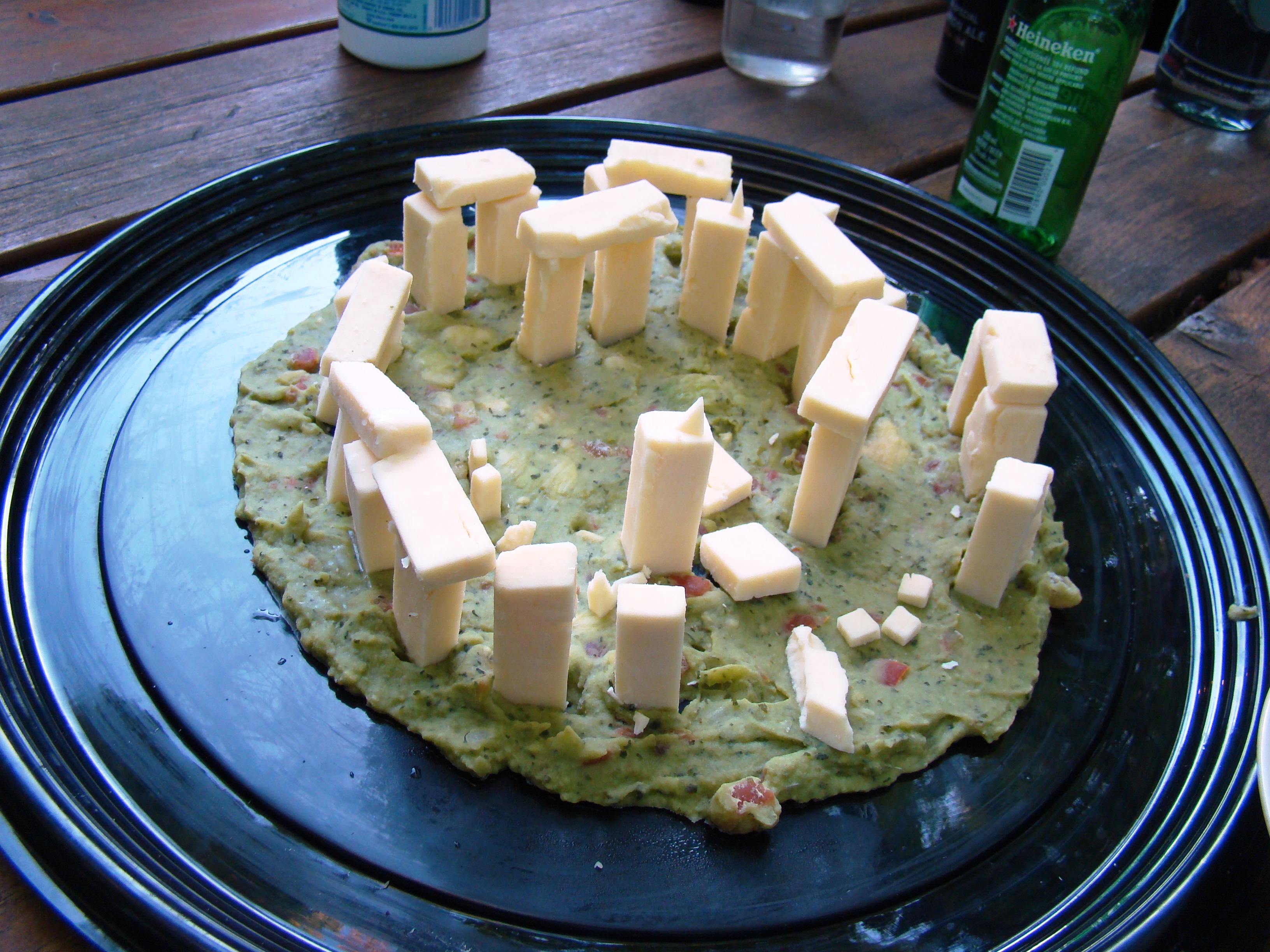
Well, after a long pause, which of course you know was caused by a freak double computer calamity because you follow us on Twitter, we are back with this excellent cheesehenge which you have of course already seen because it was our Friday foodhenge on Twitter back on March 5!

Laura Mousseau tells us, “Cheesehenge was created by Mark Stabb for a Nature Conservancy of Canada Ontario staff retreat (if you could link to the Nature Conservancy site for Ontario somehow it would be much appreciated!)” I suppose we could — [link]!. We’re, like, all in favour of the, you know, earth an’ s**t!

This is a particularly good cheesehenge. Observe tthe guacamole ground representing Salisbury Plain, inner trilithons that appear to be taller than the sarsens in the outer ring, and–la pièce de résistance–the careful placement of the inner trilithon horseshoe facing the the uprights with the three adjacent remaining lintels. Some observation definitely went into this, although we would not go so far as to say as someone does on the video (Oh, yes!) that it is archaeologically correct.

Cheesehenges, as we have said before, are among the commonest of henges, probably because cheese is capable of being cut into rectangular shapes and, of course, it is often served with alcoholic beverages, some of which appear to  have Stonehenge-generating properties. We have posted two cheesehenges before this. See here and here.

Score: 7 druids! If that seems high to you, you should know that we give extra consideration to treehuggers. It seems likely that the land was what it was all about back in the days of the original builders of Stonehenge, as well as over a millennium later in the days of the druids. Even today we all depend on it. Good to remember, people!

So kudos, Mr. Mark Stabb! Nicely done. The only problem here is all those people singing “dooooo” at the beginning of the video. Perhaps goofiness, in the end, is what makes the world go round. We sure hope so!

Until next time, whenever that is, happy henging!

Stonehenge Recycled, Australia Tries Again

photo from the Esperance Express *

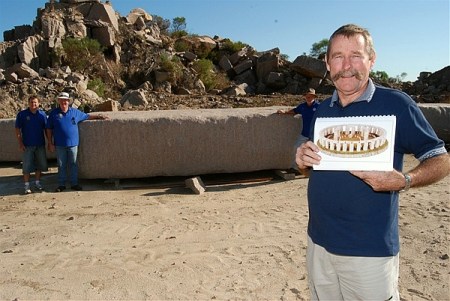
It was in the news recently–the town of Esperance in southwest Australia plans to build a Stonehenge replica in order to attract tourists. Sounds mad, of course, but it isn’t the first town to make such an announcement. A Canadian town said much the same thing last year, and right there in Australia two years ago March a determined gentleman named Ross Smith announced his intention to have one built by the winter solstice (21 June down there).

And that is where this gets interesting. It turns out that a quarry quite near to Esperance was where the stones for the Ross Smith henge were being cut, and when that effort ran into financial trouble it was stuck with most of an unassembled Stonehenge that no one wanted. The stones were then offered to the town of Esperance at a discount and after some controversy the town has said yes. (The picture above indicates they intend to build the monument as it is thought to have looked at its height.)

This is a Stonehenge replica first! No other full-sized stone replica, in fact no other replica at all as far as we know has been bought at discount after being cut for someone else. This is Clonehenge history AND recycling history taking place before our very eyes! This world is a place of infinite novelty.

The stone is being called pink, but it is actually a kind of rosy brown. The website of the granite company shows the colour at the left for the Esperance granite. This has not stopped the pink jokes, of course, and one prominent megalith expert in a quip suggested the name “Gayhenge.” Tsk tsk! Shocking! 😉 Anyone knows that in Australia that would be Poofhenge!

It is unfortunate that some people and articles are calling this the “only full-sized stone replica in the world.Ahem . . . it’s called Google, people. Use it! Certainly the Montana Stonehenge, which was carefully built to scale and made of limestone, qualifies. It’s possible that one of the Japanese Stonehenges is also of stone. And what about Connecticut’s granite Circle of Life? Well, there is still room for it to be the most accurate if they pay attention to detail. Only time will tell!

We of course enjoyed this quotation from one article: “I understand there are two or three replicas of it around the world but they are all made from things other than granite rock,” he said.

Two or three–at least! We hope people are bombarding them with links to Clonehenge. Let them find their place in the litany of replicas. They have a chance to do something terrific here. And Esperance means Hope!

*[Is that George W. Bush with a fake moustache??]

Note: Here is an update on this replica.

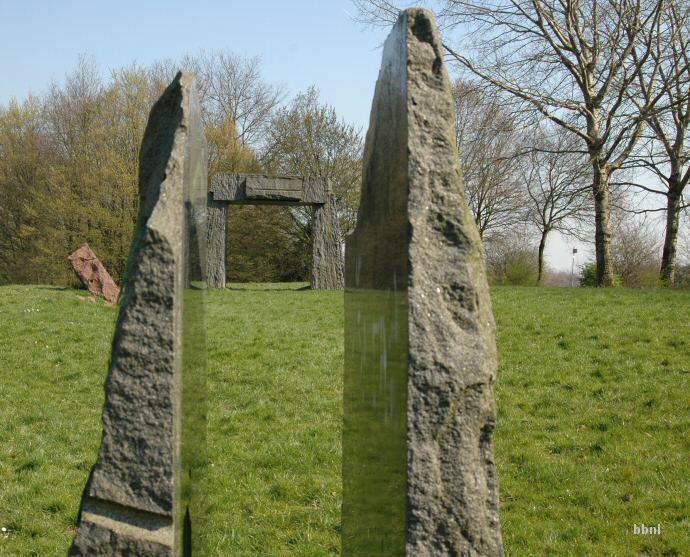
Poort van de Zon, or Gate of the Sun, Arnhem, Nederland

photo by Bert Boerma, used with permission

Okay, okay, we know it has been a while since we posted. The truth is, we came within a hair’s breadth of getting a life recently. But fear not, it has passed and we are back, kinda, sorta, at least long enough to add this admirable photo to our blog and this admirable sculpture to our list of large permanent replicas.

Created or at least placed in 1980, it is located in Immerloo Park in South Arnhem, in the Netherlands. The artist is Marius van Beek, a prominent Dutch sculptor. You can see its location and another picture of it here on Panoramio.

As far as we can make out by using internet translators on the Dutch pages, the two standing stones mark sun positions in spring and fall. The function of the red stone set on a tilt is less clear.

While it is a trilithon and resembles Stonehenge in its sun connection, this sculpture also echoes the Bolivian ruin also called the Gate of the Sun. Mr. van Beek may have had both ancient monuments in mind. A scan of his webpage will show that he has a fascination with standing stones and variations on the trilithon form. Our kind of guy! (Except he works hard and has talent.)

Score: 5½ druids. We like the sun alignments and the pleasing form of the gate. Every city should have something like this!

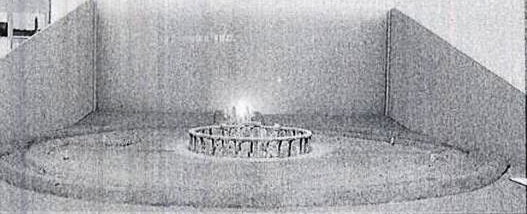
By the way, this is not Arnhem’s only Stonehenge replica ever. Check this out:

This 4 meter by 4 meter replica was built for a special exhibition called The Fascinating World of Stonehenge at the Municipal Museum of Arnhem in 1988=1989. Apparently a similar model of the Newgrange Passage Tomb was also built, although regrettably we have no photo of that. This is a very nice model and would probably rate 7 or 8 druids depending on a closer look. Perhaps Stonehenges come in twos!

We don’t have many replicas lined up to post, but we did hear there’s a town in Australia that has plans for one. We’ll post on that sometime soon.  Meanwhile, send in your homemade and newly discovered henges. The summer henging season is nearly upon us!

Happy henging!

(You didn’t expect this to be funny, did you? Everybody knows there’s nothing funny about the Dutch.)