Cheesehenge

cheesehenge

photo by Scott Weichert

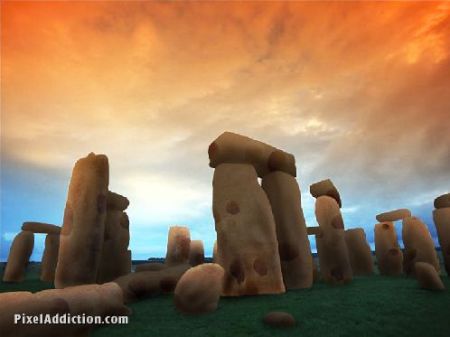
As we insinuated in an earlier post, cheesehenges may be the most numerous Stonehenge replicas on the web. Virtual cheesehenges abound on Youtube, seemingly because it’s an exercise used for teaching a computer language called Maya 8.5.

Scott Weichert’s picture above appears to have been made with real cheese, but in fact no cheeses were harmed in the making of this henge. Images of cheese were plugged into a dramatically enhanced picture of Stonehenge. Still, we like the picture and it’s a good example of a Swiss cheesehenge, Swiss inexplicably being the most popular kind of cheese with which to build a henge.

How to score what is really a sample of a type? The person who made this did use Stonehenge,and we like the inclusion of the bump on top of one stone lacking a lintel. Not everyone knows that the lintels were kept in place with tongue and groove joints and it is always a nice touch. Score: 7 druids for this surreal photo. Keep on henging that cheese, people!
Cockington Green Stonehenge

cockington-green1

photo by Julie Anderson

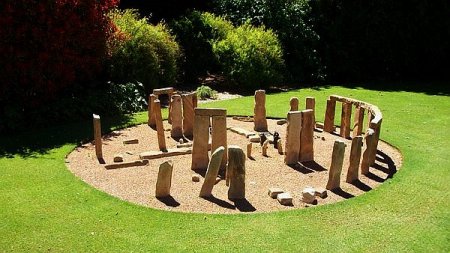
Today it’s off to Canberra in Australia and Cockington Green Gardens, beds planted around crafted miniature buildings that portray places around the world, with the original section based on Great Britain. And you can’t have Great Britain without a Stonehenge replica, in this case complete with tiny tourists. (It must be a view of the past. When were tourists last permitted to wander among the stones?)

It’s a fascinating little replica, with its disproportionally tall and slender stones. Clearly the attempt is to portray Stonehenge as it now stands with some stones fallen. The tiny people seem to get moved around. Every picture we’ve seen shows them posed differently. The interesting thing here is seeing Stonehenge portrayed as a part of England and not as the timeless, placeless array of stones most replicas try to depict.

The nearby hedges certainly dampen the effect (one website calls it Stonehedge), but we allow for the fact that everything is more difficult to do in the southern hemisphere because it has to be done upside-down. We award 7 druids to the Stonehenge that could easily be crushed by a dwarf!