
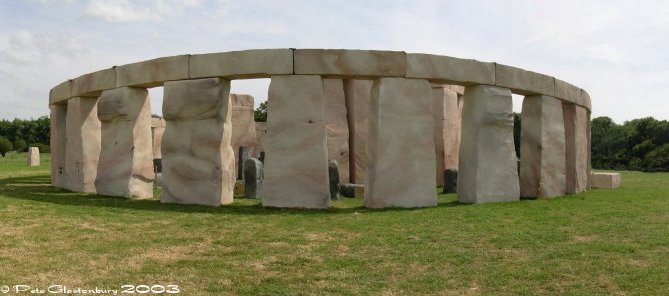
Foamed polystyrene, often known by one of its brand names, Styrofoam, makes an attractive material for Stonehenge replicas. It is light and can be formed into any shape. Lintels no doubt help to keep the light uprights in place.
We know of two Foamhenges. One is in Virginia in the States (to be covered later), and one was a temporary construction, built on the Wiltshire Downs by Channel 5 TV in the U.K., and then sold on Ebay. This was a full-sized careful reconstruction of the monument at its height, rather better-looking than many because the real shapes and irregularities of the stones were taken into account. Is the odd pink cast meant to be the colour of the megaliths when they were first cut? We welcome any information that would shed light on the mystery of the flesh-coloured stones!
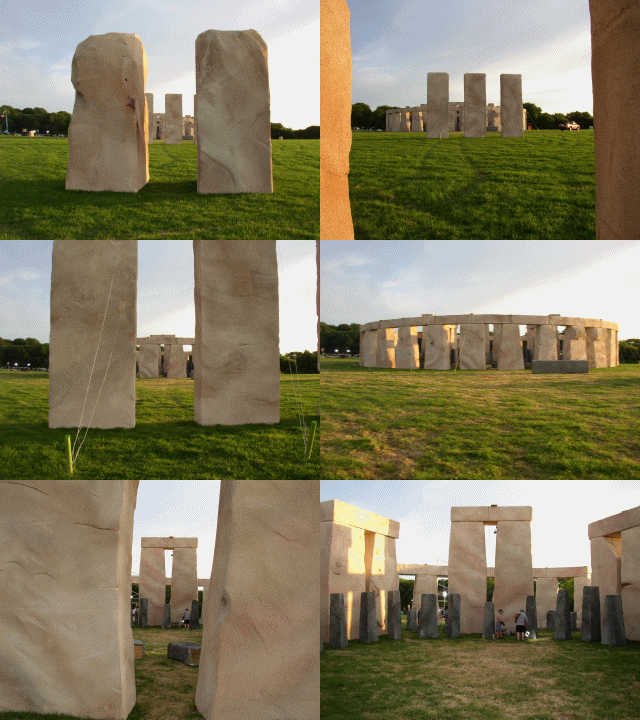
Many thanks to brilliant photographer Pete Glastonbury for permission to use his pictures. Permission to use them elsewhere must be given by him. Our original score for this henge replica was a solid (well, as solid as they can be, made of carpet tubes and polystyrene) 8 druids, but recent conversation has caused us to reconsider and this entry’s score has been increased to 9, with 9½ a future possibility. Very nice!
Just found this: a Youtube video [link] showing the research done at this Foamhenge. Brilliant! Stonehenge has always represented midwinter to us, and this bears that intuition out.
 CLONEHENGE